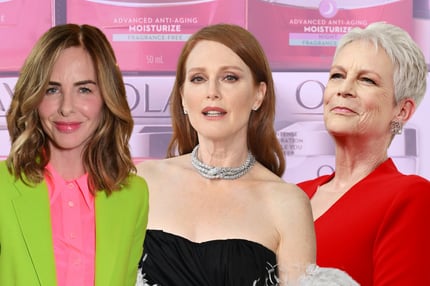
Anti-ageing. It's the beauty industry's biggest marketing success - and a term that has irrevocably changed the way we think about getting older.
Take a quick glance along beauty shelves and you're guaranteed to find a string of skincare and makeup products with the words 'anti-ageing' slapped on the front of the packaging.
And it makes sense - because there'sa lotof money to be made in the business of telling people they need to stop their skin from ageing. To 'slow down' the inevitable.
In fact, recent statistics show that the global anti-ageing market is worth a whopping $71.1 billion USD in 2023 - and it's only set to keep growing. By 2030 it's predicted to grow to 120 billion USD.
Watch: Here are 7 ways to improve your skin while sleeping. Post continues below.
However, as recent movements in the beauty industry indicate, we're on the cusp of change.
The 'mid-life' beauty revolution is here, and it's something that's been bubbling under the surface for a while now.
Back in 2017,Allure Magazineshared their decision to ban the term 'anti-ageing', inspiring other brands to follow suit and embrace different language and connotations around ageing.
The editor-in-chief at the time, Michelle Lee, shared that the term was "subtly reinforcing the message that ageing is a condition we need to battle."
She wrote in her editor's letter: "We know it’s not easy to change packaging and marketing overnight. But together we can start to change the conversation and celebrate the beauty in all ages."
This was six years ago. And it's taken that long for the change to trickle down to the rest of the beauty landscape - everything from the language used in makeup campaigns to the messaging in marketing skincare products.
Now, it's all about championing ageing by removing the traditional ways of thinking and replacing them with more positive alternatives
Take a look at Dove and their 'Pro Age' range. L'Oréal's 'Age Perfect' range. Olay's 'Age Defying' range.
Then there's CeraVe’s latest 'Skin Renewing' range - part of the brand's new line for ageing skin.
There's also the Body Shop's popular 'Drops of Youth' product, which was recently renamed 'Edelweiss'.
Cult K-beauty brand Glow Recipe also got the memo, ditching words such as 'flawless', 'poreless' and 'perfect' from their marketing.
Instead, we're seeing words like 'renewal' and 'rejuvenation' being injected into beauty's advertising vocabulary.
Because we're no longer trying to permanently erase wrinkles. We're aiming for radiance and overall skin health. These are the new pillars we're striving to achieve.
This shift is very much reflective of the changing cultural ideals. By moving away from 'correcting' and 'fixing' ageing skin, we're essentially reprocessing the way ageing is viewed.
It's not just the terminology surrounding ageing, but also the launch of new products that's creating a shift.
Over 50s beauty is having a moment, and the market is exploding - with more and more brands now offering age-specific products that focus on skin quality and texture, as opposed to 'reversing' or 'correcting' ageing features.
These beauty brands are breaking the mould with their approach, appealing to a segment of women who have been, for quite some time, under-represented in the beauty industry.
Take Trinny London, for example, which was launched by British TV star Trinny Woodall in 2017. Along with a wide range of age-inclusive products, you'll notice the brand never uses professional models for their marketing campaigns. All of the advertising shows real people, with real skin texture including acne, wrinkles, dark spots and ageing skin.
There's also Westman Atelier, run by celebrity makeup artist Gucci Westman.
In an interview with Vogue, Westman said, “I’m going to be 52 in October, and as you age, your routine needs to evolve. I’m a makeup artist, and I’m a person who wears makeup, and I need everything to be quick and effective.”
Her latest launch is a liquid foundation, called Vital Complexion Drops - and they've been an instant success with women in her own age demographic.
Because she's in her fifties, and she knows what works. The textures. The formulas. The ingredients.
Not only are these brands releasing products that are catered towards a specific age group, but they're also building communities on their social channels, posting tutorials and how-tos on different skin types and ages.
In an interview with Vogue Business, Woodall said: "The most important thing with social media is you need to talk with a voice that resonates with the woman you want to get to, so you’re candid and you’re honest."
Off the back of the success of Trinny London's online product recommendation tool, Match2Me, which offers a personalised approach to colour matching, Woodall said consumer habits for this demographic are changing.
"When they keep hearing people say the products recommended [via Match2Me] are exactly the right tone and better than in-store foundation matches, eventually they try it out. Actually changing the attitude of a demographic is really exciting."
Is age the new diversity?
The rise in inclusion is driving the beauty industry to move away from the stale 'one-size-fits-all' approach and represent women of all ages - including the older generation.
Now, we're beginning to see a broader representation, with beauty brands signing older models and celebrities to their campaigns.
And for an industry that once made hitting 40 a 'bad' thing, it's a change that's been embraced.
So why is this all happening now?
Search the hashtag “ageism” on TikTok and you'll see it has over 45 million views.
In 2019, at the age of 97, style icon Iris Apfel was signed by modelling agency IMG - which counts Gigi Hadid and Karlie Kloss as clients.
Apfel has launched fashion collections with brands such as H&M. She also paved her way in the beauty space, landing her first beauty campaign with UK makeup and nail brand, Ciaté London, at 101 years old.
Who said being old wasn't fun (and fashionable)?
There are also stars like Julianne Moore (62 years old), Helen Mirren (77 years old) and Jennifer Aniston (54 years old) voicing their opinions on ageing, each fronting the cover ofAllure Magazinein the past year.
Australian actress Naomi Watts recently launched a skincare line for women in mid-life.
The 54-year-old released her brand Stripes, a perimenopausal and menopausal beauty collection, inspired by her own experience.
In an interview with CNN Underscored, the actress said that by launching the range, she wanted to provide a "home where women could find a sense of community and the information they need to help them make informed decisions about their wellbeing."
Again, it's more than just launching new skincare products for an underserved age group - it's about building a sense of community.
Have we really stopped worrying about ageing?
While all of these examples point to progress in breaking down the shackles of ageing ideals, why is it that when you see celebrities who are ageing naturally, it's still... surprising?
Is it because we've been shielded from seeing age for such a long time? Or is it the simple act of denial because it subconsciously signals that we, ourselves, are getting older?
With this in mind - in reality, are we really where we thought we'd be?

Sign up to You Beauty
Sent weekly
Erin Docherty
Beauty & Lifestyle Editor
No Comments
Be the first to leave a comment