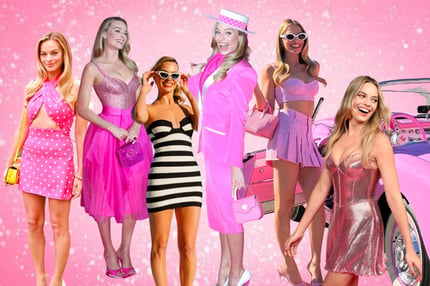
We need to take a closer look at the oh-so-hyped Barbiemovie.
I am as excited as everyone else for this new movie. Heck, pink is my favourite colour! And I will 100 per cent be lining up outside the cinema to see it the second it drops.
But I noticed something and now I’ve seen it, I… can’t unsee it.
Despite all the buzz about diversity and inclusivity, there’s one inevitable truth we cannot ignore: our leading lady is still a tall, thin, blonde bombshell, epitomising the very traditional standards of beauty and feminity that the (some would say problematic) doll has represented since its inception.
You can watch the Barbie movie trailer right here. Post continues after video.
Barbiehas been getting a lot of attention and for good reason. It's the movie we’ve been waiting nearly 15 years for, directed by Greta Gerwig, AKA everyone’s favourite feminist film icon, and starring Margot Robbie (also a proud feminist) as Barbie herself.
The supporting cast is a who’s-who of Hollywood’s finest – America Ferrera, Issa Rae, Dua Lipa, Ryan Gosling, Helen Mirren, Michael Cera, John Cena, Kate McKinnon, Simu Liu… I mean, the list goes on and on. This is a bloody huge ensemble cast, and on the surface, it seems like the movie is going to be a progressive and inclusive take on the iconic doll and her world.
But after taking a closer look, I'm not so sure.
TheBarbiemovie has flirted with diversity. But it hasn't committed.
There are definitely elements of diversity in the film, more than many major films that have come before it can claim. There’s no denying the array of Barbies of different races, body types, personalities, gender identities and sexual preferences puts it light years ahead of… well, most Hollywood blockbusters.
And it is, of course, a great and incredibly important thing that the movie is featuring Barbies of different races and body types. It's crucial for people to see themselves represented in the media, and this is a step in the right direction. It shows kids (and, ahem, adults) that there is no one right way to look like a Barbie and sends the message that beauty comes in all shapes and sizes.
But ultimately, the film still seems to be centred around the traditional image of Barbie as the tall, thin, blonde icon.
It’s set in a white woman’s world, and the diverse members of the show seem to be there as support only.
Which raises the question: can a franchise so rooted in one specific ideal of beauty truly embody inclusivity?
Can we truly embrace diversity while still centring the narrative around a character that perpetuates a limited and often unrealistic standard of beauty?
It's a pickle, and one that’s left me pondering a missed opportunity to redefine Barbie herself.
While the director may be decidedly feminist in her views, and the Barbiemarketing team may wave the diversity flag high, I can't help but feel a twinge of disappointment as I watch the trailers in the lead-up to the big event. I hoped for aBarbiemovie that would challenge conventions and push the boundaries of representation, not one that clings to the same old ideals.
It's a reminder that true inclusivity requires more than just checking off boxes; it necessitates a fundamental reimagining of what our beloved characters can be.
Granted, this is not the blatant tokenism we've seen so often before (and, let's be real, probably will continue to see). More of a gentle woke-washing that directs our attention towards the diverse members of the cast and away from the fact that adding ‘pops of colour’ around the classic Barbie figure ultimately reinforces the same old stereotypes.
Now, I obviously haven’t seen the whole movie yet (duh, it’s not out) – and, yes I absolutely plan to, because as a person with many facets (that's how I'd like to think of myself at least), I can notice potential issuesand alsobe excited to see some of my favourite actors bring to life one of my favourite childhood toys, all painted in my favourite colour.
And maybe, just maybe, I’m barking up the wrong tree.
I’d love to be proven wrong when I do finally get the full 90-or-so-minute experience. But I… don’t think that will happen. With Robbie as (main) Barbie and the equally hot (equally white) Gosling as (main) Ken, it feels a little bit like the creators started with that combo and went, “Okay now how can we sprinkle in the diversity?”
Speaking of those at the helm of this big pink ship, I think the potential woke washing that seems to be going on here is especially egregious because the ride is being captained by feminist extraordinaire Gerwig, who has made some seriously great films that challenge gender stereotypes, likeLady BirdandLittle Women.
Working to implement some diversity,anydiversity, in the ensemble cast is no surprise – and should be applauded. But it’s the fact that it was for the ensemble cast and not the leads that they decided to cast their net wider that hints at a continued perpetuation of stereotypical ideals of beauty.
True, they probably would’ve run the risk of backlash had they cast anyone who looked different to the classic doll – the live-actionThe Little Mermaid is proof enough of that, with many fans of the OG animated film irate after the phenomenal Halle Bailey was cast in the lead role instead of someone who looked the same as their beloved cartoon version.
But is that a good enough reasonnotto venture outside of the stereotype?
I wouldn’t have thought so when someone like Gerwig is involved. And Margot swears she never planned on playing the iconic role in the first place (despite looking every bit the part).
“This is going to sound stupid, but I really didn’t even think about playing Barbie until years into developing the project,” Robbie told Vogue in May.
Alix Nicholson
Senior Weekend Editor
No Comments
Be the first to leave a comment