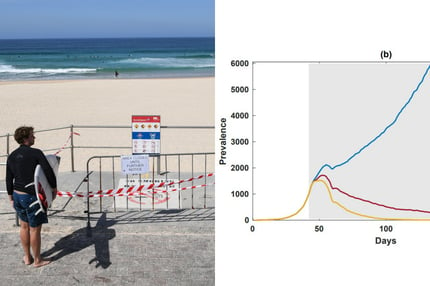
As the outbreak of COVID-19 continues to heighten around Australia, new measures continue to be implemented to reduce the rate of infections.
At the time of reporting, there have been more than 2,400 confirmed cases of the virus in Australia. Of those confirmed cases, 11 people have died from COVID-19.
From the closure of non-essential services, to strict interstate and overseas travel bans, the Australian government continues to introduce new strategies to stop the spread of the virus.
In press conferences and announcements, Prime Minister Scott Morrison has continued to reiterate that the future of the virus – and exactly how long it will take to contain – is uncertain.
However, new modelling from the University of Sydney has demonstrated how the spread of COVID-19 could be controlled in Australia within 13 to 14 weeks.
The research, which was led by Complex Systems academic and pandemic modelling expert, Professor Mikhail Prokopenko, found the spread of the virus could be controlled in that time frame if 80 per cent of the Australian population adopted social distancing.
As an example, this could mean that one person in a household could leave the house once in five days. Alternatively, one person in a family of five could leave the house daily if the other four people remained at home all the time.
The research also found that if less than 70 per cent of the Australian population adopted social distancing measures, the pandemic would not be suppressed in Australia.
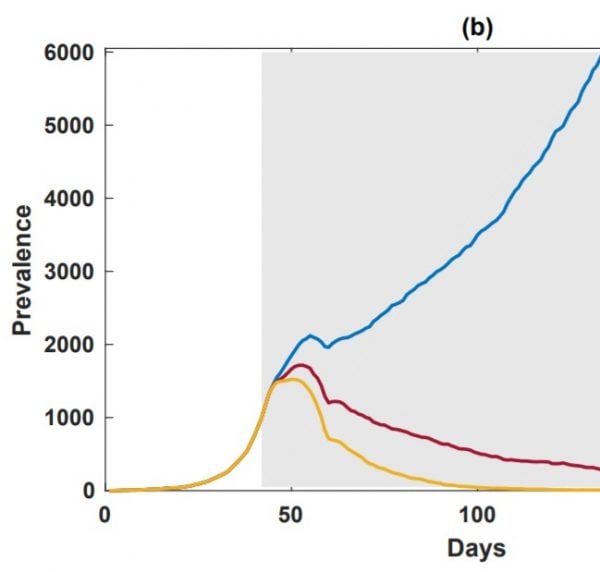
To slow the spread of the virus, 8 in 10 Australians would need to adopt social distancing by limiting nearly all of their in-person social interactions. Image: Supplied / Professor Mikhail Prokopenko, University of Sydney.
Here's how to interpret the graph above:
"If we want to control the spread of COVID-19 – rather than letting the disease control us – at least 80 per cent of the Australian population must comply with strict social distancing measures for at least four months," Professor Mikhail Prokopenko said in a statement toMamamia.
"However, if 90 per cent of the population complies, then the duration could be as short as 13 to 14 weeks – meaning if we began tomorrow we could expect a control of COVID-19 by July," he said.
"Conversely, if less than 70 per cent of the population is adopting social distancing measures, we cannot suppress the spread of the pandemic and any social distancing could be a fruitless effort," he added.
"There is a clear trade off – stricter measures imposed earlier would reduce how long our lives are impacted by this disease. On the contrary, laxer protocols could mean a longer, more drawn-out and ineffective struggle against COVID-19."
The research has also found that for every day that stricter social distancing measures are delayed, Australians would need to spend even more time practicing social distancing.
"There’s good reason for imposing tough measures early on. The longer we delay the peak, the more time our healthcare system has to prepare for it by accessing more resources such as ICU beds, ventilators, antivirals and trained health workers," Professor Prokopenko said.
The research was based on a simulation of the Australian population, using information such as the number of adults and children in each household, which was calibrated from Australian Census data.
The modelling, which has not yet been through a peer-review process, was previously used to map the spread of influenza in Australia.
What about school closures?
Currently, the NSW Government have advised parents to keep their children out of school if possible, while Victorian schools have closed early for the school holidays.
In their research, it was found that school closures had the potential to delay the peak of the pandemic by two weeks, however, school closures did not have an impact on the number of people infected.
Although school closures did not reduce new cases of COVID-19 for adults, the fraction of new cases in children slightly increased in children around the peak of the virus in Australia. This is because in the event of school closures, children are more likely to be mixing with their local communities.
What is social distancing?
To prevent the spread of COVID-19, the instruction from the Australian Government is to practise social distancing.
At the time of reporting, Australians have been advised to stay home unless it is absolutely necessary to go out (e.g. shopping for food), do not have parties or barbecues at home, avoid non-essential travel (including domestically), and keep 1.5 metres away from other people.
To assist in social distancing, stage two restrictions mean that a number of non-essential services have been forced to close their doors. This currently means the closure of:
Other rules include:
The information will continue to change, and as it stands schools and shopping centres are exceptions. Essential services, including supermarkets, petrol stations and pharmacies, will also remain open.
The World Health Organisation as well doctors on the front line continue to reiterate the importance of social distancing. Essentially, the best thing for Australians to do right now is to avoid all unnecessary social gatherings. This might mean working from home (if possible), not having parties with friends at home, and avoiding leaving the house unless essential.
As best we can, we should all be staying home.
Listen to the latest episode of Mamamia's daily news podcast, The Quicky, below. Post continues after podcast.
Feature Image: Getty / Supplied / Professor Mikhail Prokopenko, University of Sydney.
For more on COVID-19:
The current situation around COVID-19 might be making you feel scared or uncertain. It's okay to feel this way, but it's also important to learn how to manage feelings of anxiety during this time. To download the free PDF:Anxiety & Coronavirus - How to Manage Feelings of Anxietyclick here.
Sign up for the "Mamamia Daily" newsletter. Get across the stories women are talking about today.
Jessica Kingston
Author
No Comments
Be the first to leave a comment