"I was so weak I couldn't even walk." 12 people on what it feels like to have COVID-19.
At the time of reporting, there have been over 660,000 confirmed cases of the coronavirus, now officially known as COVID-19, worldwide.
In Australia alone, the number of confirmed cases of COVID-19 has risen to over 3,600, while 16 people have died from the virus.
As cases of the virus continue to rise worldwide, people have come forward to share their experiences.
From no symptoms at all to brutal aches and pains, the symptoms and experiences of patients with COVID-19 seem to vary on a case-by-case basis.
In over 80 per cent of cases of COVID-19, the symptoms are mild and very similar to a common cold or flu.
“The most common symptoms that people will get are fever and a cough,” Dr Sanjaya Senanayake, an infectious diseases physician and Associate Professor at the Australian National University Medical School, toldMamamia.
“There may be other symptoms to a lesser extent, like fatigue, sore throat, shortness of breath, muscle aches and pains, and uncommonly diarrhoea and a runny nose.”
Others, typically those with underlying chronic health conditions such as heart disease and diabetes, can become more severely ill and experience pneumonia.
An even smaller proportion – roughly six per cent – have no symptoms at all at the time of diagnosis. However, most of those cases do eventually develop symptoms within the following two days.
What does it feel like to have COVID-19?
“I wouldn’t wish it upon my worst enemy.”
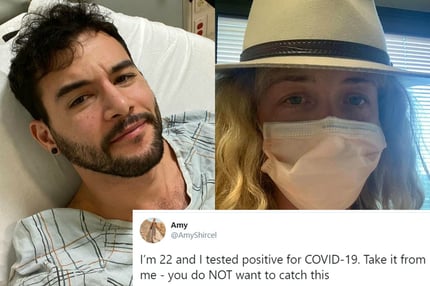
Amy Shircel, a 22-year-old from Madison, Wisconsin, shared her experience of COVID-19 on Twitter.
Amy tested positive to the virus after travelling through Europe.
“Take it from me – you do NOT want to catch this,” the 22-year-old posted on Twitter.
For the first few days, Amy’s symptoms were “manageable”. She had a fever, a mild cough, chills, headache and a runny nose. But by the third day of symptoms, Amy was “vomiting constantly”.
“I couldn’t keep anything down. I couldn’t sleep. I obviously couldn’t eat,” she wrote.
On the fourth day of being unwell, Amy tested positive for the virus.
“I developed shortness of breath. It’s scary, it feels like your lungs are shallow and you can’t take a proper breath. I was weak and I had a 102 degree fever and rising,” she said.
“On the fifth day, things got worse and worse. I had never been this ill in my entire life. I was genuinely afraid I would die, because that is what it felt like.
“By the sixth day of symptoms, I was so weak I couldn’t even walk. I crawled to the bathroom to vomit. I called 911, and they took me in an ambulance to the emergency room.
“From the seventh to the 11th day of symptoms, ER again. I had never been that weak or fatigued by fever in my life. I either violently shivered in bed all day, or I would wake up in a literal puddle of my own sweat. I couldn’t eat for nine days. I was completely miserable.”
Now on her 12th day of symptoms, Amy has regained her appetite, but the end of the virus for the 22-year-old is “nowhere in sight”.
“I still have all the major symptoms,” she shared on Twitter.
“A coronavirus diagnosis is dehumanising and lonely, and I wouldn’t wish it upon my worst enemy. You aren’t invincible just because you’re in your 20s.”
“I felt like I was dying.”
Tarek Soliman, a New Yorker who has designed clothes for reality showRu Paul’s Drag Race,shared his experience of COVID-19 on Instagram to warn young people about the severity of the virus.
At first, Tarek dealt with what he thought was “a normal cold/flu”. Within a few days, however, his symptoms worsened.
“I had a high temperature, severe chills, sweating, body aches, terrible headache. I stayed home for five days and continued to monitor my symptoms, thinking that it was maybe a bad flu,” he said.
After five days at home, the interior and costume designer received some medical care. When he fainted during his medical assessment, Tarek was transported via ambulance to a nearby hospital.
“From the moment I got there I was kept in an isolated room by myself, they definitely didn’t know what to do,” he said.
“They ran some tests on me every four hours. I was shaking and felt like I was dying with only IVs in my arm. After they took some blood and swabbed my nose for the COVID-19 test, I got discharged and sent home after 12 hours in the ER.
“After four days, I got my test result back that I am positive. I still have the same symptoms with no progress, but I started developing pneumonia and I can’t breathe normally right now. It was followed by coughing blood.
“This isn’t something small we are dealing with, be responsible and stay home. I don’t want anyone to go through what I am going through right now.”
“I felt like I was 80 years old.”
Australian Bridget Wilkins, 29, was diagnosed with COVID-19 in early March after flying from London to Brisbane, via Singapore, for her best friend’s wedding – but she never made it to the ceremony.
Speaking toABC‘s7.30,Wilkins said she initially found the symptoms to be no worse than a headache or sore throat and she believed she could just be jetlagged.
She went to the doctor for a general health checkup and discovered she had the coronavirus. It’s not known where Wilkins picked up the virus, but she said doctors think it could’ve been at Heathrow or Singapore Changi Airport.
Wilkins has spent 13 days in isolation at a Brisbane hospital.
“I’ll be honest, the first question I asked the doctor on the phone was, am I going to die? Which sounds a bit dramatic but at that stage, two weeks ago, I didn’t really know what coronavirus was,” she told7.30.
She said she felt only mildly sick, but around days eight to 10 her condition deteriorated.
“I became very, very fatigued and I had quite intense headaches and a level of chest pain,” Wilkins said.
“I felt like I was 80 years old. I thought of my grandmother at that moment.
“I recognised how hard it may be for her generally but also if she was to have a condition like coronavirus.”
During those worst days, Wilkins struggled to sit up, get out of bed and “do all the basic things that we probably all take for granted”.
After recovering, Wilkins was unable to leave isolation until she returned two negative swabs in a row, which she did after 13 days.
“Now I have no coronavirus in my system,” Wilkins told7.30. “I’m not infectious and I’m not contagious according to medical advice, which is nice.”
Watch: Mamamia’s Claire Murphy breaks down your most asked questions about COVID-19. Post continues below.
Jessica Kingston
Author
No Comments
Be the first to leave a comment