Plastic surgery has become entertainment. Here's why it's worrying.
Scroll through social media and you'll find yourself sitting front-row in an operating room, watching a surgeon make incisions on a body. There's blood. Implants. Discarded fat. The hum drum of music in the background.
And it's all happening in real life.
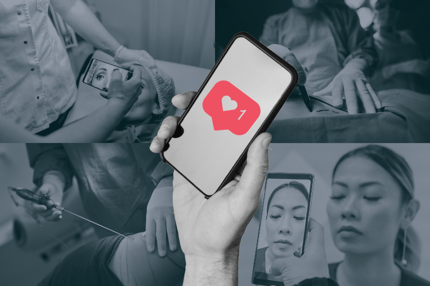
With the rise of cosmetic surgery, platforms such as Instagram and TikTok have become extremely powerful marketing tools, with surgeons filling their feeds with before-and-after photos, videos of clients, memes, skits - and of course, surgery.
Watch: Curiosity got the better of us! Renny asked Dr. Naomi McCullum, a cosmetic physician who runs a luxury clinic called The Manse, everything she'd do to her face. Post continues below.
From injectable treatments to BBL surgery - it seems like nothing is off limits. These days you can consent to having your procedure broadcasted to millions of people all over the world. And bar a couple of well-placed emojis, there is often little to no censorship involved.
Here, it's all about satisfying the public's appetite for transformations - giving followers and viewers a sneaky 'behind the scenes' pass to see the performance of various surgical procedures.
And while these kinds of videos are hugely popular and literally watched by millions upon millions of people, you can't help but fear we've crept into some very dangerous territory. And for good reason.
Some social posts - shared here in Australia - appear to show practitioners singing and dancing during procedures, even displaying bags of removed fat or tissue, possibly without consent.
Although they don't represent the vast majority of responsible doctors, the popularity of this content could help share a dangerous misperception of surgery. A false illusion of something that is actually wrought with serious risks and complications.
And so we're left asking ourselves questions - what are the ethics around plastic surgeons sharing content on social media? Is it really educational? Or is it increasingly just blurring the line between patient care and entertainment?
Let's take a look.
How plastic surgery and social media became a thing.
You don't have to know much about plastic surgery to know the name "Dr Miami". Board-certified plastic surgeon Dr Michael Salzhauer, who goes by the name Dr Miami, is one of the most popular surgeons at the forefront of this social media movement.
Jumping on the trend several years ago, Dr Miami has been credited as the first plastic surgeon to film his surgeries in real time, posting them on social media. This was totally unheard of before then.
Originally experimenting with Instagram, he found astounding success on Snapchat starting back in 2015.
Today, Dr Miami is not only one of the most well-known plastic surgeons in the world, but also one of the most followed – with 1.1 million followers on TikTok checking out what's going on in his operating room on the daily.
He's become a social media icon. And he's not the only one.
Over the last couple of years, plastic surgery influencers have snowballed. Surgeons from around the world have been building strong followings on Instagram, Snapchat, Twitter and now TikTok.
To put into perspective just how this kind of content is performing on the platform, the hashtag #plasticsurgery has racked up a whopping 10.2 billion views, with posts ranging from educational clips to plastic surgeons doing viral TikTok dances.
Why are these plastic surgery videos so popular? And what is it about them that we find so interesting?
Good question.
Generally, viewers tend to fall into one of three different categories.
There are those followers who are interested in pursuing a career in the medical field, those who are considering a certain surgery and want to find out more, and those who just simply... can't look away.
Which one are you?
Are there any regulations around filming surgery?
In recent years, the social media and plastic surgery trend has incited a lot of debate, with the chief argument being that broadcasting surgeries blurs the ethical boundaries about what is acceptable in the practice of safe surgery.
The very murky area between education, entertainment and self promotion has called for the development of more structured guidance in this area.
Dr Amira Sanki is a Sydney plastic surgeon and the chair of education of the Australian Society of Aesthetic Plastic Surgeons.
She toldMamamiathe official guidelines for social media use in advertising cosmetic aesthetic surgery have been created by Australia's health regulator, AHPRA.
All medical practitioners also have an obligation to follow Australian Consumer Law which is regulated by the Australian Competition and Consumer Commission (ACCC).
"Social media and how it is used is constantly evolving, but the regulations still apply," she said. "The Australasian Society of Aesthetic Plastic Surgeons (ASAPS) considers a respectful representation of our patients on social media, critical to maintaining a trusting relationship between surgeon and patient."
"A significant amount of our surgical training and our ongoing education is dedicated to teaching ethical decency and respect that all patients deserve. As plastic and reconstructive surgeons, we are governed by a code of conduct from these regulatory bodies to guide ethical and respectful practice."
The issue with patient consent.
Part of what these guidelines stress is the confidentiality and privacy obligations. That is - patients should be asked to consent to filming prior to the surgery, and they should also be allowed to refuse this request.
"Patients feel grateful to their surgeons for improving their body image and their quality of life, but they should still feel no sense of obligation for their images to be shared on social media. And those photos must absolutely be de-identified," said Dr Sanki.
"Many patients are incredibly happy for their images to be used because they were grateful to other patients for sharing photos of themselves, which ultimately helped them to compare and understand the surgery, and how they might benefit from it."
While a majority of patients will usually request for their identity to be concealed, many patients request to be shared or plugged on social media - especially those who sought out surgeons due to their social media presence.
"There should be no incentives for a patient to allow their procedure to be filmed or their before and afters to be used. This can confuse their decision-making process when it comes to proceeding with surgery," stresses Dr Sanki.
It's also important to note that even when patients give written consent, there's no exact way of controlling where their content appears. Images can be copied, manipulated and redistributed on social media - and that content can obviously be very difficult to remove once it’s posted.
Setting unrealistic expectations.
According to the advertising guidelines set by the Australian Medical Board, practitioners must not only maintain patient confidentiality, but they also must not mislead or deceive potential patients with photoshopped images or before/after images taken in different positions, using makeup or enhanced lighting.
The recommendations that ASAPS has set out for its members include the use of a disclaimer "such as ‘not all patient results are the same, you should seek the opinion of a specialist surgeon’, along with a disclaimer about possible risks," said Dr Sanki.
ASAPS member Dr Justine O’Hara tellsMamamiathat patients should choose to go ahead with an operation because they believe the benefits outweigh the risks for their individual case, and that the procedure will provide a substantial benefit to their life. Not because they have seen something on social media that looks good.
"A patient may decide to have surgery due to an insecurity or dissatisfaction with a part of their body. Once this thought is in their mind, social media can act as a great distraction or even leverage those insecurities, which can sometimes bypass genuine feelings from the patient," she said.
"They are then trapped in a web of comparison and insecurity over the decision, and can become overwhelmed at the volume of choice. This can eventually cloud judgement and create confusion for this patient. And this is why a great deal of care must be shown in making sure social media posts are realistic, that they declare possible risks of surgery, and that they are not encouraging procedures or drawing on emotions."
Most importantly, Dr O'Hara said a person should not be portrayed in a sexualised manner.
However, it's not uncommon for patients to be relatively nude in these videos or before and after images - sometimes with strategically placed emojis covering nipples or genitals.
"These videos do not represent the enormous responsibility it is to be a surgeon. Your team are in charge of your patient’s wellbeing while they are under anaesthetic, they are literally resting in your hands," said Dr O'Hara.
"Day in and day out, when operating we are working with a body that will be back up and awake, interacting and walking around within a matter of hours. It isn’t just a body at any stage of the procedure and should never be treated or trivialised in that way."
Even when patients agree to be filmed and have videos shared online, Dr O'Hara said doctors still have an obligation to protect patients’ privacy and portray them in a respectful manner.
"We are solely responsible not just for the surgical outcome, but the patient’s mental and physical health following the procedure. A patient should be respected as a whole person, not just a physical body."
Dr Sanki said practitioners should always put patients before profits.
"Of course, a level of entertainment can be derived from using certain emojis, or filming a procedure to music, but this is unethical and irresponsible."
"It is recommended that social media posts include disclosure of risk for all cosmetic surgery procedures. Imagery should not be sexualised and the use of fun emojis should be careful to not make light of the serious nature of surgical procedures. Can you imagine the same thing happening in any other medical profession?"
But that's not all that's at risk. There's also the very real possibility of a distracted surgeon.
"Creating videos during an operation is distracting to the surgical team, whose sole focus should be completing the procedure in a safe and timely fashion," Dr Sanki said.
This kind of content can also seriously misrepresent the risks involved with undergoing a surgical procedure - building false illusions about what having surgery is really like.
"Surgery should never be trivialised."
What to look out for.
So, when it comes to before and after images, how do you know if what you're looking at on social media is real or... fake? And what are the dangers s
Erin Docherty
Beauty & Lifestyle Editor
No Comments
Be the first to leave a comment