In 2008, when I was thinking about having kids, I knew a handful of women so desperate to secure paid maternity leave that they quit their jobs and moved to an organisation that offered it.
The Australian government eventually introduced an 18 week paid parental leave scheme on January 1, 2011, which continues today. Dads and partners can apply to take two weeks paid leave when the baby is born, and unpaid parental leave is available for 12 months with some flexibility for the first 24 months (if employers agree).
Once the 12 months of maternity leave time is over, mums (and it is mostly still mums) go back to work; juggling all the balls and cursing the person who came up with the concept of 'having it all'.
Because taking a few months off work after giving birth is not enough.
Watch: Madeleine West's tips for working parents. Post continues below.
Having a baby and then a child changes your whole life in a myriad of ways and yet you must now parent, as well as work, (if this is what you choose or need to do), until you retire. As the saying goes, 'We're expected to work like we aren't parents and parent like we don't work'. But it's not sustainable.
In 2022, after two years of pandemic life and a period of huge technological changes, it's time to start conversations about the whole working-parent-parental-leave system.
How can we build on what we have and make it better serve parents, families, and businesses for longer?
How can we properly acknowledge that parents do an important job of raising the next generation of humans, but might also want or need to work too?
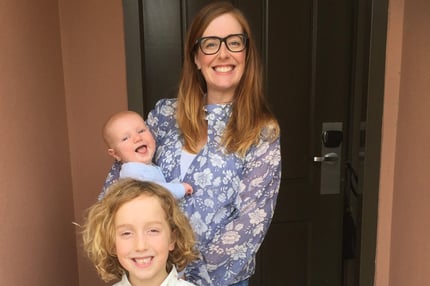
After maternity leave with my first son in 2010, I didn't want to return to the then inflexible world of the 9-5 workday, so I quit my job and began working as a freelancer.
As Toby and his little brother Leo grew, in theory the work and parenting balance should have got easier, but as any parent will tell you, it was still a juggle.
There's expensive and hard to find childcare, followed by school hours, extra-curricular activities, and long school holidays that don't work well with regular jobs and hours.
Not working was not an option for me, so we eventually made it work thanks to my husband's flexible job. But for many other families, this is not possible.
So, where do we make changes?
Compared with many other countries, the Australian parental leave scheme is not bad.
The government together with employers offer financial support for parents in those crucial early days, weeks and months of a child's life. Breast or bottle feeding, sleep deprivation, and adapting to new roles as parents of a baby is a huge deal.
But when we have a baby, we don'tjusthave a baby.
Babies turn into energetic toddlers, toddlers turn into apprehensive kids starting school, kids turn into confused and emotional teenagers, and finally teenagers turn into adult humans with stressful jobs and maybe even kids of their own.
We need to consider parenting as not just something that needs attention or recognition in the first 12 to 24 months, but for upwards of 18 years.
Listen: The Great Resignation: Do I need to quit my job? Post continues below.
Terri Martin, mum-of-two teenagers and General Manager of The Marketing Room, believes we can do better.
She thinks it is time we recognised the limitations of our current parental leave offerings at the same time as we examine old models of work.
"We need to change a lot of things, including attitudes," Martin says.
"We need to look at our antiquated idea of maternity leave as a one time only solution and the antiquated model of a 9-5 work day, five days per week.
"We need to shake the whole thing up so we can better support our modern lives and family structures."
Martin believes that offering more continued support for mums after they return to the workforce is good for the health and happiness of the whole family.
"I take my hat off to women who choose to stay at home, I think it is amazing. I know that for me however, I want and need to work. I am happier for it and I'm a better parent. My teenagers watch me thrive as I enjoy my work and I know that this is good role modelling for them.
"I don't believe I should have to choose between being a parent or working - men have never had to! A lot of women derive happiness from having a career and parenting and they want to juggle both without feeling like they're always failing."
But it is not just about individual families, Martin says it is also about the economy.
"Companies like mine are looking at innovative ways we can help mums and all parents to stay in the workforce, if that is their wish. According to the Grattan Institute, 'Increasing women's workforce participation could generate GDP growth of $11 billion per year', so its literally good for everyone."
Martin believes businesses need to maintain an open dialogue with employees and offer flexible work conditions that allow parents and in particular, mums, to keep working.
"I work full time but I also work from home, which requires a degree of trust from my employer. This means that when my teenagers come home, I am around if they need me and I can taxi them to any extra-curricular activities or social engagements.
"It also means I can keep a bit of an eye on how they are going and they know I am there if they need to talk to me."
She believes that there is a broad misconception that babies and little kids need more support than bigger kids, but that women shouldn't have to take more time away from work.
"We have this view that only little kids need us, but I would argue that older kids and teenagers need us to be available and present.
"I don't think women should
Laura Jackel
Author
No Comments
Be the first to leave a comment