One in every two Australian women is estimated to have a common chronic health condition.
One in two. That's 49 percent of women.
Meaning? If you don't suffer from a chronic health condition, chances are the woman sitting beside you does.
Because here's the thing – you don't have to *look* sick to be battling an illness.
From endometriosis to mental health illnesses, back issues and diabetes, the umbrella term ‘chronic condition’ offers up a broad range of health issues – often complex and non-communicable conditions that are scattered across a wide spectrum of illnesses.
Watch: Things guys need to know about endometriosis. Post continues below.
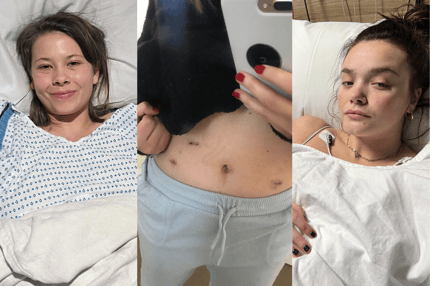
Many celebrities have shared their own experiences with invisible illness, including Bindi Irwin, who has opened up about her ongoing battle with endometriosis in the past.
The 25-year-old shared that she was "trying to remain a positive person and hide the pain" but decided to share her journey to help other women in pain.
She wrote: "For 10 years I’ve struggled with insurmountable fatigue, pain and nausea," she wrote alongside a photo of herself in a hospital bed.
"These last 10 years have included many tests, doctor's visits, scans, etc. A doctor told me it was simply something you deal with as a woman and I gave up entirely, trying to function through the pain."
Endometriosis is a condition in which the tissue similar to the inner lining of the uterus grows outside the uterus.
"I'm aware of millions of women struggling with a similar story," Irwin continued.
"There’s stigma around this awful disease. I’m sharing my story for anyone who reads this and is quietly dealing with pain and no answers. Let this be your validation that your pain is real and you deserve help. Keep searching for answers."
To help create a conversation around chronic pain, we asked nine women fromMamamiato share their journeys of dealing with an 'invisible' illness. Here are their stories.
Maddie.
"By the end of last year, I'd lost count of the number of times I had been admitted to hospital. The cause? Stage 4 endometriosis. The pain was indescribable; excruciating to the point where morphine barely had any effect.
"To say this has impacted my day-to-day life is an understatement, and the fact that this is an invisible illness and one that some people think is "just a bad period" makes it a lot harder. To be honest, it is really frustrating having to constantly justify the way I'm feeling.
"I was lucky enough to be fast-tracked for a laparoscopy to remove the endometriosis from my insides. The surgeon was able to get it ALL and even though I'm only six weeks post-op, this has been life-changing and an enormous weight had been lifted off of my shoulders. Although this isn't a cure, I am hopeful that this surgery means flare-ups won't be as common and/or intense, which would mean no more sick leave from work and no more bailing a dinner or night out early to check myself into the hospital."
"If you are a person suffering from this debilitating illness, I see and feel you! We have a long way to go in terms of diagnosis, awareness and a cure, however in my experience, speaking about this and connecting with others who are going through the same thing is reassuring and almost therapeutic."
Charlie.
"When I was 17, I was suddenly tired and sore all the time. Simple things like stacking the dishwasher, vacuuming the house or typing a late-night essay were all pretty impossible. My joints would ache to the point where I was left feeling like I had run a marathon; I would sleep all day, even after a proper eight hours' sleep at night, and I barely ate.
"After seeing many specialists and trialling different medications with nothing working, I was diagnosed with chronic fatigue syndrome and fibromyalgia – both chronic illnesses and, for me, both debilitating in the early years.
"Following my diagnosis, I missed three months of my final year of high school, along with many social occasions, and I had to get special provisions at university. I eventually quit my retail job because it would get too painful. It would take me hours just to get out of bed each day because my arms hurt so much and I gained weight because I couldn't exercise. I was so unhappy.
"Five years on and I'm now managing the pain. I'm no longer on a truckload of meds (I'm actually not on any) and I exercise daily. I made a lifestyle change, and it works for me (I've written about my story in more detail, here)."
Isabella.
"Around midway through 2021, I started to experience pretty bad chest pain on and off. Initially, I thought it was related to panic attacks, as I have experienced those before. But this felt different. On two occasions I ended up in hospital, the pain was so bad, mimicking what I believed a heart attack or having an elephant on my chest would feel like.
"After lots of medical appointments with GPs and specialists, X-rays, CT scans, blood tests, consultations with pain specialists, ultrasounds, heart check-ups and more, I was finally given a diagnosis in mid-2022: Chronic costochondritis. It’s inflammation of the cartilage that joins your ribs to your breastbone, basically resulting in stabbing chest and under-boob pain from time to time.
"I've had knee reconstructions before so I have a decent high-level pain tolerance. But on some occasions, the pain of the costochondritis has reached an eight out of 10 – crying, not screaming. As for how it happens, my doctors couldn’t give me much of an explanation – perhaps wear and tear, an injury from exercise I was doing. Commonly, it's a condition that does go away with time. For me, unfortunately, that hasn't been the case."
"But I've learned how to manage the chronic pain. For me personally, that means seeing an exercise physiologist, swimming, having access to doctor-approved pain medication if needed and managing stress levels (which can exacerbate the symptoms). Interestingly, my doctors told me that this condition can be quite common in young women for some reason.
"Overall, it was an exhausting process, as is having a condition which is 'invisible' in a way. It's emotionally debilitating when the pain is bad, too. Fortunately, I only have flare-ups now perhaps once every two months, which is a massive improvement. It just shows that you never know what someone is going through physically, emotionally or mentally, because not all illnesses are outward facing."
Tamara.
"Two years ago I had an intense episode of dizziness. Basically, the room started spinning, and I fell to the ground. I threw up a few times from the spinning sensation and went to bed, enduring ongoing nausea and head spins for three days afterwards.
"Feeling extremely unwell and confused, my husband took me to the doctor and I was diagnosed immediately with benign paroxysmal positional vertigo (BPPV), a minor type of vertigo which has to do with the tiny crystals in your ear being dislodged. It can generally be treated with some basic exercises. But this turned out to be a misdiagnosis. About a month later, while working from home, the spinning returned. I would describe it like that moment when you've had too much to drink and you hit the bed, and everything around you is spiralling – but so much worse.
"When I googled my symptoms, I kept seeing 'vertigo'. But that apparently only lasted minutes and this was lasting for days. The worst episode came when I was at work, weeks before my wedding. I fainted in a meeting and when I came to, the spinning was out of control. I had a full-blown panic attack, I couldn't leave the bathroom and had to be taken in an ambulance to hospital.
"Desperate for answers, I booked into a top vertigo specialist who charged $1,000 for a consult and treatment. My husband and I decided it was worth it. He diagnosed me with a textbook case of vestibular migraine, which can be chronic and is often brought on by stress along with a combination of other factors.
"Two years on, I have tools to help me manage the episodes, but unfortunately it's not something that's easily 'treated'. Medications work for some people, but I've had mixed results. Lifestyle factors like reducing stress, keeping active and eating well (classic) are important, but there's no actual fix, which is a hard pill to swallow.
"I now live in constant fear of a random attack in the middle of my day or night, and it's so debilitating. It takes days to feel okay again. When I'm having an episode, I would do anything to make it end. It is absolute torture. Friends, family and my workpla
Erin Docherty
Beauty & Lifestyle Editor
No Comments
Be the first to leave a comment