As of today, more than five million hectares of Australian land has been lost to bushfire this season.
We’ve lost 19 human lives – three of which were volunteer firefighters.
We’ve lost 480 million – almost half a billion – animal lives.
At least 1400 homes have been destroyed.
But these are just the numbers, these figures don’t put into perspective the emotional turmoil, the fear, the worry, the heartbreak.
Here’s an insight into the fear. Tracey and her family ran for their lives last week as fire licked its way up their holiday home. Post continues after video.
If we were to compare the destruction on a global scale, the 2019 Amazon fires (across four countries) destroyed 906,000 hectares, and the California fires burnt 102,000 hectares. The fires in NSW alone have burnt through an area the size of Belgium.
The fires in Australia right now are unprecedented. The scale of this disaster is unfathomable.
The even more terrifying reality is that they’re far from over. Yes, the fires are still burning, but we’re also now facing a humanitarian crisis because of the scale and unrelenting nature of them.
Victoria’s Gippsland.
A state of disaster has now been declared in Victoria.
The number of people missing in the bushfire-affected communities of the East Gippsland region has risen from 17 overnight to 30.
Another person has been confirmed dead, taking the death toll in the state to two.
Buchan resident Mick Roberts was found dead at his home. The identity of the second fatality isn’t yet known, but it’s believed the man suffered a medical episode while fighting the fires.
As authorities search for those still missing, residents in the East Gippsland and Alpine areas have been urged to leave now ahead of the weekend. They’re being told they have a “small window of opportunity” to get out.
About 24 communities are isolated and reaching them to deliver supplies has been difficult.
Authorities fear two fire fronts burning in Victoria could merge to create a bushfire of enormous scale. Tourists are being urged to leave nearby national parks. https://t.co/SvFKUrJrla
— The Age (@theage) January 2, 2020
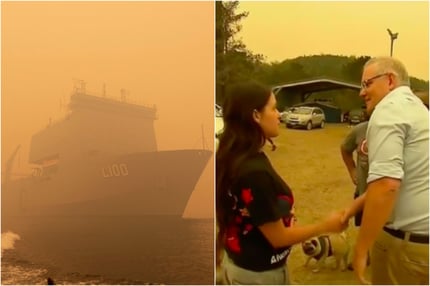
A huge rescue operation is underway at Mallacoota, where thousands are stranded.
1000 were evacuated by sea this morning by the army, but there are still 3000 to go. Every half an hour a group are shipped out to a bigger vessel offshore.
The military operation at Mallacoota is running like clockwork. Groups of evacuees being brought in every half hour or so and shipped out to the large navy ship using smaller boats. People leaving here have so much praise for @AustralianArmy & @Australian_Navy | @9NewsMelb pic.twitter.com/7IPGBuzhfz
— Sam Cucchiara (@SamCucchiara9) January 3, 2020
180 fire crews from the US and Canada are on their way to Victoria to help exhausted crews.
Here is what it looked like in Mallacotta over New Year:
We’re being told the conditions will be even worse than this tomorrow.
NSW South Coast.
A State of Emergency has been announced for the state from today and for the next seven days.
Over the past few days, eight lives and around 400 homes have been lost in NSW alone, with the latest death confirmed this morning.
A 72-year-old man’s body was found in Belowra.
On New Year’s Eve a father and son who were killed at Cabargo trying to save their property from the flames.
Patrick Salway’s wife posted emotionally on Facebook after the death of both her beloved husband and father-in-law.
Volunteer firefighter Samuel McPaul, 28, died after his truck flipped near the NSW-Victoria border on December 30. His wife is four months pregnant with their first child.
Communities in the area are still in immediate danger and crisis.
Phones remain cut across sections of the region and people are struggling to communicate with the outside world – even to just get the latest information on the fire risk.
At least 40 power poles have been destroyed, as have conductors. As NSW Rural Fire Service Commissioner Shane Fitzsimmons explained, “it’s not just about rocking up with a generator and plugging it in,” adding that there were “three big issues: power, communications and food.”
Kosciuszko National Park has now been evacuated due to fire threat and new communities like Batlow are under threat – locals there have been told their town will not be defendable.
The Dunns Road fire, which is threatening the town, is also threatening a nearby prison, after burning through 130,000 hectares in recent days.
Leave Zone – Batlow / Wondalga Dangerous conditions in Batlow, west of Blowering Dam. If you’re in this area, particularly Batlow north to Wondalga & west of Blowering Dam, leave before tomorrow. It is not safe. For road closures go to @LiveTrafficNSW #nswrfs #nswfires pic.twitter.com/GA0xJjlCQH
— NSW RFS (@NSWRFS) January 2, 2020
The humanitarian crisis.
Thousands remain stranded in towns on the south coast of New South Wales and in Victoria with food and water supply now becoming an issue.
Fire-hit communities stretching from Nowra in NSW to Mallacoota in Victoria’s East Gippsland region are fast running out of essentials as authorities race to try and evacuate everyone before the fire threats once against rise to catastrophic on the weekend.
9News has reporters on the ground and says in some areas the situation is getting “increasingly desperate” because “everything is running out.”
“We’ve been lucky because we’ve been with families who have been looking after us. But that is all coming to an end and we need food,” local Ron Coote toldToday.
“The shops have nothing. There is no water on the shelves.”
The queues for everything from the payphone to the supermarket snake down the street, everyone after the same things.
The countdown to a horror Saturday.
There are almost 30 road closures in the region south of NSW. Of the few roads that are open, the traffic is bumper to bumper as holidaymakers and locals try to flee ahead of the weekend.
Saturday is when extreme fire danger is predicted to return to the region. NSW Rural Fire Service Commissioner Shane Fitzsimmons says the conditions are predicted to be worse than New Year’s Eve.
“We’re expecting to see temperatures up into the high 40s, a westerly-northwesterly wind pattern will dominate which means it’ll bring very hot, very dry air across the region,” he said.
“That’s going to result in some fairly widespread severe and more importantly, extreme fire danger rat
Gemma Bath
True Crime Conversations host
No Comments
Be the first to leave a comment