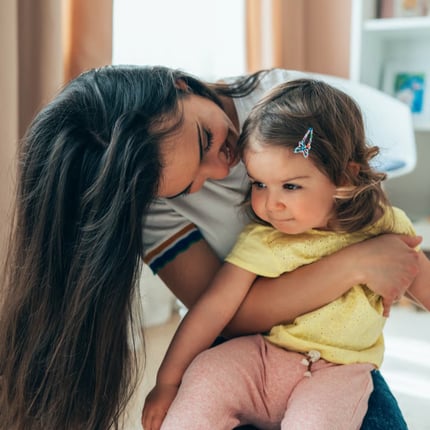
*Kayla was sitting with her little girl, freshly two years old, sharing a pastry on the bench at the playground. It was a sunny Wednesday and the two were having a lovely snack break when an older woman strolled past and remarked, “She’d better slow down on those with a belly like hers. ”
“I almost couldn’t believe it,” Kayla told Mamamia. “Looking back, I wish I had snapped something back to her, but I honestly was too stunned to speak. I think I muttered something like, ‘Er what?’ but she kept on walking, and anyway, I was more focused on changing the subject, so my kid didn’t have time to take in what she said.”
So this is the world we're throwing our precious little girls into. Still. Even now. Even with all the progress we've made.
Watch: The Cost of Beauty campaign by Dove. Post continues below.
Just last week, I sat with my perfect three-year-old niece as she ate lunch, watching as she gleefully devoured her plate and reached for more.
This precious little girl has such an easy relationship with food, taking what she likes, leaving what she doesn’t, unafraid to ask for more. It’s a dream for my sister and brother-in-law. But it has me worried — how long will it be before she gets told off simply for eating?
My young son is just as 'into' food as my niece is, yet I know he won’t have to face what I fear is coming for her.
At what age do our little girls’ appetites stop being celebrated and start being censored?
“Data suggests that once children are active, around 2½ is the point at which parents can become concerned about their weight status,” paediatric psychologist Deirdre Brandner confirmed.
We also know “with regard to weight and body image, there is little gender difference before the age of three."
"From that time onwards, more attention is paid to a boy’s height and athleticism, whereas girls from three onwards receive more comments about their appearance,” she said.
Deirdre pointed to research confirming that parental concern about little girls' weight is reported at higher levels than for little boys — a pattern that persists for most females into adulthood.
My own eating disorder didn’t come on until my early 20s. By that time, I had absorbed so much anti-fatness from all possible angles that my belief in the importance of staying thin was unshakable.
My habit of finishing friends’ meals at restaurants and always having snacks on hand was becoming a liability. My body was changing, but I knew that allowing it to get bigger simply wasn’t an option.
In their book, More Than a Body, Lindsay Kite PhD and Lexie Kite PhD explored how young women fall into self-objectification from a young age.
“Regardless of how our definition of beauty expands, it’s still being reinforced as the most important thing about us,” they wrote.
And it’s true — as little girls start growing into the bodies that will carry them through adulthood, we stop celebrating their beautiful appetites and start to scrutinise their bodies and eating habits.
Even worse, if the body they’re growing into happens to fall outside of the ‘thin ideal’, we put them on diets. We set them up for eating disorders. We fill up their powerful minds with calories to track and scales to step on instead of adventures to take or maths tests to dominate.
Now more potently than ever, the messaging around girls’ bodies and their appetites is inescapable. It bleeds out of every app, streaming service and screen they encounter and dominates conversations with their peers, who helpfully exchange tips on how to make their bodies shrink.
So what are we up against when it comes to the harms of weight stigma for our kids?
By now, we know that the BMI is, well, bullshit, and research confirms it’s not a helpful measure of a child’s fatness, let alone health. Yet, time and again, parents are encouraged to ‘intervene’ upon hearing from health professionals that their child is ‘obese’.
The problem is, we don’t have reliable, evidence-based methods for lasting weight loss in adults, let alone children. What we are confronted with is a mound of evidence that demonstrates the negative health impacts of weight stigma, weight cycling (weight loss and inevitable regain), and restrictive feeding from parents.
This twin study is among the research confirming restrictive feeding practices from parents can actually lead to weight gain in children.
How can we look out for our little ones’ health while protecting them from body shaming?
Health interventions such as reduced screen time, more physical activity, and a varied diet are all fantastic and should be encouraged for all families. But if the sole measure of whether these changes are improving our child’s health is whether their weight is dropping, those interventions might be abandoned when the desired outcome is not achieved.
This can also lead to parents blaming themselves or shaming the child for 'not doing it right' when the promised outcome of weight loss doesn't happen.
To counter this, Brandner suggested several ways we can take the focus away from a child’s appearance and onto the benefits of healthy living instead.
“We don’t want our own behaviour and language to negatively impact the development of our child’s self-esteem” she said. “We want to be sending the message, ‘I’ve got this fabulous body, how can I look after it?’”
Equally, it’s part of our role as parents to teach our kids about nutrition and set helpful boundaries around how we feed ourselves, just as we do with other things like screen time and bedtime.
Brandner advocated for taking the moral messaging out of eating in order to neutralise it, steering away from talk about ‘good’ and ‘bad’ foods, and keeping the focus away from body weight or size.
“If your child struggles with food, it’s important that the dinner table doesn’t become a battlefield, but rather a safe place for discussion,” she said.
Brandner suggested talking to our kids about why we love to eat fruits and vegetables, explaining to them, “They give our body energy to play, be in a good mood, and help us to grow strong and healthy.”
Lastly, and most importantly, “As a parent, be a good role model: accepting yourself right now in the way you look is the best thing for your child.”
It is essential to lay the foundations for a healthy body image early in our young girls’ lives. This means not discussing other women and our own bodies negatively in front of our little ones. It means enjoying food with them and celebrating our healthy hunger and the weird wonder of our diverse bodies.
One of the things that drove me to get help with my eating disorder was finding out my pregnant sister was having a baby girl. I refused to be a part of the dissolution of that kid’s positive body image. I will not model restrictive eating, calorie counting, over-exercising or body-hating practices for that child.
It stops with her. It has to stop with her.
And with us.
Feature Image: Getty.
Hannah Vanderheide
Author
No Comments
Be the first to leave a comment