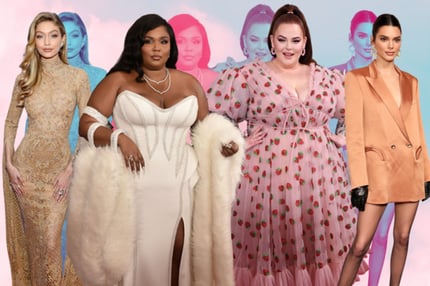
Famed fashion designer Yves Saint Laurent once uttered the phrase “fashions fade, style is eternal”.
But if you’ve ever cast an eye across modern media, you’ll know that’s just not true.
When it comes to social currency, ‘stylish’ is one of the coveted accolades women delight in finding within the comments section of their latest Instagram posts.
Unlike being called ‘beautiful’, which infers you’ve just scored extra points in the genetic lottery, stylish is an otherworldly term that elevates you - implying that you have a skill, an instinct, a vibe that's worth commending.
And yet, it’s a term only afforded to a certain group of women.
Watch: Lizzo talks about body positivity and negativity. Post continues below.
If you closed your eyes and thought honestly (and I meanhonestly, now) about the women in both the public eye and within your own inner circles who are universally labelled as ‘stylish’, chances are the second word you’d truthfully use to describe them is ‘thin’.
This way of thinking doesn’t necessarily mean you have a judgmental, fat phobic little gremlin tucked away in your subconscious who is calling all the shots (although some people certainly do).
Instead, it’s all just part of the internal bias that’s so deeply ingrained in all of us.
So much so that even if you live in a body that could be viewed as 'overweight', your eyes have still been trained to equate body weight with style.
In recent months the topic of thin privilege and its equation to style has been widely debated in the public sphere thanks to designer, author and plus-size model Tess Holliday.
Tess, who has always been an outspoken advocate for positive body image, published a post on Instagram blatantly calling out the way thin privilege is slicked over every surface of fashion culture.
In January, the model walked the red carpet at the Grammy Awards in a strawberry-covered dress by Lirika Matoshi. A dress which had been crafted especially for her after Tess spied a picture of the gown and fell in love with it.
Just like clockwork, she was then placed on a number of ‘worst dressed’ lists (many of which have now mysteriously disappeared) and the comments across social media channels were less than complimentary towards her, to put it mildly.
Then, as if the thin privilege fairy had gently secreted her magical fat phobic dust all throughout the crevices of TikTok, the dress suddenly went from a fashion dud to a fashion love.
Once placed on the bodies of thin women and strewn across the popular video-sharing app, the strawberry creation suddenly became the most coveted garment of 2020.
The blatant hypocrisy highlighted by Tess’ post spawned a slew of outraged reactions on her behalf, with news sites enticing readers to clutch their pearls in shock while being faced with fashion's "surprising" double standards.
But for plus-size women, Tess' point of view was as run-of-the-mill as feeling underwhelmed by a New Year’s Eve party.
If you look closely at the majority of women who are lauded for their style on platforms such as Instagram, then you begin to notice that praise for bodyweight is often replaced with the more socially acceptable praise for style.
A thin woman can clad herself in anything from the questionably trendy bike shorts and blazer combo, to tracksuit pants and a crop top or even something as basic as fitted denim shorts and a white shirt and instantly be classified as a winner in the style stakes.
All because their bodies hold the clothes in the only way that movies, media and magazines have taught us is acceptable.
The latest crop of young fashionistas gracing catwalks, magazine covers and, more importantly, taking up valuable Instagram real estate are mostly young women who are all traditionally deemed thin.
This fault does not lay at the feet of the Kendall Jenners, Kaia Gerbers, Gigi Hadids or Hayley Baldwins of the world, but the way the world chooses who to praise and who to ridicule, based on weight.
Take for instance body image advocate, entrepreneur and influencer Katie Sturino, who runs an Instagram series called “Super Size The Look”.
In this photo series she dresses in plus-size versions of the same outfits 'stylish' celebrity figures are lauded for, all in an attempt to crush the never-ending narrative around 'who wore it best' and show that style is for any size.
Unfortunately, this inclusive exercise can be met with vitriol (mainly when shared by external outlets) because she is attempting to place herself in the same style category as smaller women, despite the fact the outfits look identical.
Thankfully, due to the fact that social media influencers have been able to take the reins from magazines when it comes to the content we’re seeing, plus size women are now carving out space for themselves in the style stakes.
Yet with every step forward, where our social feeds fill with images of bigger bodies clad in lavish dresses and sleek suits, designed to be on show rather than hidden away, we are also reminded there is still a long way to go.
There is still the harsh reality of thin privilege lurking beneath our fashion commentary, and the reality is that plus-size woman are held to a different set of rules, at every level of critique.
There's no denying that when a traditionally thin woman dons a simple tracksuit, especially if she has a flat stomach on display
Laura Brodnik
Head of Entertainment
No Comments
Be the first to leave a comment