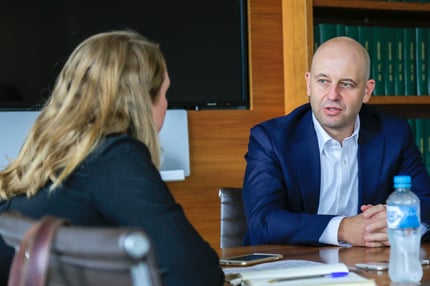
Two floors up and in the shadow of a stadium in ruins, Todd Greenberg is shaking his head.
He doesn’t understand sex-sharing videos.
And who could blame him? The CEO of the National Rugby League is no stranger to waking up to a fresh horror involving one of the 500-plus men he’s indirectly in charge of: “I don’t often buy the paper, let’s put it that way”. But this latest rush of scandal – footballers sharing degrading images of consensual sex to porous messaging apps – seems to him beyond sense or reason.
Still, if the act itself is not against the law, it’s a battle for another day. “I’m not the morality police,” Greenberg tells me.
And that’s true. This year, the man in charge of the multi-million-dollar business has had to be more than that. In a bid to address what we coyly refer to as the “cultural issues” in his sport – five players or former players are currently on charges involving sexual assault or violence, plus more than a few DUIs – he’s had to be The Enforcer, bringing in the kind of career-ending bans and benchings that many both outside and inside the code have spent years begging for, but plenty of others think are an outrageous overreach.
When I asked the NRL if I could sit down with Greenberg to ask him 11 uncomfortable questions that had been handed to me directly from ourMamamiaaudience, I expected a no.
After all, I wrote this about the NRL. Oh, and this.
But things have changed. Greenberg is over it. There’s no more brushing shame under the carpet, not when there’s CCTV of a player assaulting his wife and details of alleged but truly shocking sexual violence being read out in New South Wales court rooms. Greenberg’s done. And he’s addressing everything.
So, I found myself at NRL HQ for the third time in as many months –Mamamiahas been working on various partnerships with the code – meeting the CEO as demolition started next door on the Sydney Football Stadium, the arena where Greenberg’s sport lives and breathes, and where a shiny new start will spring up in, oh, about three years.
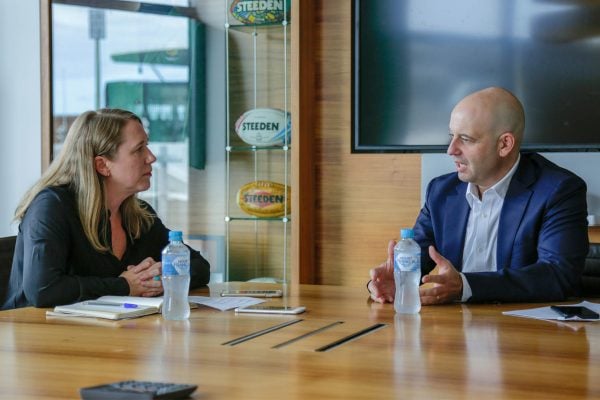
Holly sits down with Todd Greenberg at NRL HQ, Sydney.
At the boardroom table, Greenberg, 48, is friendly and frank. He's just back from the memorial for victims of the the Christchurch terrorist attacks and is filled with awe at the sense of community spirit. There are no questions ducked, no pandering or posturing. No, he doesn’t buy that the code has a blanket ‘female problem’. Yes, he is standing strong on zero-tolerance on violence against women and children. No, they won’t be banning booze. Yes, he believes the sport is truly changing and that values will trump brute skill.
The Sydneysider father-of-two is clear-eyed and unsentimental about his mission, and that is ensuring that the sport he loves survives, even if it means that no-one much loves him back.
As he says, "It's not my job to be popular."
And so, to your questions*. And the first one's a doozy.
1. Do you believe that thehas a "problem" with women?
“No. Categorically, no I don’t... I think you have to understand that one in three women experience a form of domestic violence. That’s not a stat that sits inside Rugby League, but it sits inside our communities every day, [and] as a sport, we have to use our voice to try to make sure we’re working with government to reduce that number.
"We can’t get away from the fact we do have those problems and they challenge us. No matter how much work we do, no matter how good our policy settings are, we’re going to have confronting challenges.
“But I’m also at pains to say, 'Don’t judge us on the issues, judge us on how we deal with them’.”
2. So, do you believe that issues such as domestic violence, sexual assault as - as we've seen recently - image-based abuse are more prevalent inthan other sporting codes. Or purely that they get more attention? If so, why? And if not, why?
"I don’t think we’re any different than lots of other sports. In saying that though, I’m a realist and I know that the young men that play in the NRL competition... a lot of them come from a long way back . That’s not an excuse, but it gives some context to some of the challenges we face.
"When I talk about this, what I really mean is… Before I came into Rugby League, I took for granted that I went to a good school and when I finished my day, I came home and I sat with my mum and dad and my younger brothers and we had dinner together. And then I went on to a good university… I thought that’s what everyone did.
"A lot of the young men who come into our care, a lot of them haven’t had that privilege. In fact a lot of them have a development phase of their life missing. Now, again, that doesn’t excuse any of that behaviour, but it puts some context to a lot of the challenges we face.
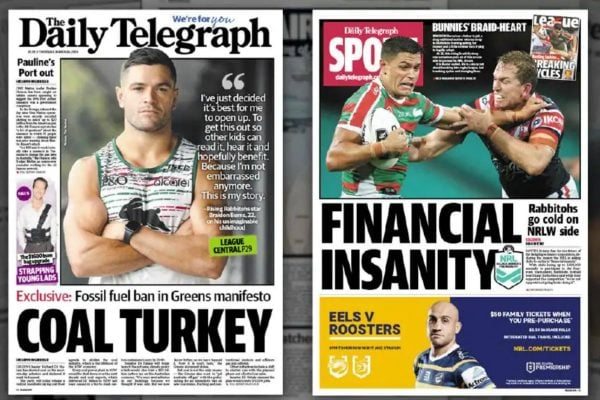
South Sydney player Braidon Burns told the The Daily Telegraph about his "unimaginable childhood". Image: Daily Telegraph from March 27, 2019.
"We spend an inordinate amount of time [and] money ensuring that these young footballers have a much greater understanding of their obligations outside of their 80 minutes on the field every week.
"Now, we want them to be fitter and stronger and faster and we want them to be the great rugby league players, of course. But my responsibility and our clubs’ responsibility is much, much greater and much, much deeper than that. We want them to become better men, better husbands, better fathers, better people, and you can’t just click your fingers and assume that’s going to happen because they play good footy on the field. We have a huge duty of care to that.
"When it goes wrong for us, and when those players make some mistakes - make really big mistakes - we have to have accountability in place and we have to balance the concept of, 'Are we going to provide player opportunities to grow inside the game or are we going to get tougher, and tougher and tougher on sanctioning and ultimately have strong deterrents for those who step outside the lines.'
"Which is where we’re at."
3. There's an overwhelming feeling of frustration in thecoming from our readers and listeners about why issues around violence against women haven't been officially addressed until now - a sense of "Why is this so hard?". So, why is this so hard?
"That’s a really good question. Because I’m forever challenging myself with being the organisation that provides discipline and sanction on players for misbehaviour, versus an organisation that’s providing opportunities for people to make mistakes and ultimately use the vehicle of the sport to get better.
"And it’s a paradox, it really is. It has a competing interest, sometimes."
Greenberg tells me he was recently watching a video about West Tigers' Russell Packer, an NRL player with a violent past who is now raising a young son with autism.
"He was in jail for a period of time for a very violent assault and he spent a number of years outside the game. He’s put himself through an MBA, he’s done an enormous amount of community engagement for us to even consider us allowing him to play again. He’s now playing again. And there was huge criticism of him coming back to play which I understood fully. But he’s now a person making such a difference, and I’m always conflicted about when do we provide that next opportunity for that player, or when do we say, 'No, no, it’s a privilege to play here, and you’re no longer welcome'. And I think that line has to get harder.
And it’s going to be tougher and tougher and tougher for people to get back into the sport. We have to do that. But I never want to close the door because I think rugby league is a sport that gives people opportunities.
In saying all of that, when it comes to violence against women and children, we just have to have a policy that says you’re no longer welcome. If you’re proven in that space there’s no second chances here, the line’s drawn and we’ve made that very clear. Particularly in the last 12 months.
I ask Greenberg why he seemed so emotional when he was announcing Ben Barba's lifetime ban after the former Townsville player was caught on CCTV allegedly abusing his wife in a casino car park.
"In some respects, the incident around Ben Barba was simple because there was clear evidence that I saw which made my decision a simple one.
“But it’s the impacts of those decisions. You have to understand you’re impacting people’s livelihoods, their careers. You’re impacting his family, probably forever, so you have to think very carefully about those decisions. They’re easy to judge because for people on the outside they’re a soundbite, but for people on the inside who have relationships with players and their wives and their children, they affect us much more deeply than that."
4. What's your motivation for being the CEO who changes the culture? Throughout your career, what have you learned about changing a culture from within?
"Leadership is not about popularity, and people get those commodities confused. I think a lot of people think that to be in a leadership role you need to be popular. You’re not going to do my job if you want to be popular. Almost every decision I make will polarise people’s opinions. That’s okay, I don’t make those decisions to be popular, I make them to be fair.
"And ultimately, I make them to protect the sport. A lot of the decisions that have been made on disciplinary matters have been criticised by a number of people, are there to protect the game... We are looking to make considered, reasonable, rational decisions that protect the interest of the sport. That will prove unpopular at times and that’s okay."
5. Why should a parent choose Rugby League as the sport for their young child to play?
"Before Rugby League, let me say, it’s really important that kids play in a team sport. Because team sport teaches you values and life lessons beyond any other measure you can take. League has the ability to teach you I think a million life lessons that you can’t find elsewhere.
"It’s safer than it’s ever been at an under-six level, it’s much more affordable than lots of other sports. But it’s about at that level, having fun and being active."
"Character has to be a consideration. In fact I think it’s played a much bigger part in the decision making of clubs in, I’d say, the last three years, but maybe the last five years.
"You or I would never hire someone solely on skill-set. I’m much more interested in the value set than the skill set. Because you can teach a skill set, but it’s very hard to teach a value set. And sometimes you have to sacrifice skill over values ultimately for the long-term good of your club.
"Ultimately what we’ll get to is in the recruitment of high quality people and well-paid athletes, there becomes a very diligent risk-assessment that has to be undertaken by a club in the hiring of that player. Because as we get stronger and tougher on sanctioning, that has a huge price to pay when you buy a player, when you recruit a player to your club who has questionable value set that ultimately could get you in trouble later on, and those deterrents are strong in the beginning, you’re going to think very carefully about how that player comes in and out of your roster. And if your club espouses a certain set of values, you have to live them, you can’t just talk about them."
"It’s safer to play Rugby League than it is to play unstructured in the playground.
"We spend a lot of time on the non-contact version of the sport. So you’ll watch the NRL on the TV and for all the things you love watching about it, the physicality, the collision, are maybe some of the things you don’t want your children to play. And that’s okay.
"We have a very different offering at the bottom with the same football and the same structure but no contact. So we’ve got 600,000 boys and girls, men and women play non-contact rugby league, touch football, tag football every weekend across the country. Our fastest growing segment is women playing non-contact and league-tag. There are 300,000 of them playing every week."
8. Some of our readers think that more women in and around the game is key. There are now female refs and touch judges, which is great. What else are you doing on a broader scale to encourage more diversity and inclusions for women?
"Let’s start right at the top. The Game’s governed by an independent board, the independent commission. We have two high-calibre females who sit on that board. We now have femal
Holly Wainwright
Executive Editor
No Comments
Be the first to leave a comment