Content warning: This post includes discussion of suicide that may be distressing to some readers.
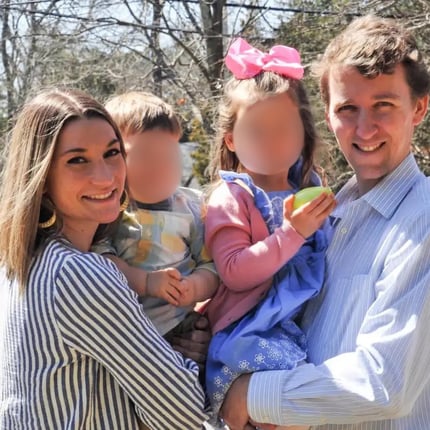
In January 2023, Patrick Clancy, a Massachusetts man and dad of three, left the house to pick up some takeaway food, leaving his wife Lindsay Clancy at home with their three children.
When he returned home, takeaway in hand, he noticed the house was eerily quiet, he recently told the court, per the BBC.
Outside, in the yard, he found his wife lying on the ground injured.
Eventually, he says, she directed him to the basement, where he was faced with the unimaginable.
Watch: One woman's story of postpartum psychosis. Post continues below.
Clancy, aged 32 at the time, had strangled their three children — a five-year-old girl and two sons, aged three years and eight months — in the basement of their home when Patrick left to pick up dinner.
She then attempted to take her own life, leaving her partially paralysed, per CNN.
Patrick found the children "unconscious, with obvious signs of trauma".
The two older children were pronounced dead in hospital soon after the incident. The youngest died a few days later, reportedly succumbing to his injuries.
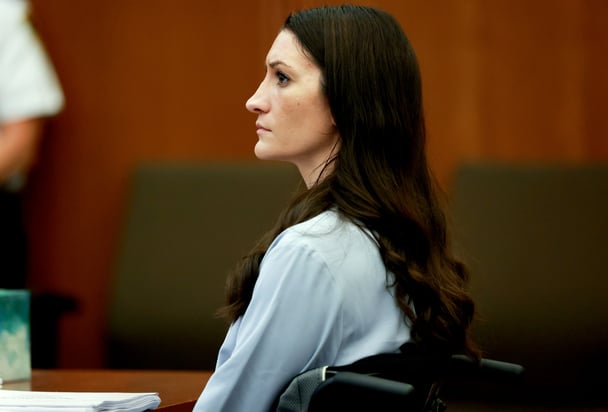
Clancy was charged with three counts of murder and strangulation over the deaths of her three children. She has pleaded not guilty and is currently on trial.
The crux of this murder trial is not whether Clancy killed her children; rather, should she be held criminally responsible for their deaths?
According to NBC News , her defence does not dispute that she killed the children but says she was suffering from postpartum psychosis — a condition that disrupts a person's sense of reality after they give birth,
Her attorneys say Clancy had bipolar disorder that wasn't fully diagnosed until after the killings and that her condition seemed to worsen with changing medication. They have criticised her psychiatric care and questioned her treatment.
Meanwhile, prosecutors contend that she acted "intentionally, rationally and swiftly." They claim she "chose to deal with her mental health issues in the worst way," by manipulating her providers and constantly changing treatment plans.
Here's everything we know about the trial so far.
August 18: Patrick's mother testifies.
On Tuesday, Clancy's former mother-in-law Susan Clancy testified that she and Clancy were close and described her as a "wonderful mother" who was "very nurturing, very loving", per PBS News.
Susan said Clancy was open about struggling and often asked for her mother-in-law's support.
She told the court Clancy was "begging for help" in the months before the killings.
"I'm not okay and I'm terrified of taking meds tonight," Clancy said in a text shown to the jury from November, two months before the killings. In the texts, Clancy spoke about fears she had become dependent on benzodiazepines but couldn't sleep without taking them.
"Lindsay was struggling — we were all concerned," Susan said.
August 17: Clancy's mother and sister testify.
After three weeks of testimony, the prosecution finished presenting its case. Now, the defence gets to call witnesses and first up was one of Clancy's former co-workers, Margaret Hamp, a labor and delivery nurse at Massachusetts General Hospital.
Hamp said Lindsay was skilled at her job and loved being a nurse.
"She was the type of nurse you wanted taking care of you or your loved one," Hamp said, per NBC.
The defence called Clancy's mother, Paula Musgrove, to the stand. She described her daughter as a loving, caring mother, who would "do anything for her children."
Musgrove testified that her daughter always wanted to be a mother.
"I felt it was the best thing that ever happened to her," she said, per Associated Press.
She said her daughter's mental health started to decline in October 2022.
She recounted how she saw her daughter become increasingly anxious, paranoid and suicidal in the months before the killings.
"She would mention that this wasn't her mind," Musgrove said, per CNN. "She would say to me, 'This isn't me, I've never been like this before.' And I would agree, because she wasn't."
Musgrove said Clancy's mental health started to seriously decline in October 2022.
According to a text message displayed in court, Clancy wrote to her mother that month asking if she would come stay with her as she struggled with insomnia after taking anxiety medication, per CNN.
"Mom, will you please come up and stay with me for a bit? I'm really sick. Something is wrong," Clancy wrote. "I had horrible insomnia all night, and I just don't know how I am going to get through the day. ... It's just really scary, and I don't want to be alone."
At Thanksgiving, Clancy had low energy and "seemed off", her sister Allison Ozga testified.
By December, she said things had gotten worse.
"She reported her mood was worsening, as she described it as depression. She was having more suicidal thoughts. Insomnia continued to be an issue. She was really not feeling like herself," Ozga testified.
Musgrove recalled a conversation from later that month in which Clancy told her mother and Patrick she had thoughts of harming the children.
By the end of the month, Clancy said she was feeling hopeless and experienced suicidal thoughts every day, Ozga testified.
Ozga said her sister seemed to be improving after a multi-day stay at a psychiatric facility in early January. However, Musgrove said Clancy had lost a lot of weight that month and became paranoid about illogical things.
"She said that she couldn't remember anything. The medication was pretty much just destroying her mind, and it wasn't her," Musgrove said. "She said, 'This isn't me. I just want to feel better and enjoy my kids again.'"
August 11: Mental health treatment in focus.
The trial has focused on the state of Clancy's mental health and the medications prescribed to her in the lead-up to the deaths and her attempted suicide.
The court was told that Clancy saw several mental health professionals and tried a range of different medication combinations, according to the Associated Press and CNN.
Dr Jennifer Tufts, a licensed psychiatrist, testified in court about her interactions with Clancy over roughly a dozen sessions between September 2022 and January 2023.
Tufts said Clancy initially reported having anxiety and trouble sleeping. By December, she reported having intrusive thoughts but still denied having thoughts of self-harm, Tufts said, per CNN. By mid-December, Tuft said Clancy went to the emergency room due to suicidal ideation.
In January, just weeks before the killings, Clancy was admitted to a psychiatric facility for a multi-day stay where she was treated by psychiatrist Dr Alia Goodheart, who also testified in court.
Goodheart said Clancy reported feeling numb and appeared anxious, so she diagnosed her with insomnia and worked on adjusting her medication, per CNN.
After several nights of sleep in the facility, Goodheart said Clancy asked to be discharged from the facility to be "home with her family and her children".
After discharge, Tufts said Clancy was still depressed on January 16. They had made plans to taper her off one medication and start on another, according to CNN.
Clancy reportedly saw Tufts the day before she killed her children. She testified that Clancy said she wasn't having any suicidal or homicidal ideation.
Rebecca Jollotta, a psychiatric nurse practitioner at South Shore Health Perinatal Behaviour Health Program, testified at the trial that she exchanged messages with Clancy regularly on a patient portal in late November and December 2022, per the Associated Press.
She said that Clancy reported having trouble sleeping, depressive symptoms and was hoping to get the right mix of medications to treat her symptoms. Clancy also reportedly said she was experiencing "very intrusive thoughts that [she had] never had before".
Clancy reportedly told the psychiatric nurse practitioner that she wanted to reduce or dosage or change her prescription based on the side effects she said she was experiencing.
Jollotta came up with several alternative treatment plans for Clancy, including different medications, behavioural therapy and support groups but she acknowledged that it was ultimately Clancy's decision to follow the advice, per the Associated Press.
Jollotta said that Clancy did report thoughts of suicide but never talked of having a plan to harm herself or her children.
Associated Press reports that Clancy expressed thoughts of suicide to Jollotta during a call in mid-December 2022. That was when Jollota reportedly suggested she seek a higher level of care in hospital.
Another psychiatric nurse practitioner who treated Clancy at South Shore Hospital, Julia Paul, testified and was cross-examined as well.
The court was told that Clancy was prescribed 13 different psychiatric medications in the months leading up to the killings, per The Guardian.
Reddington argued that the medical professionals who treated Clancy failed to communicate with each other and failed to properly diagnose and medicate her, per America's ABC News.
Her attorneys say Clancy did everything she could to seek help. Rather than improving, her attorneys and family say her condition worsened due to changing medications, per ABC7 Eyewitness News.
August 6: Clancy breaks down over autopsy photos.
Clancy broke down in tears during testimony about her infant son's autopsy. The juror was shown multiple pictures of her baby's injuries, as Clancy loudly sobbed, shuddered and covered her face with her hands, per CNN.
Some of her close friends testified, saying she told them she was having dark thoughts and felt like a "zombie" in the weeks before the killings, per ABC.
Amy Bevins, Clancy's friend of 29 years, told the court Clancy said the medication she was taking at the time was negatively impacting her mental health. Bevins said her friend was hopeful she would feel better as she came off the medicine.
Bethany DeCollibus, a friend from Clancy's neighbourhood, recalled a conversation with Clancy in January when she said she was still struggling with sleeping.
"She responded that things haven't gotten any better, and that she feels like a zombie," DeCollibus testified, per ABC, before describing her friend as typically "warm, kind, consistent, and loving."
Later that day, Clancy's father-in-law Christopher Clancy testified, saying she was a great mother but he noticed she was having some issues.
"I knew she was having a hard time sleeping," Christopher said, per NBC News. "I knew she just didn't feel well. I knew she went to the emergency room where my wife was working. Those types of struggles."
August 5: Clancy was a 'wonderful mum', ex-nanny testifies.
A friend of Clancy's testified in court that Clancy said she was experiencing "dark thoughts" that she believed to be a result of her medication, per CNN.
The family's former nanny also earlier painted a concerning picture of Clancy in the months before the killings.
Clancy lost significant weight, couldn't sleep and complained of post-pregnancy mental health issues, Elaine Rossi told the court, per Associated Press.
But Rossi never feared Clancy might be a danger to her children or to herself.
"I observed a wonderful mum who loved her kids," she said.
"She was concerned about their safety, and [her baby] eating and sleeping. She was a wonderful mother."
August 3: Jury hears Clancy's diary entries.
The jury was told of a kitchen cabinet in Clancy's home with books and notebooks about postpartum depression, including a "postpartum anxiety workbook" with nothing filled in, per CNN.
Massachusetts State Police Detective John Santos said one notebook had a list of medications and when to take them, while another had notes on medications and dates.
He said the book Good Moms Have Scary Thoughts, about mothers struggling with intrusive thoughts, was also found in the cabinet.
NBC News reported that both the prosecution and Clancy's defence attorney read pages from her journal. In them, she indicated she was struggling with motherhood.
Clancy detailed an ever-shifting line-up of psychiatric prescriptions and thoughts of suicide.
"I want help. I want to be well," one journal entry read, per the publication.
"It's like I'm so desperate to get a mental break from taking care of everyone that my mind is trying to make something physically wrong with me," she wrote of struggling to care for her three children, per CNN.
She was actively seeking care for postpartum depression before the killings, NBC reported.
Clancy was reportedly on leave from her job as a labour and delivery nurse at Massachusetts General Hospital at the time of the killings.
"We are shocked and saddened to learn of this unthinkable tragedy," the hospital said in a statement at the time. "We extend our deepest sympathies to all those affected by these devastating events."
Pyschiatrists tell of Clancy after the killings.
Two psychiatrists who spoke to Clancy in the days after the killings also testified, telling the court she appeared clear-headed and rational.
Dr Jhilam Biswas recalled a hospital evaluation with Clancy two days afterwards in which Clancy, who was on a ventilator and couldn't speak, wrote that she was "horrified" and asked for an attorney, Biswas said, per CNN.
Biswas testified that Clancy also wrote, "is my body broken," "are my legs straight," if she could have visitors and where her family was.
The doctor said Clancy seemed anxious, but she understood the questions and did not show signs of psychosis or hallucinations.
Dr Sejal Shah also told the court she examined Clancy multiple times at Boston's Brigham and Women's Hospital in January and February 2023.
In one assessment on January 30, Clancy denied having suicidal or homicidal intentions, denied having hallucinations that day and had an "organised" thought process, Shah testified, per CNN.
In a February assessment, Clancy was focused on her legal and physical situation, Shah said.
Several medical professionals also testified about the fatal injuries to two of Clancy's children and Clancy's injuries.
July 31: Jury visits Clancy family home.
Jurors visited the family's former home.
During the 40-minute visit, the jury, escorted in groups of six, viewed the inside of the home, including the basement where the children died. They also saw the yard where Clancy was found after jumping from a second-storey window, per Associated Press.
July 27-29: Patrick Clancy takes the stand.
Patrick told the court that Clancy was "having one of her best days" when he left her alone, People reports.
In his testimony, per the BBC, Patrick recalled returning to the house to find blood in the bedroom before going outside, where he found his wife injured on the ground and quickly called 911.
Duxbury Police Department Officer Brian Josephine soon arrived on the scene. Only then did Patrick leave his wife's side.
Patrick said Clancy then told him that the children were in the basement. That was where he found them strangled.
Josephine testified that he heard anguished cries coming from inside the house and rushed inside to find Patrick standing over his children's bodies.
"He looked up, and he screamed, 'She killed the f***ing kids!' " Josephine told the court, per People.
Patrick told the court he went "back and forth" between the children attempting CPR until first responders took over, per the BBC.
According to the BBC, Patrick said his wife told him after the incident that she "heard a man's voice" directing her to kill the children.
July 27: Opening statements.
Plymouth County Assistant District Attorney Shanan Buckingham said Clancy "deliberately and meticulously" killed her children.
Buckingham acknowledged Clancy had mental health issues, but argued she was not "in the throes of psychosis" when she killed them, per CNN.
"This was a woman who acted intentionally, rationally, and swiftly to accomplish a very specific goal — to kill," she told the court.
Defence attorney Kevin Reddington told jurors Clancy "had no motive" to kill her children and was "suffering from psychosis" at the time of the killings.
Reddington argued Clancy was suffering from postpartum depression and was prescribed a cocktail of medications in the months before.
"She was walking around absolutely a zombie. She would rock on the sofa, crying hysterically, banging her head into the sofa," he said.
He spoke of how Clancy worked as a delivery nurse and was a caring mother, per CNN.
"This is a woman who did nothing in her life but dedicated her life to helping people and be a good person and a good nurse and a great mother," he said.
If convicted of murder, Clancy faces life in prison without parole. If found not guilty by reason of lack of criminal responsibility, she will be committed to a state mental health facility, according to NBC News.
The trial continues.
This article was first published in 2023 and has been updated with new information.
If you or anyone you know needs to speak with an expert, please contact your GP or in Australia, contact Lifeline (13 11 14), Kids Helpline (1800 55 1800) or Beyond Blue (1300 22 4636), all of which provide trained counsellors you can talk with 24/7.
If you or anyone you know needs to speak with an expert after welcoming a child, please contact the Perinatal Anxiety and Depression Australia (PANDA) Helpline on 1300 726 306.
If you or anyone you know needs expert help, please contact Bravehearts — an organisation providing support to victims of child abuse. If you are concerned about the welfare of a child, you can get advice from the Child Abuse Protection Hotline (1800 688 009) or the 24-Hour Child Abuse Report Line (131 478).
Feature Image: Facebook.

Sign up to Mamamia Daily
Sent daily
No Comments
Be the first to leave a comment