Content warning: This story includes mentions of child sexual abuse, domestic violence, and sexual assault that may be distressing to some readers.
A character reference.
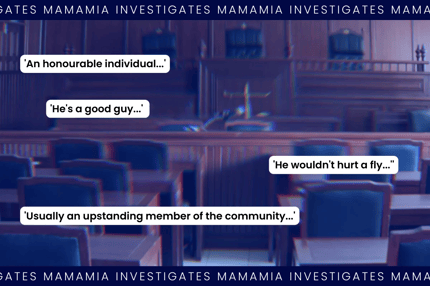
It's a simple piece of paper that plays a crucial role in our justice system and offers those on trial the opportunity to argue they are a personnormallyof sound character. We've seen it play out in the Danny Masterson case recently, when his co-stars Ashton Kutcher and Mila Kunis wrote character references for a man convicted of rape.
But for many victim-survivors, they say it can feel like a "kick in the guts" to watch someone vouch for a convicted perpetrator. And they say it can hurt even more if that character reference plays a mitigating role in a reduced sentence length for the perpetrator.
One recent court case shone a light on the use of character references.
It was regarding the charges against Jeffrey "Joffa" Corfe, often known as the 'Collingwood superfan' in the media.
Corfe pleaded guilty to sexually abusing a then 14-year-old boy in 2005. In late February, he was sentenced to a 12-month jail term, but it was wholly suspended for two years. This means he avoided prison, but if he steps out of line in the next two years, he risks being locked up.
He will be a registered sex offender for 15 years.
Watch: Breaking the silence — reporting historical sexual assault. Post continues below.
The judge said the sentence handed down was partly influenced by character references Corfe's legal team had used in court proceedings. He said the "powerful testimonials" had highlighted Corfe's "lifelong, genuine commitment to helping others" - in turn leading to the lighter sentence.
One of the references was written by a former fundraising general manager of a well-known foundation. The man wrote the reference for Corfe years prior, unaware it would later be used to help Corfe avoid jail time in a child sexual abuse case.
This general manager has since expressed his frustration over the reference being used in court without his knowledge, telling 9News: "It is really shocking".
A charity boss spruiked in court as standing up for child abuser Jeffrey “Joffa” Corfe’s “good character” has revealed an old reference was used without his permission in an “appalling” betrayal. #TheAdvertiser https://t.co/yiy0mgSt5m pic.twitter.com/PhZeKVgzsV
— The Advertiser (@theTiser)
For the victim of this crime, he told ABC News: "I find it both concerning and offensive he could provide these character references... given the weight that was given to them. I question how often it has happened in other cases."
And he's not the only one asking themselves that question.
How are character references used in court cases? And specifically, how are they used when it comes to cases where a perpetrator has pleaded guilty in a sexual assault, domestic violence or child abuse case?
Mia Madafferi is a lawyer and the founder of Grey Rock Consulting. She works with clients trying to navigate communications with controlling, narcissistic, or high-conflict personalities.
She explains toMamamiathe general process behind how and why character references are used in court.
"A character reference is a legal document that describes one person's opinion of another person's character, often used to assist the court in their decision-making process in criminal law matters," Madafferi says.
"They are most commonly used (and this is probably where the concerns of victim-survivors are arising) when the accused pleads guilty or is found guilty of an offence. In order to determine the appropriate sentence, the judge or the magistrate will look at a wide variety of mitigating factors - and one of them is character references."
From a legal perspective, Madafferi says she understands why character references exist.
"Character references are used in a wide range of criminal offences. It does assist the court in their decision-making process as to what sentence is appropriate for the particular offender before them," Madafferi notes.
On the other hand, the experience of victim-survivors must be taken into account.
As Madafferi tellsMamamia, our court process is not set up in a way that is trauma-informed.
"There's so many elements of our system which can be really traumatising. It would be incredibly difficult as the victim to hear these character references when the offender has pleaded guilty or has been found guilty.
"And I'm highly cognisant that in domestic violence matters for example, many offenders are covert in their actions. So, a reference saying the perpetrator is 'wonderfully involved in the community' and 'a great person' would be terribly traumatising as these people do not see what happens behind closed doors."
Sifting through a series of recent and highly publicised cases, it becomes clear how frequently character references are used by courts.
A former lecturer at Deakin University pleaded guilty to murdering his wife Chen Cheng in 2022. Character references were read out to the judge at his pre-sentencing hearing last month.
In a legal case for the late Cardinal George Pell, former Prime Minister John Howard provided a character reference, saying the cardinal was "a person of both high intelligence and exemplary character".
Tasmanian paedophile, John Wayne Millwood, pleaded guilty to historic child sexual abuse in 2016.
His friends and colleagues told a court the former businessman was "honest, reliable and trustworthy" and "ethical at all times" - reportedly hoping to reduce the paedophile's eventual jail sentence.
The victim of Millwood's crime soon after wrote to Tasmania's Premier, asking that "good character" referee evidence no longer be admitted as a mitigating factor in sentencing child sex offenders.
These examples are not isolated.
For survivor-advocate and Director of Advocacy at RASARA, Saxon Mullins, she says it's a nuanced conversation.
"It's kind of complicated. From a legal sense, I think people understand the reason for it. If we are going to use character references, I think it is important that it's pointed out to the jury or the judge that just because there are great character references from friends who say 'this person is great', we still have all of this evidence to say that [a great character reference] is kind of irrelevant," she tellsMamamia.
" In my case at sentencing for the first trial where this person had been found guilty, the character reference said: 'Oh he's not the type of person who could do this'. What's the purpose of saying that? Are we trying to discredit what the survivor said happened?"
As Saxon notes, perpetrators of sexual and domestic violence can be very duplicitous. To friends and work colleagues, they can be completely different to the person they are behind closed doors.
It's also important for the victim-survivor's wellbeing to be front of mind in how character references are presented in court.
"When you go to testify as a survivor of sexual violence, you don't get afforded the same opportunity to defend your character. I was called a liar. I was told that I had made this up. I didn't get to give a glowing reference from my friends of 20 years to say that I'm not a liar."
Kathleen Maltzahn is the CEO of Sexual Assault Services Victoria, the peak body for Victoria's specialist sexual assault and harmful sexual behaviour services.
"Character references clearly have a role in the justice system. But where people have committed serious sexual offences, that speaks more to their character than anything else they've done in the community," Maltzahn says toMamamia.
"And we have to believe what people have been found guilty of and not treat serious violent offences as somehow an abe

Sign up to Mamamia Daily
Sent daily
Isabella Ross
Senior News Writer
No Comments
Be the first to leave a comment