To keep up to date with the federal election campaign as we head to the polls to vote on May 21, visit our election hub page. There you'll find analysis, explainers and all the results of our Mamamia Votes survey.
The 2022 federal election is upon us.
Pre-polling booths are well and truly open, and millions of Aussies have already cast their vote.
If you're still feeling confused, conflicted or just haven't bothered to lean into the election chatter just yet - we've got your back.
I've done you a solid, and spoken to three politicians from the three major parties on your ballot paper. Of course there's plenty of others - there's a bunch of other minor parties, and plenty of independents to choose from.
Read more : The teal appeal: The rise of independents, and the pros and cons of voting for them.
But I wanted to ask the three most prominent parties - Coalition, Labor and the Greens - the same five questions so we could directly compare their answers.
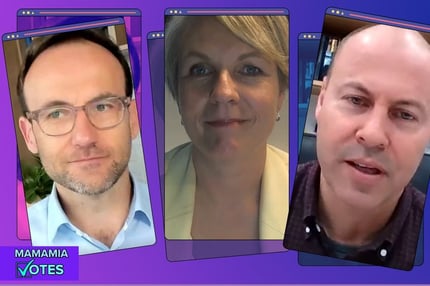
Lucky for us, Labor frontbencher and Shadow Minister for Education and Women, Tanya Plibersek, Deputy Leader of the Liberal Party and Treasurer Josh Frydenberg, and Greens Leader Adam Bandt, all allowed me to pick their brains.
Here's exactly what they told me:
1. Do you think your party is doing everything in its power to help Australia save the planet?
Josh Frydenberg:
"We are certainly doing everything we possibly can to reduce Australia's carbon footprint and to get Australia to net zero emissions by 2050. That has been our agreed commitment, it's a significant one, and we're focusing on doing so with a very detailed plan. The plan involves a technology investment roadmap, where we're investing more than $22 billion and leveraging more than $80 billion off the private sector. And it's everything from microgrids, which is small scale wind and solar in remote communities, to Snowy 2.0, which is effectively a big battery for the east coast of Australia. We're also investing in clean hydrogen, particularly in areas in Australia's regions, whether it's in the Pilbara, whether it's in Bell Bay in Tasmania, the Latrobe Valley in Victoria, the Hunter in New South Wales... and capitalising on a low emission form of new power generation. We've also got carbon capture and storage and a host of other new technologies that Australia is investing in.
"I think we've got a great story to tell, our emissions are down by 20 per cent on what they were in 2005. In comparison, New Zealand's are down by four per cent. Canada is down by one per cent. The average across the OECD - they're down by seven per cent. We've actually seen around $35 billion of renewable energy invested in Australia in the last few years, that's eight times the pace of the rest of the world on average. And so we've got a story to tell about the technologies that we're investing in, we've got a story to tell about our target, and our commitment. And I think we've got a story to tell about how it's creating jobs and lowering electricity prices."
WATCH: The pollies answers in video form.
Tanya Plibersek:
"We've got a really strong commitment to zero net emissions, and it's a commitment that we're going to keep. At the moment the government is still fighting itself about whether they're committed to zero net emissions or whether they're not going to reach zero net emissions. We've already said that we want to invest in making sure that we have more renewable energy; that we upgrade our transmission grid so that it can accept more renewable energy into the grid. That's great for lowering emissions, it's great for lowering power prices, and it's great for jobs as well as investing in upgrading our transmission system [by] putting more renewables into our system.
"We also want to help industries transition, so that they can use more renewable energy in their production processes. So really energy-intensive industries like metals manufacture, aluminium, steel, cement, industrial chemicals, and those kinds of big users of energy - we want to help them transition so that their products are made with green energy. That's great for our environment here in Australia, but it's also really good for our export products, when we're trying to export to Europe [and] to the United States [and] countries around the world that are also on a path to zero net emissions. By having low emissions exports, we can capture some of those markets overseas.
"We [have also] made an additional announcement about the Great Barrier Reef. So it's about what we do in energy and climate change, but it's also what we do in our environment to make sure that we're protecting the reef, protecting our beautiful natural environment, investing to protect species. We've got really big pressures on species extinction as well. Oh, and cheaper electric vehicles, that's a really good one too... because that's not just good for the environment, it's good for the family budget if you can lower your transport costs as well.
"So I think we've got I think we've got a really good set of policies."
Adam Bandt:
"It's our top election issue, and it's the reason why I quit my job and started running in elections. We've got a limited window of time left to stop climate change becoming a runaway chain reaction, and so it's right that it's people's number one concern. The scientists are telling us we've got to act in this decade, 2050 targets are too late, we need to act now. Coal and gas are the main causes of the climate crisis, we have to stop opening up coal and gas mines and then work out how to get out of the existing ones that we've got.
"Our number one priority this election is to change the government because we think we need to do that to get climate action, and then to put the Greens in balance of power. [Then we can] put on the table our demand that we stop opening up coal and gas mines, [and] have a conversation about how we get out of coal and gas in a country like Australia; where we can support workers and communities to get out of coal and gas and into renewables and other secure jobs. We've come up with a comprehensive plan to do that, it's the centrepiece of our campaign this election.
"When we've been in balance of power in the past, we've got action on the climate crisis and it's the only time in Australia that pollution has meaningfully dropped, and we want to repeat that again. For us, this is the number one issue and we have to act now, and we're the only ones putting on the table a plan that looks after workers in communities, but that is consistent with the science. We're the only ones with targets that are consistent with a science that will cut the pollution in the time needed. It's a critical issue for us this election."
2. What is the most important election issue to you, and how are you planning on tackling it as an individual and a party if you win?
Josh Frydenberg:
"It might not be a surprise to you as the treasurer, my focus is on creating jobs, and I'm really pleased about what Australia has been able to achieve in the last couple of years. It's easy for us to forget what it was like back in March and April 2020, when 1.4 million Australians either lost their jobs or saw their working hours reduced to zero. That's more than 10 per cent of the workforce and Treasury actually came to me and said that they thought the unemployment rate could reach as high as 15 per cent; that's more than two million people unemployed. The good news today is that the unemployment rate is at four per cent, which is the equal lowest in 48 years, and we've got female unemployment to its lowest level since 1974.
"So for me as treasurer, I don't see my job as achieving a number on a page. I think my job is about supporting the people behind the numbers. For every one of those 700,000 jobs that were saved with Job Keeper, that was a mum or a dad or a brother or sister - somebody who now has the dignity of work. I come across people all day every day who have seen their job saved by Job Keeper. Just yesterday [I was] speaking to a young couple who run a small business where they fix antique fireplaces and they live above the shop on the main street. Without Job Keeper, they said their business would have closed and closed permanently. Now they're up and running and they're feeling really strong about it. So whether it's in the retail sector, whether it's the local dry cleaner, whether it's people in hospitality... people's jobs have been saved with the initiatives that we've taken. And for me, going forward, I want to create more jobs. So for me, the biggest issue is how can I steer the economy towards that path of creating more jobs, particularly for young people."
Tanya Plibersek:
"The thing that most people bring up with me, it doesn't matter where I am in the country, is that they're really struggling to make ends meet. Cost of living has gone through the roof and wages just haven't kept up. So I think that for this election that is the most important issue, and we've got plans to make childcare cheaper for 96 per cent of families in the system, we've got a plan for cheaper power bills for families, we've got a plan for cheaper medicines, cheaper electric vehicles - all of those things take a bit of pressure off the family budget.
"We also need to see pay increases, and we've got a government at the moment that says that people on the lowest wages, so people earning $20.33 an hour, don't deserve $1 an hour pay increase. They've said in the past that low wages are a deliberate design of their economic architecture, and they want to keep wages low. Well, we say that we can afford to increase wages, take pressure off the cost of living, reduce the gender pay gap; basically make it easier for people to make ends meet. I think that's the biggest issue for most people in this election.
"Can I say one thing personally that I really want to focus on if we're elected? I'd like to see a change in rates of sexual assault in this country. I want to work through the next National Plan to End Violence against Women and Children, to have a real focus on sexual assault, because it is one of the areas where we can continue to see rates of crime increase when most other areas of crime we've seen a decrease in crime rates. I think there's a lot we could and should be doing. There's a lot we know about how to change behaviour, including in investing in respectful relationships for teenagers in high school; we've got a $77 million plan to teach kids about respectful relationships. But also [it's about] sending strong and consistent messages about the legal response, the justice response to sexual assault, [and] making the process easier for victims of crime. Basically, we need to jail more rapists and keep them off the street and I would really want to focus very strongly on that in the next term if we are elected to government."
Adam Bandt:
"The most important election issue for the Greens is the climate crisis. We want to make sure we get out of coal and gas, and at the very least stop opening up new coal and gas mines. There's 114 new coal and gas mines on the books in this country that Liberal and Labor both want to proceed with, and we know the government's terrible because they're making the climate crisis worse. But Labor has been at pains this election to say they agree with the government, including on opening up new coal mines. I just don't see how in a time of bushfires, floods and droughts, you can go ahead and open up new fossil fuel projects - we've got to stop doing it. And with the floods that have been ripping through New South Wales, and the fires that came off the back of record drought in this country, we know we've got to act. Australia has got a lot to lose if we don't get it under control.
"I think probably level pegging with the climate crisis would be what we see as the inequality crisis that we're seeing in housing affordability, with so many people being locked out of homes. We're seeing the gap between the very well off and everyone else growing in this country, [and] we think government has a big role in tackling that to make this country a more equal place where everyone is looked after. So I guess climate crisis first but then level pegging with that is tackling the inequality crisis to ensure that we get dental, mental health into Medicare, [and] we fix housing affordability. And critically for us, we want to wipe student debt. We think that is a much better and fairer way of addressing cost-of-living pressures, rather than giving tax cuts to billionaires like Liberal and Labor want to do."
3. Women are still not equal in politics, in business and in the home. What do you think needs to change to truly dismantle that for good?
Josh Frydenberg:
"We're taking a lot of steps to improve women's economic security, women's health, and women's safety and in the last two budgets alone we've had a women's economic statement, which has included more than $5.5 billion dollars worth of measures.
"Take, for example, women's safety. We're investing in frontline services, legal assistance, safe houses, and a range of other support measures to help people who are really in need and particularly young children as well. So we have a National Plan to End Violence against Women and
Gemma Bath
True Crime Conversations host
No Comments
Be the first to leave a comment