This post deals with disordered eating and body image and might be triggering for some readers.
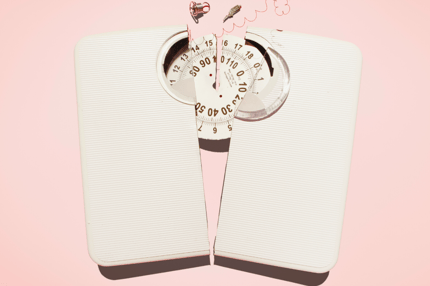
In a viral post within aMamamiaFacebook Group - MamamiaOutlouders -mum Leah shared the story of her nine-year-old daughter and classmates being publicly weighed at school.
"How is this still even allowed to happen?" Leah said.
"They were all asked to weigh themselves at school today as part of their phys ed class. Whilst the teacher told them 'it doesn't matter what the number is' to me, the activity itself is so insanely problematic. There were comparisons, commenting on other people's numbers and calling out the heaviest kids as 'fat'," she continued.
Leah had to have a long conversation afterward with her daughter about self-worth and body image, hoping that what happened at school today doesn't have a lasting impact. She's not alone.
Almost 200 women have shared their horror at the situation and their own similar stories.
Watch: Negative Self Talk | Butterly Foundation. Post continues below.
Dr Natasha Magson is a postdoctoral researcher at the Centre for Emotional Health at Macquarie University.
Speaking withMamamiaabout the problematic nature of this practice, Dr Magson said: "It focuses on weight as an indicator of health when the focus should be on regular exercise, a healthy and varied diet and educating young people about body diversity and acceptance. From research, we also know that from a very young age children (as young as three!) view larger bodies as 'bad' and thin bodies as 'good'."
As Dr Magson notes, equating weight with health has been shown to perpetuate social exclusion, weight-based victimisation, stigma and prejudice. Not to mention that body weight and shape is the most common reason that children and adolescents are victimised by their peers.
"Weighing a child in front of peers encourages school-aged children to engage in body and weight comparison, and with this comes feelings of embarrassment and shame. This has the potential to exacerbate an already concerning problem," she said.
The Butterfly Foundation shares a similar sentiment, stressing the importance of focusing on overall health and wellbeing rather than weight.
"A high level of body dissatisfaction and weight concerns are also leading to an increasing number of men and women engaging in disordered eating behaviours. It is important to note that only a clinically trained health professional is qualified to provide medical advice on your physical health," The Butterfly Foundation says.
Of course not all teachers, education institutions or schools practice this. Most would completely disagree with it. But the fact even a small minority do is concerning.
To highlight just how sadly common Leah's story is, these women below share their experiences of being publicly weighed at school.What their anonymous stories speak to is that not only is this practice incredibly problematic, it also has long-reaching effects.
"I still remember what I weighed in year two when we did it in class, and now I'm 46 years old. It has stuck with me."
"I too experienced the same almost 30 years ago. And when I discovered that my son had to do the exact same thing in his year seven maths class last year, I was mortified. How have things not changed?"
"I have two teenage daughters with Anorexia Nervosa. 26 admissions between the two of them in the last two years. Improved and improving but it's been horrific. For those who make the decision to do these weighing activities: this is what's at risk."
Listen to This Glorious Mess: The seven parenting moments that broke us. Post continues after audio.
"As a dietitian, this is absolutely horrifying. Weighing students is completely inappropriate and potentially damaging. The scientific literature consistently demonstrates how discussions around weight and negative body image at a young age can have profound impacts in later life."
"We, as a society, are not in a place where you can weigh children and just say 'oh don't worry about the number'. I vividly remember having this happen to me as a child. I was taller and a little more developed than the other girls, and because of that, my number was bigger. I still to this day remember the anxiety and embarrassment."
"Sad to say this type of thing is standard practice throughout a lot of the UK. I went to boarding school in England, and every term we had to be weighed and all of our numbers would be added to a spreadsheet which was then printed out and pinned to the corkboard in the school's hallway for all the students to see. Those students whose number were considered overweight (I might add based on stupid BMI) were then highlighted in a different colour. I was one of those people."
"My ten-year-old is overweight, and as a family we are judged all the time without anyone knowing our child's medical history. There's often more to the story. This would be heartbreaking if this sort of thing described happened to her. Bullying and teasing about her size is our constant fear. And weighing school students in front of one another would be a breeding ground for potential teasing."
"In high school I remember we once did an activity where all the students were lined up in order of weight and height. I think it was supposed to be part of a maths exercise, but the whole thing felt super problematic."
"I'm a teacher and developed an eating disorder in high school: but even without that background there is no way I or any other teacher I know would do this! It's heartbreaking."
<
Isabella Ross
Senior News Writer
No Comments
Be the first to leave a comment