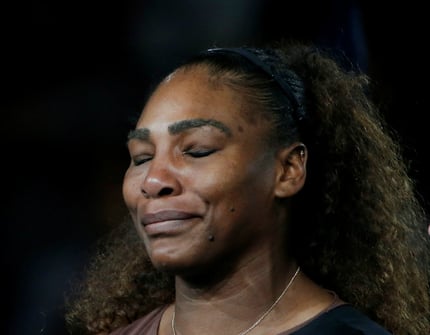
In the wake of a women’s US Open final unlike any we’ve seen in recent memory, fans are grappling with some tough questions.
It all started when Serena Williams was given a coaching violation early in the second set.
“I don’t cheat to win, I’d rather lose,” Williams told umpire Carlos Ramos.
“I didn’t get coaching. You owe me an apology. I have never cheated in my life.”
It seemed the argument was over, but then, when Williams smashed her racquet after dropping a serve, she was docked a point for a second violation. Immediately, she became frustrated and emotional.
Serena Williams after receiving a coaching violation in the #USOpen final:
“I don’t cheat to win. I’d rather lose.” pic.twitter.com/ml8FOrecQy
— Complex Sports (@ComplexSports) September 8, 2018
“Every time I play here, I have problems,” she said. “I did not get coaching, I don’t cheat. You need to make an announcement. I have a daughter and I stand for what’s right for her. You owe me an apology.
“For you to attack my character is something that is wrong.
“You will never ever, ever be in another final. You are a liar.” She then called Ramos a “thief” for docking a point from her, at which point he gave her a code violation for verbal abuse, resulting in a game penalty.
Williams then demanded referee Brian Earley come on to the court, telling him, “You know my character. This is not right. To lose a game for saying that, it’s not fair.”
“How many other men do things? There’s a lot of men out here who have said a lot of things. It’s because I am a woman, and that’s not right.”
Williams’ opponent, 20-year-old Naomi Osaka, ultimately won the match – making her the first Japanese player to win a grand slam.
As it ended, however, Williams refused to shake Ramos’ hand, and continued to demand an apology.
Standing on the podium, the crowd booed at the result, leading Osaka to cry. Williams put her arm around her, and said, “No more booing. Let’s be positive.”
Serena putting her arm around Naomi Osaka as the crowd boos is quite a moment. (via ESPN) pic.twitter.com/BjlDH13F1z
— Kyle Griffin (@kylegriffin1) September 8, 2018
In tears, Osaka said, “I know everyone was cheering for her and I’m sorry it had to end like this. I just want to say thank you for watching the match.
“It was always my dream to play Serena in the US Open finals. I’m really glad I was able to do that.”
It was an emotional and almost unbelievable spectacle to watch at times, with many opinions taking over the headlines.
The question everyone’s ultimately asking, however, is: were the calls fair?
Was Williams justified in her outburst? Or just frustrated by her strong opponent?
US player Andy Roddick, who won the US Open in 2003, was initially infuriated by the referee’s calls. “Worst refereeing I’ve ever seen,” he tweeted.
A few hours later, he clarified his statement, acknowledging that he was “emotional”. Roddick explained that while the referee was within his power to dock Williams’ game, “common sense should’ve prevailed”. He highlighted the inconsistent calls during the Open as the cause of his frustration.
Emotional first take by me. common sense should’ve prevailed in my opinion. He’s within his power to make that call. I’ve seen an umpire borderline coach a player up,and another dock a game for being called a thief in same tourney. There needs to be some continuity in the future https://t.co/T5oI1M0Cu7
— andyroddick (@andyroddick) September 8, 2018
ESPN‘s Mike Greenberg said he had witnessed male players use far worse terms than ‘thief’ towards umpires, and not receive the same penalties as Williams.
I have heard with my own ears Jimmy Connors, John McEnroe and plenty of lesser known players say far worse than “thief” on the court with far lesser comsequences. #USOpen
— Mike Greenberg (@Espngreeny) September 8, 2018
A number of journalists echoed this perspective.
The chair’s ego in this situation not only penalized Serena Williams but also deprived Naomi Osaka of the spotlight (and smile) she deserved. #USOpen pic.twitter.com/VEDzDucP0y
— Arash Markazi (@ArashMarkazi) September 8, 2018
Serena is 100% right. Male players are allowed to scream, curse, break rackets, yell at referees and they get away with most of it. She does it and she’s penalized. It’s sexist.
— Ryan Rosenblatt (@RyanRosenblatt) September 8, 2018
Belarusian professional tennis player Victoria Azarenka shared a similar sentiment, writing that male players wouldn’t have been treated the way Williams was.
If it was men’s match, this wouldn’t happen like this. It just wouldn’t
— victoria azarenka (@vika7) September 8, 2018
Former World Number 1 and tennis icon Billie Jean King said coaching isn’t allowed, but should be, and agreed with claims of a double standard.
(1/2) Several things went very wrong during the @usopen Women’s Finals today. Coaching on every point should be allowed in tennis. It isn’t, and as a result, a player was penalized for the actions of her coach. This should not happen.
— Billie Jean King (@BillieJeanKing) September 9, 2018
(2/2) When a woman is emotional, she’s “hysterical” and she’s penalized for it. When a man does the same, he’s “outspoken” & and there are no repercussions. Thank you, @serenawilliams, for calling out this double standard. More voices are needed to do the same.
— Billie Jean King (@BillieJeanKing) September 9, 2018
As The Washington Post’s Tramel Raggs pointed out, John McEnroe received one point penalty in his entire career.
It is, however, important to note that the calls made by the umpire were well within his rights.
During a panel conversation onSport’s Sunday,former Australian men’s tennis star Sam Groth said the coaching penalty wasn’t “that harsh”. He also believes the fact Williams was down in the match contributed to her frustration.
“She got a code violation warning which is basically the first step,” he said.
Panellist Richard Freedman admitted he was annoyed by Williams’ reference to motherhood in her argument with the umpire – referring to the moment the 36-year-old brought up her daughter. Freedman also thought it was “unbelievable” that the crowds were cheering Williams’ behaviour.
Ultimately, it appears, many things can be true at once.
The referee was well within his rights to make the calls he did – based on the rules of tennis. The question, however, is whether these rules are applied differently to men and women.
It’s likely a question that will be thoroughly explored in the days and weeks to come.
But it’s also important for us to acknowledge Naomi Osaka’s humble, composed and iconic win, which, through no fault of her own, will be remembered alongside a referee’s controversial calls.
Clare Stephens
Contributor
No Comments
Be the first to leave a comment