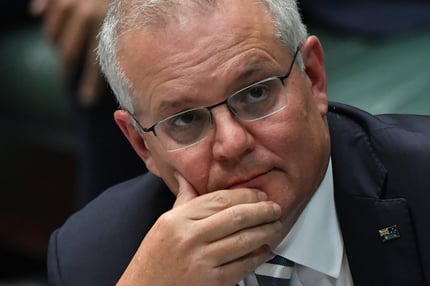
Government promises to reach net zero by 2050.
Prime Minister Scott Morrison has released his plan to achieve net zero emissions by 2050, ahead of the COP26 climate summit in Glasgow.
Morrison unveiled the plan on Tuesday, announcing the government is committed to spending $20 billion on low emissions technologies by 2030.
"Australians want action on climate change. They’re taking action on climate change but they also want to protect their jobs and their livelihoods. They also want to keep the costs of living down," he said.
"And I also want to protect the Australian way of life, especially in rural and regional areas. The Australian way of life is unique."
The prime minister said there would be no legislation or mandates attached to the target and the plan will "not increase energy bills" or cost jobs.
"It will not impact households businesses or the broader economy with new costs or taxes imposed by the initiatives that we are undertaking," he said.
"It will not cost jobs, not in farming, mining or gas. Because what we’re doing in these plans is positive things, enabling things."
The Productivity Commission would undertake reviews of the economic impact of the policy every five years.
"It will be a safeguard for rural and regional Australia," he toldThe Australianon Tuesday, adding it would provide "accountability" for the government's emissions plan.
UK Prime Minister Boris Johnson hailed the commitment as heroic because of Australia's heavy reliance on coal and other emissions-heavy industries.
But the COP26 summit is expected to focus on more ambitious 2030 targets from nations ramping up climate action.
Meanwhile, Morrison said the target of a 26 to 28 per cent reduction in emissions by 2030 would remain unchanged, despite projections showing that Australia is on track to drop emissions by 30 to 35 per cent by 2030.
"We may even achieve better, but this is the approach we put to the Australian people," he said.
The Brittany Higgins-inspired training video no one in charge has watched.
Top-ranking bureaucrats in charge of federal parliament have not watched a 13-minute training video created after the alleged rape of a former Liberal staffer.
The Department of Parliamentary Services signed off last week on new procedures for responding to serious incidents in the building.
The material was produced after ex-ministerial adviser Brittany Higgins went public in February with allegations a former colleague raped her in parliament house in March 2019.
DPS secretary Robert Stefanic and one of his deputies, Cate Saunders, confirmed at a Senate estimates hearing on Monday they have not watched the video.
While Parliament creating a ‘serious incidents protocol’ is a positive step, it’s really difficult to see how flippantly they continue to regard their duty of care to staff. (1/3) https://t.co/YNxdUxtSNv
— Brittany Higgins (@BrittHiggins_)
Security branch assistant secretary Leanne Tunningley, who signed off on the training, is the only executive to have seen it.
"It just doesn't seem like people are taking it seriously," Labor senator Katy Gallagher said.
Mr Stefanic and Ms Saunders intend to view the training video, which is designed for parliamentary security officers.
"I don't want to leave you with the impression that we're not taking this seriously," Mr Stefanic said.
"We've dedicated, I think I could confidently say, hundreds of hours into ensuring that our policies and processes are robust and that we have made improvements.
"I wouldn't characterise not having seen the video as being not concerned about the seriousness of this."
He said the video was a visual aid for written training material over which executives had oversight.
Senator Gallagher said new training came into place eight months after Ms Higgins' allegations were made public.
"I just thought something like this that has come out of the whole Ms Higgins saga, maybe the secretary and deputy secretary would have watched the video," she said.
Meanwhile, the government has rejected a claim by Australian of the Year Grace Tame that she was sidelined in the development of a new national strategy to prevent child sexual abuse.
Asked on theABClast week whether she had been involved in the drafting of the strategy, Ms Tame said: "No."
Believe it or not, I wasn’t at all surprised to learn for the first time today—live on national television—that I hadn’t been consulted on the National Strategy to Prevent Child Sexual Abuse. I’d like to share some constructive insights on the reality of working in this space: pic.twitter.com/WKgI0EUL6k
— Grace Tame (@TamePunk)
One of the ministers responsible for the consultation, Ben Morton, told parliament Ms Tame had been involved in consultation in March, May and June including talks with him in Tasmania.
"I thank her for her insight," he said.
The details of the plan are due to be released later this week.
If this post brings up any issues for you, or if you just feel like you need to speak to someone, please call 1800 RESPECT (1800 737 732) – the national sexual assault, domestic and family violence counselling service. It doesn’t matter where you live, they will take your call and, if need be, refer you to a service closer to home.
Unvaccinated stars may still be at Australian Open.
Unvaccinated players will seemingly be allowed to compete at next year's Australian Open after all.
A leaked email from the WTA to its Players' Council has revealed unvaccinated players must still endure 14 days' hard quarantine in a hotel.
The memo asked players to "please keep this information confidential until the government makes an official announcement".
Government leaders only last week insisted the world's tennis stars needed to be fully vaccinated against COVID-19 to take part in the Open, casting doubt on Novak Djokovic's participation at the Melbourne Park major.
Djokovic has repeatedly refused to reveal whether he has received a jab, having also previously expressed hope the vaccine would not become mandatory for players on the ATP circuit.
The state government says the fate of unvaccinated tennis players is up in the air, despite a leaked email suggesting they'll be allowed in the Australian Open. Health Minister Martin Foley hoped the January tournament would go ahead with "a safe and vaccinated playing group". pic.twitter.com/gO7ulCenPl
— 10 News First Melbourne (@10NewsFirstMelb)
Victorian Premier Daniel Andrews last Tuesday said unvaccinated sports stars would be unlikely to receive a visa, while federal Immigration Minister Alex Hawke on Wednesday confirmed there was no prospect of travel rules being relaxed for incoming tennis players.
"Not at this time. Our health advice is that when we open the borders, everyone that comes to Australia will have to be double vaccinated," Hawke toldABC Radio.
But it appears the Victorian and federal governments have both completed an about face.
Victorian Sports Minister Martin Pakula on Monday morning maintained nothing was set in stone, a fact which Tennis Australia acknowledged.
"We are working with the Victorian and federal governments on the conditions for players at Australian Open 2022 and look forward to having the details confirmed soon," TA said in a statement.
Pandemic powers law reaches Vic parliament.
The Victorian government is set to introduce new laws to parliament that would allow the health minister to make public health orders for the COVID-19 pandemic.
Several MPs have confirmed toAAPthe Public Health and Wellbeing (Pandemic Management) Bill 2021 will be introduced to the lower house when parliament resumes on Tuesday.
The bill is expected to permanently replace the current state of emergency, which has been in place for more than 18 months and expires on December 15.
"The bill establishes several mechanisms designed to improve the transparency of pandemic decision-making and accountability of decision-makers to parliament and the community," a summary of the bill reads.
According to the summary, sent to MPs on Monday night, the bill will provide the health minister with "broad powers to make pandemic orders" on the advice of the chief health officer.
The Victorian government has proposed controversial new pandemic laws to replace the highly contentious state of emergency powers they wielded during the 2020-2021 lockdowns. https://t.co/yBCsFQEzxX
— Sky News Australia (@SkyNewsAust)
Currently, only Chief Health Officer Brett Sutton can issue such orders.
The laws will bring Victoria in line with jurisdictions such as NSW and New Zealand, where the health minister is directly accountable to parliament.
The bill is expected to pass the lower house, where Labor has a commanding majority, but in the upper house the government will require the backing of three of the 11 crossbenchers.
Majority of NSW COVID cases outside Sydney.
The majority of COVID-19 cases reported in NSW are now being diagnosed in the regions and smaller cities, rather than in Sydney where the Delta outbreak first took hold.
Of the 294 cases reported on Monday, 166 - or 56 per cent - were outside the state capital.
The caseload is highest in the Hunter New England local health district, which had the most cases of any district in the 24 hours to 8pm on Sunday - 59. It recorded 53 cases the day before, down from 78 the previous day.
Case numbers in southwest and western Sydney once dwarfed any other area, but Hunter New England has in the last week been the district with the highest caseload on three occasions.
The district takes in Newcastle, Tamworth, Glen Innes and Moree as part of its 131,785 square kilometre area.
The majority of COVID-19 cases reported in NSW are now being diagnosed in the regions and smaller cities, rather than in Sydney where the Delta outbreak first took hold. #7NEWS https://t.co/P5pr1Py6f9
— 7NEWS Sydney (@7NewsSydney)
There is also a notable surge in the Murrumbidgee Local Health District, which takes in the Snowy Mountains and the Riverina region in the state's southwest.
That area reported 46 new cases on Monday, 47 on Sunday and 37 on Saturday.
Concerns that vaccination rates were lower in the regions drove the NSW government's decision to postpone unrestricted travel from Sydney until November 1.
Regional communities wanted more time to get their double dose vaccination rates as high as possible before welcoming back visitors.
Authorities reported four new deaths from the virus on Monday, including a person from the Central Coast.
Each person had underlying health conditions, said NSW Health. They were an unvaccinated person in their 40s, two people in their 60s with one dose of the vaccine, and a person in their 70s with both doses.
State-wide vaccination coverage is now at 85 per cent double-dose and 93.1 single-dose for over-16s.
Of children aged 12 to 15, 78 per cent have had their first dose and 51.5 per cent are fully vaccinated.
ACT vaccination rate nears 90 per cent.
ACT health authorities are set to provide a major update on Canberra's COVID-19 outbreak as the city's vaccination rate continues to climb.
A detailed epidemiological update on the ACT's coronavirus situation will be delivered on Tuesday along with the daily case numbers.
Meanwhile, Canberra's vaccination rate is inching towards 90 per cent of people over 12 years of age being fully vaccinated.
The ACT has stopped reporting vaccination rates over 99 per cent to avoid confusion and anomalies when its official figure exceeds 100 per cent in the coming days. Via @FinnianMchugh https://t.co/Hsd9wGVWnZ
— Canberra Times (@canberratimes)
The latest figures have shown 88 per cent of the eligible population having had two doses of the COVID-19 vaccine.
There were nine new cases reported in the capital on Monday, the second day in a row of infection numbers in the single digits.
However, it came amid a drop in testing rates with just 647 negative tests recorded.
Coronavirus booster program moves closer.
As Australia edges towards a national 80 per cent COVID-19 vaccination rate, preparations are being made for the booster program.
The latest figures show 73.4 per cent of Australians are double-dosed, with 86.8 per cent having received one dose.
While the ACT has achieved 87.9 per cent full vaccination, Western Australia is trailing all other states and territories on 59.6 per cent.
The Therapeutic Goods Administration's vaccine committee and the Australian Technical Advisory Group on Immunisation met on Monday to discuss the next phase of the vaccination program - booster jabs.
While boosters have been made available for severely immunocompromised Australians, they have yet to be approved for the general public.

Sign up to Mamamia Daily
Sent daily
Gemma Bath
True Crime Conversations host
No Comments
Be the first to leave a comment