Content warning:This story includes descriptions of sexual assault that may be distressing to some readers.
There's no nice way to put it: Harassment is something women and members of the LGBTQIA+ community have faced since the beginning of time.
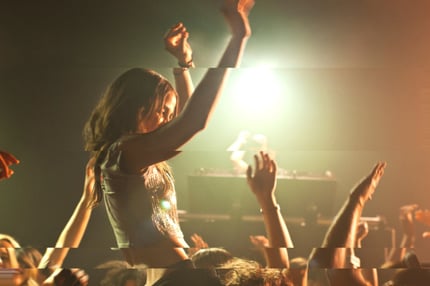
One of the spaces in which cases of https://www.mamamia.com.au/sexual-harassment-workplace/#:~:text=If%20this%20has%20raised%20any,and%20family%20violence%20counselling%20service. sexual harassment and/or assault are rife is music venues – we're talking nightclubs, festivals, bars and everywhere in between.
Personally, I've lost track of the amount of times I have been groped and harassed within settings like these – encounters with men who feel they have the right to do what they like with someone else's body, or that touching someone inappropriately without consent is a way to get attention.
Every woman I know has a story that rings eerily reminiscent.
Watch: Stand up to harassment. Post continues below.
Isabelle vividly remembers the moment she was a bar and a man approached one of her friends, grabbing her without consent.
"She was waiting to order a drink, the bar line-up was packed, and it was dimly lit. A clearly very intoxicated man with his group of friends tried to put his hand up her shorts. We told the bar staff and the man was removed from the venue. But it still makes my blood boil that it happened in the first place."
Emily was groped at her first-ever concert when she was just 13. The man was at least in his mid-30s.
"It was my first concert without parents – just me and two of my cousins – so we were really excited and tried to get to the front of the mosh, not realising how f**ked it was. A guy behind me groped me every five minutes and it was so tightly packed I couldn't move away," she tells me.
It's stories like these that prompted Dr Andrea Jean Baker to become a lead researcher for a new report from Monash University. The Victorian Department of Families, Fairness and Housing, and the City of Melbourne also funded this research.
The report explores how sexual violence is being normalised in Melbourne's clubs and venues.
And as a renowned music city – Greater Melbourne hosts the most music gigs of all Australian states and territories – it was an issue Dr Andrea wanted to unpack further.
"Sexual violence is rife in our music city. It disempowers music workers, [and] deters others from working in it and audiences to participate in our vibrant music scenes," Dr Andrea tellsMamamia.
Listen to Mamamia's news podcast The Quicky. Post continues after audio.
For around 10 years, Dr Andrea has been working in the Melbourne music space, as well as being the first academic to work on the City of Melbourne's committee to look at Melbourne as a music city.
Recently, we saw the music industry report, Raising Our Voices, which focused on the experiences of people in the music industry specifically.
In contrast, the Examining Sexual Violence in the Music City of Greater Melbourne report aligns the industry and audience together – an intersection that Dr Andrea feels was important to explore.
"This report is the first time a world music city has measured the problem and looked for fresh solutions in a post-pandemic world. And it's key to look at audiences' experiences, because being a punter myself, I have heard so many stories," she says.
As per the report, 80 per cent of respondents surveyed never reported the incidences of sexual violence they experienced. Of those who have spoken about their experience, Dr Andrea found that those willing to speak out came from a position of privilege, rather than marginalisation.
"It's mostly cisgender white women aged between 25 and 44 years who share their stories. It's also really disappointing to know that only 10 per cent of victim-survivors sought medical help or counselling after the incident. The subtext is they feel nothing will be done," says Dr Andrea.
"Another group who often don't feel comfortable speaking are those who work within the industry, fearing their jobs will then be on the line. This was particularly the case among older women in the music industry, with one participant saying she felt 'harassed' and 'ridiculed on a regular basis' by the men around her."
Of course, incidences of sexual harassment aren't specific to Melbourne. They occur everywhere.
As another woman, Sumi, tellsMamamia: "I was once at a gig when I was 15 at Brixton Academy [a concert venue] in London and someone behind me kept on reaching between my legs and grabbing my vulva. Like, they reached right under.
"I kept turning around and yelling furiously at everyone behind me and they kept doing it. I still remember that really vividly."
Dr Andrea hopes we can continue sharing victim-survivors' stories, and look to them for their perspective on what solutions are needed.
The report makes five recommendations, including more effective bystander training for security staff; improved policies to address sexual violence; gender and cultural diversity in music leadership; and more phone counselling.
"We're also calling for music festivals, record labels and radio stations to be excluded from government grants and funds if they do not meet gender diversity, inclusion and equity criteria," Dr Andrea notes.
"Policymakers need to hear people's experiences – because that is what should inform their policy and move us forward in the right direction."
If this has raised any issues for you, or if you just feel like you need to speak to someone, please call 1800 RESPECT (1800 737 732) – the national sexual assault, domestic and family violence counselling service.
Feature Image: Getty.

Sign up to Mamamia Daily
Sent daily
Isabella Ross
Senior News Writer
No Comments
Be the first to leave a comment