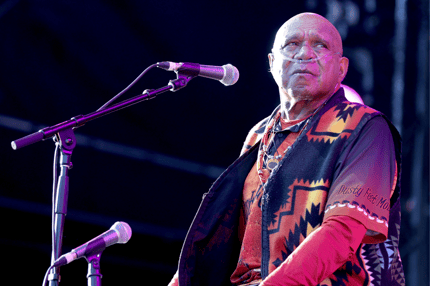
Content Warning: Aboriginal and Torres Strait Islander readers are advised that the following article contains images, names and voices of people who have died.
Archie Roach's family has given permission for his name, image and music to be used.
When Archie Roach AM was a young boy, he was taken away from his family.
Born in Mooroopna, a town in regional Victoria, in 1955, Archie's family lived on the Framlingham Aboriginal Mission near Warrnambool. His father, also named Archie, was a Bundjalung man from New South Wales, and his mum Nellie, was a Gunditjmara woman.
At the tender age of three, Archie became a part of the Stolen Generation.
Listen to No Filter. Story continues after audio.
After passing through an orphanage and several foster homes, he was settled with the Cox family at age seven - a white couple, Alex and Dulcie Cox, who had moved to Melbourne from Scotland. Archie acknowledged in his autobiographyTell Me Whythat his foster parents looked after him well. But the trauma of being forcibly separated from his biological family - his Indigenous roots - affected him for the rest of his life.
Alex and Dulcie had been told by the government agency that Archie's biological parents had been killed in a house fire. It was only the start of a snowball of deception from those in positions of power.
Growing up in the Cox family, Roach was surrounded by music - particularly music from Black artists.
His foster father's record collection included albums by the Ink Spots, Nat King Cole and Mahalia Jackson, and Archie's foster sister Mary taught him the basics of keyboard and guitar. It sparked a love for music that would run through the rest of Archie's life. Archie still referred to them as 'Mum Dulcie' and 'Dad Cox' in his later life.
"A mate of mine who I grew up with in primary school asked me 'Archie, how come your parents are white?' And I didn't understand what he meant. I figured I was a bit darker than the Italian and Greek kids. I never saw myself as different until it was pointed out to me," Archie said on Anh's Brush With Fame.
When Archie was 15, he received a letter that stopped him in his tracks. It was from one of his biological sisters, Myrtle.
In the letter she told Archie that his biological mother, Nellie, has passed away, confirming to him that he was one of seven siblings - something he hadn't known.
Soon after that letter, he embarked on a journey to track down his family and uncover where he was from, taking his guitar with him. But it took a long time. And along the way, he faced hardship.
Over this next chapter, he experienced homelessness, alcoholism and a prison stint after being charged with vagrancy. He was still only 15.
"If it wasn't for this old Blackfella named Albert, I wouldn't have known what to do. He took me under his wing and showed me the ropes - where to get a feed, how to find a bed," Archie said. "The guitar made me feel safe."
It was a chance meeting with a sibling that reconnected Archie to his family.
"Poor old dad - after the kids were taken from him and mum, he struggled mentally and physically. He was picked up one night, put in jail, got a bit crook and asked the police to take him to hospital. They said 'Shut up you Black [slur], go to sleep'. Next morning he passed away. Never got to know the old man, or mum."
Archie said that it was through stories from his siblings that he feels as though he knows who his parents were, even if he was taken from them at such a young age.
At 17 in a Salvation Army centre in Adelaide, he met another homeless Indigenous Australian teenager with a similar history to his own - she too was a member of the Stolen Generation. Her name was Ruby Hunter, and she became the love of his life.
Ruby was also a musician, and they became a deadly duo.
Archie stopped drinking at Ruby's request, they married, had children and created music together. Years later, their house would remain open to disadvantaged young people in need of the support they themselves had found in each other.
By 1989, Archie had caught the attention of Australian musician Paul Kelly and his Messengers' bandmate, Steve Connolly.
After being encouraged by an uncle to write about his trauma, Archie wrote and sang 'Took the Children Away'. It was a hit that became an anthem associated with victims of the Stolen Generation - the lyrics touching on the pain and loss Indigenous people had endured at the hands of the Australian Government and their white assimilation policies.
Paul Kelly asked Archie to open for him at his performance at the Melbourne Concert Hall, and from there Archie's music career progressed. Archie and Paul then worked on an album together,Charcoal Lane.
Watch Archie Roach perform 'Took The Children Away'. Story continues below.
Reflecting on that first big performance, Archie said to The Guardian that the response he received from the crowd never left him.
"Then the clapping started. It sounded like rain that starts with a pitter-patter and builds up and becomes a downpour. It was the most amazing experience I had ever had."
Later in 2008, Archie would perform the song 'Took the Children Away' with Ruby joining him on backing vocals, when then-prime minister, Kevin Rudd, gave a public apology to the Stolen Generations.
Archie went on to win Aria awards, create multiple albums, was inducted into the ARIA Hall of Fame in 2020 and toured Australia and overseas with artists including Bob Dylan, Billy Bragg and Leonard Cohen.
As for Ruby, she achieved mass success too - writing a powerful song 'Down City Streets' for one of Archie's albums

Sign up to Mamamia Daily
Sent daily
Isabella Ross
Senior News Writer
No Comments
Be the first to leave a comment