

I have gone my entire life never being able to use a tampon. I have gone my entire life thinking penetrative sex is excruciatingly painful, and women just pretend to enjoy it. I have gone my entire life being scared of my own body. And according to my physiotherapist, it started the day I began my period.
Suffering from polycystic ovarian syndrome (PCOS), I was told that due to the lack of estrogen at the entrance of my vagina, my vulva was red and dry when it should be pink, moist and elastic. What annoyed me the most was, if I had been prescribed estrogen cream from the time I was 11, I probably wouldn’t have vaginismus at all. Since using the cream, I can see my skin getting better, but the association of penetration equating to pain still occupies my mind every single day.

I self diagnosed a few months ago when I searched ‘why does sex hurt’ on the internet. I went to my GP who specialises in women’s health and told her, ‘I think I have vaginismus’. Initially, she was shocked. She said that I was her first patient to correctly diagnose myself and who knew that vaginismus existed. She told me she had seven patients currently being treated for vaginismus but she believes that number would be much higher if there was more education about the condition.
Since being diagnosed, I’ve been going to physiotherapy to work on pain reduction and muscle flexibility. I have to do exercises with dilators every day and every day I cry. Not necessarily from pain but from the fact that I can’t believe this is my life. The one thing my vagina is supposed to do, it can’t. Whenever my friends talk about ‘mind-blowing sex’ or even just having a one-night stand, I feel immense rage and jealousy. Something that comes so easily and naturally to them, is something that I have to mentally prepare myself months in advance for and even then, it’s not guaranteed.
Being single has helped me a lot with my treatment. I was dating someone when I was initially diagnosed and although he didn’t put any pressure on the situation at all, I put a lot of pressure on myself. I believe that knowing I am doing this treatment for myself and not for anyone else has made the experience of being treated 100 per cent better.
***
The curable condition no one has heard of.
There’s not enough research yet to truly tell us how common vaginismus - or genito-pelvic pain, which is the name we're moving towards - really is.
If you ask the three expertsMamamiaspoke to, it’s absolutely everywhere. But unfortunately, it’s still not being talked about nearly enough, and there are still plenty of GPs sending women away with instructions to ‘just relax’ or ‘have a red wine and a valium’ when they complain about painful sex.
Just look at theMamamianewsroom. Out of a team of 22, seven of us have suffered with or are still living with vaginismus. We’ve lived with it for years, many of us just thinking there was something ‘wrong’ with us or that we didn’t enjoy sex.
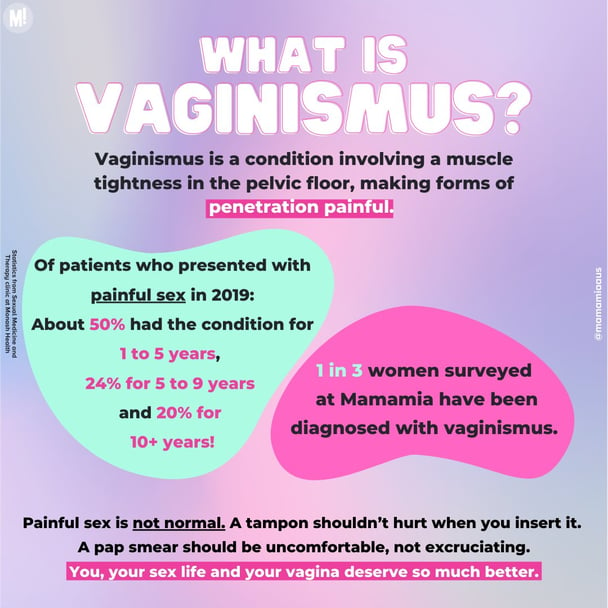
Once we had a name for it, everything changed. Because vaginismus is a condition involving a muscle spasm in the pelvic floor and it’s completely curable.
As Dr Irmina Nahon, a pelvic floor physiotherapist and senior lecturer at Canberra University toldMamamia, “In about 40 per cent of women we never find a cause or origin of the pain. Causes can be physical, emotional or psychological and it’s definitely common in women who have experienced unwanted, violent or painful penetration or sexual experiences.”
To get technical for a moment, your pelvis is hollow. So we need pelvic floor muscles to hold and support all of the organs inside. The pelvic floor is made up of three separate paired muscles, which together literally create the floor of the pelvis. In females there are three ‘tubes’ that pass through the pelvic floor: the urethra, the vagina and the rectum.
As Dr Anita Elias, from the Sexual Medicine and Therapy clinic at Monash Health explains the pelvic floor contracts (or tenses) when we jump, sneeze, laugh, and cough, and it is important for it to be strong enough to keep us continent. However, we also need the muscles to be able to relax sufficiently in order for anything to ‘go in’ comfortably when we want it to.
“Those with vaginismus still need their pelvic floor to be strong enough, but also need to learn how to consciously be able to relax and release the tension and tightness in it, in order to have comfortable, pain-free penetration,” she toldMamamia.
Penetration can be sexual, but it also refers to the insertion of tampons or medical procedures like internal ultrasounds and pap smears.
While vaginismus can be fixed, a physical-only approach to curing the condition rarely works. As Dr Nahon will tell you, it’s as much about the brain as it is about what is happening inside your body.

On the day of the appointment I was on my period, so my mum called ahead to check that I wouldn’t be internally examined. I hadn’t shown anyone my vagina before, and the thought of having to do it while bleeding was mortifying for a 13-year-old.
They assured my mum they wouldn't. But once there, the urologist matter-of-factly told me it 'wasn’t a big deal,' as she ushered me into her stirrups. It wouldn’t be until I was 28 that I'd comprehend how much the fear of wetting my pants as a young girl, and that consequent appointment, traumatised me.

When I tried to use a tampon for the first time not long after that medical visit, I remember almost having a panic attack in the bathroom. I physically couldn’t get it in, and I felt so giddy from trying I had to stop and sit on the floor. For the next 15 years I struggled with tampons, and only wore them if I was swimming. Every time, I had to take a mental run-up.
Fast-forward to my mid-20s and after some unrelated symptoms I spent two years in and out of specialist appointments having invasive internal tests. I would ready my mind and breathe through the stinging sharp pain I felt during every examination, hating every minute.
In the years after that, penetrative sex also started to hurt, and that’s how I found myself in a pelvic floor physiotherapist's office in 2020. She told me my pelvic floor looked like a 'W' when it should like a 'U'. I had developed vaginismus from overusing my pelvic floor as a tween and from the trauma I associated with medical examinations. Thanks to an increase in those in recent years, it had started to impact my sex life, too.
I cried in her office that day. Everything she said made so much sense, and for the next few months, every second night, I did the exercises she prescribed me. She taught me that my pelvic floor needed to be stretched, just like a calf muscle needs to be stretched after a run. That visual made it so much less daunting. Slowly with her guidance I felt the ‘W’ get flatter, until eventually the pain eased. I was advised to see a psychologist alongside my physical treatment to make sure I cured my condition. I opted not too purely because of how much dual appointments would cost me.

Ever since I was a teenager I remember having a complicated relationship with my vagina. I couldn’t insert a tampon, and when I told people I found it exceptionally painful and most of the time completely impossible, they looked at me like I was crazy.
It wasn’t until my early 20s that sex became really uncomfortable. It sounds really weird, but basically it felt like I had these muscular… rings… inside my vagina that were super tight, and they couldn’t relax. It’s unlike any other pain I’ve experienced. I dismissed it for many years and just tried to ignore it. Sex was possible, but just not pleasant.
Looking back, this seems to have emerged a few months after I was sexually assaulted on the street when walking home one day. Ultimately, I managed to get away, but it was like my body remembered even more than my mind did.

I was diagnosed with vaginismus after getting a particularly painful pap smear probably at around 26. It felt like a bee sting and the process of even inserting anything in there was excruciatin

Sign up to Mamamia Daily
Sent daily
Gemma Bath
True Crime Conversations host
No Comments
Be the first to leave a comment