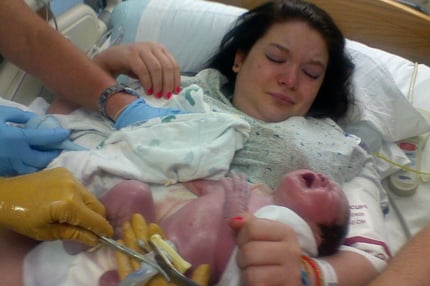
‘Shut up, close your mouth and push: there is only one voice in this room, and it is mine
On the movie, which has since been viewed over half a million times, Kimberly can be heard begging, ‘No! Why? Why can’t we try?’, as the doctor’s voice becomes more aggressive, telling her, ‘Listen: I am the expert here’, and mocking her suggestion that she can do it herself, telling her, ‘You can go home and do it. You go to Kentucky.’ Just to clarify, Kimberly was not from Kentucky – he meant it as a slur and an implication of ‘backwardness’.
The doctor then proceeds to perform the episiotomy with twelve, audible cuts to her perineum.
It’s harrowing viewing. Perhaps more harrowing is the thought that Kimberly is very much not alone: a survey in 2013 by Childbirth Connection
Watch: For many women, birth is a positive experience. Post continues after video.
‘Many of the lawyers we’ve spoken to are not sure whether a woman giving birth has the right to say “No” to a medical procedure’, her colleague Cristen Pascucci told me during their search for legal representation. ‘And they don’t see the dollar value in litigating this kind of a case, when they know that, just like them, any jury probably believes that the best outcome of childbirth is a live baby – irrespective of whether the mother has been maimed by her care providers in the process.’
Eventually the case was settled out of court in 2017, amidst wide praise for Kimberly for highlighting the issue of consent and abuse in the birth room. Her attorney, the prominent civil rights lawyer Mark Merrin, called the law-suit, ‘a big step for women who have been silenced’. It’s easy to see this story as an isolated case, or to conceptualise it as an American problem, but unfortunately, it’s just one example of a widespread, global issue, referred to as ‘obstetric violence’.
It’s worth saying at this point that the term ‘obstetric violence’, perhaps understandably, tends to push buttons and cause misunderstanding, first and foremost because people mistakenly think that ‘obstetric’ implies it is only perpetrated by obstetricians. In fact, ‘obstetric’ simply means ‘relating to childbirth and the processes associated with it’, and the term therefore covers any violation a woman experiences in the birth setting. This second word in the term – ‘violence’ – also causes confusion. While people are generally able to accept that pushing or hitting or maliciously hurting a person is ‘violence’, when a professional is ‘just doing their job’ and ‘helping the baby to be born safely’, for example by insisting they stay on the bed when they really want to move, it is harder to understand this as a violent act. Nor do we always understand acts of coercion, emotional or psychological abuse, lack of proper consent, misuse of power, or abusive or unkind language as acts of ‘violence’. Indeed, as we have seen in the case of Kimberly Turbin, even when the act is quite clearly aggressive and violent towards the woman, there is a kind of cultural blind spot that allows us, for the most part, to accept it as ‘just what birth is like’.
Kimberly’s case is an extreme example of obstetric violence; there are also many other more subtle ways in which a woman can feel violated during her birth experience, and they are all equally valid. It might be helpful for everyone if obstetric violence were instead called ‘obstetric abuse’ or even ‘birth abuse’, in order for everyone to understand fully just what and who is encompassed by this broad term. However, too much debate around the semantics can evolve into a distraction from the solid fact: this is happening to women, and we need to hear their voices. Perhaps, as Mila Oshin, the director of the Digital Institute for Early Parenthood (DIEP) put it at a Birth Trauma conference I attended in 2018, we need to accept that those who have not experienced obstetric violence are last on the list to decide how it should be named. ‘The term obstetric violence is one that does not necessarily reflect the intentions of others, but I feel entitled to use it in reference to my experience’, she said.
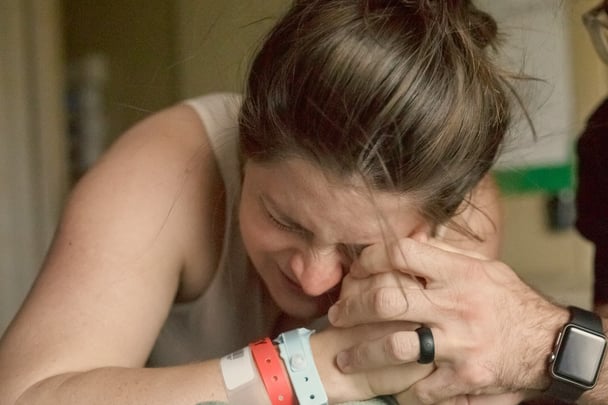
"Both action and inaction can be violent, and violating." Image via Getty.
Thanks to Latin American birth activists, Venezuela
‘The appropriation of a woman’s body and reproductive processes by health personnel, in the form of dehumanizing treatment, abusive medicalization and pathologisation of natural processes, involving a woman’s loss of autonomy and of the capacity to freely make her own decisions about her body and sexuality, which has negative consequences for a woman’s quality of life.’
The following list, from Venezuelan law, of what constitutes obstetric violence, is also helpful. They state that it encompasses:
Both action and inaction can be violent, and violating. Neglecting a woman in labour who is asking for pain relief or stating that something is wrong, denying access to a caesarean, or intervening too late,
Women who say they have experienced obstetric violence normally describe situations where they feel their personhood has been disregarded, their voice has not been heard, they have not been properly informed of what is happening to them, they have not given their consent to a procedure, or they feel that their body boundaries have been transgressed without permission. They often use the language of rape and violation, reflecting the sexual and intimate nature of the birth process. In many cases they feel they have been treated with straightforward cruelty or disrespect, but at times they also express an understanding that the professionals in charge of their care were ‘doing what they had to do’, but that they could have done this in a way that made them feel more involved, informed, and respected: ‘This would not have taken much time but it would have made all the difference to me’. Often, the health professionals’ superior knowledge is used as a justification for proceeding against the woman’s wishes: as one doctor told his patient, ‘I have delivered hundreds of babies, you have not delivered any’.
Interestingly, and also in common with other forms of violence against women, it is often the woman who is left carrying the blame and shame in the aftermath. Just as the woman who has been attacked may feel that the clothes she wore, or the route she took home at the end of the night may have contributed to her violation, women traumatised by birth will spend the days, weeks or even years afterwards going over the events in fine detail and asking, ‘What could I have done differently?’. And, just as men are rarely asked to reflect on what they could do to reduce violence against women there is similarly considerably less postnatal analysis – and often none at all – done by the individuals, institutions and systems that inflict birth trauma. Women are left with the shameful reflection that they ‘should not have got their hopes up’, ‘should not have made a birth plan’, or ‘should have just gone with the flow’ and these messages are consistently reinforced in popular culture. Those who try to take control of their births, and ante-natal courses and teachers who encourage them to believe they can do so, are consistently derided and mocked. ‘Yes’, the woman thinks to herself, ‘I was totally unrealistic to think I could have a positive experience of birth, and that is why I now feel so awful. It is my fault I feel this way.’
This is victim-blaming, pure and simple.
This is an edited extract from Give Birth Like A Feminist: Your Body, Your Baby, Your Choices. You can buy it, here.
Milli Hill
Author
No Comments
Be the first to leave a comment