"Can everyone please stay in your seats," said the captain over the speaker. Everyone on the plane was peering to the left, trying as hard as possible to look out the tiny cabin window, desperate to catch a glimpse.
Below stood an orangey-red sandstone formation. One of the most recognisable natural icons in the world and the spiritual heart of our nation.
"Mum," said my wide-eyed five-year-old as he too rose from his seat. "It's Uluṟu."
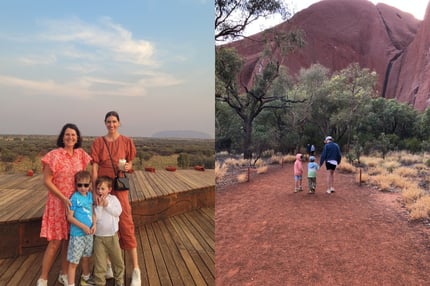
Rewind to a month before when I was invited for work to visit the Red Centre and instead of taking a solo trip, I brought two of my sons (six and five years old) and my mum along. And while yes, a trip without them would have meant more time in the resort spa and more wines by the pool, sometimes a destination becomes even more special when seen through a child's eyes. Especially a destination that is as iconic as Uluṟu.
Watch: Horoscopes At The Airport. Post continues below.
But for an iconic place to become an equally iconic trip, it's crucial to be as organised as possible. Going to Uluṟu isn't really a 'let's follow the wind' type of holiday.
To nail this bucket-list adventure, especially with kids, planning is key. So here is everything you need to know from where to stay, what to eat, what to do and what to pack.
Where to stay: Ayers Rock Resort.
Ayers Rock Resort is in Yulara and just a 20-kilometre drive from Uluṟu-Kata Tjuṯa National Park. It's the hub for all tourists wanting to visit this incredible part of the world. It has various accommodation types (Sails in the Desert, Desert Gardens Hotel, Emu Walk Apartments, The Lost Camel Hotel, Outback Hotel and Ayers Rock campground) to suit different budgets and needs - all in the shadow of the rock.
There are swimming pools, tennis courts, restaurants, a spa and a town centre with an IGA, post office, tourist shops and some cafes. There is also an art gallery and a small movie theatre.
We stayed at Sails in the Desert, one of the more luxury hotel options. We had a superior room with two queen beds (these types of rooms start at $475 a night) and it easily could fit a family of four.
As I went with my mum, we ended up getting a second room, purely so she could have her own space, AKA an escape route from two hyperactive grandchildren, but in hindsight we didn't really need it.
Our room was on the ground floor room opening up to the pool and grassy lawns, all shaded by gum trees. This was an ideal playground for young and old between activities. The room included buffet breakfast each day, and the hash browns proved to be a highlight amongst our younger travel companions.
Now you have your bed and breakfast sorted. Here's what to do:
Best activities for kids at Uluṟu.
Wintjiri Wiru Sunset Dinner.
This was the absolute highlight of the trip. Wintjiri Wiru, which roughly translates to 'beautiful view out to the horizon' in the local Aṉangu language, is a drone and light show that tells the ancient Mala story which forms a part of the Aṉangu Tjukurpa (Creation Stories).
We were picked up from our hotel about an hour before sunset and taken to a private viewing platform on a sand dune. Once we walked up to the platform we were greeted with cocktails and arresting views of both Uluṟu and Kata Tjuṯa. Native ingredients were used in the canapés so we enjoyed crocodile pie and cured cucumbers topped with ants (the boys were served juice and kid-friendly snacks).
We watched the sunset, which was one of the most memorable things I've ever done, before being handed a grazing hamper for dinner filled with local delights. The children's option was well received as it featured sandwiches, cheese and crackers, and Tiny Teddy's.
The show itself is almost hard to put into words as it's like nothing you've ever seen before. It's powerful, it's awe-inspiring, and it really makes you think about the beauty of the Aṉangu culture. Lights fill the sky, animals are projected onto the landscape and words in Pitjantjatjara and Yankunytjatjara languages boom through the air. You walk away almost in a reverent silence.
When we returned to the hotel, Mum and I just looked at each other and both said, "We feel so lucky to have witnessed that". The boys watched every second attentively.
There were some points where they said they were scared, but afterwards they were both able to recount the story and understood the cultural significance. The next morning it was all they could talk about.
Price:$385/ adult and $125/ child.
Note:Kids under five can't attend.
Desert awakening.
This is the next must-do for your list. It requires a 4am wake up time but is 1000 per cent worth it, even if you strongly believe it's an hour only reserved for birds. A local guide took us from our hotel to a lookout where under the star-studded skies we had a breakie of bacon and egg rolls, tea, coffee, and homemade damper as we waited for the sun to rise over Kata Tjuṯa and Uluṟu.
Once the sun was up and we'd watched the sky dramatically turn from purple to orange to pink we were taken into the National Park where we got up close with the rock itself.
There we did two walks: the Mala Walk, and the Kuniya Walk to the Mutitjulu Waterhole. They are two kilometres and one kilometre respectively, making them very doable with two kids whose legs often don't want to move.
In both walks, you see the Tjukuritja (physical evidence) of the Mala Tjukurpa and the Kuniya Tjukurpa (part of the creation stories), which held the boys fascinating so much they didn't even have time to whine about flies or walking (which is no mean feat). They loved pointing out the marks on the rock and the formation of caves that fit the creation stories.
We finished the tour at the culture centre where you can learn more about the cultural significance of this place and the First Nation's people who have called it home for many millennia.
Price:$210/ adult and $160/ child.
Note:Kids under four can't attend.
Camel Farm.
Early the first morning, we walked to the Camel Farm from the resort. It took around 40 minutes, but it was a good way for the boys to burn energy running through the red sandy desert. Those who'd prefer to stay in air conditioning can take the shuttle bus there and back. At the farm you'll find some very tame camels, some goats, chickens and a small museum that charts the history of camels in Uluṟu.
The highlight was a camel named Ghan who enjoyed a head massage. When you massaged his head, he'd fall to the ground in a deep slumber.
There are a few different tours you can take through the national park on camelback, and there are also short rides available for kids at the farm. Unfortunately, the day we went the short rides weren't running but just seeing the camels was more than thrilling.
Price:Free to enter the farm.
https://www.ayersrockresort.com.au/experiences/field-of-lightxTA8_p7A0Pkjoq1DP6YaAvmnEALw_wcB
Fields of Light.
This light installation by Bruce Munro, is the stuff of postcards and Instagram feeds, and it's even more spectacular in person. We went to an 8pm session where in the pitch black you walk through this maze of colour and lights. With a general admission ticket you get transfers there and back, and you have about an hour to explore the installation. It's a memorable pre-bed stroll, under the outback's famed night sky, with the occasional dingo howling faintly in the distance.
Price:$46 / adult, $33 / child (for general admission).
Note:There are also options to attend the Sounds of Silence dinner at Field of Lights, however kids need to be over nine.
Other activities to add to your list for kids:
Best places to eat in Uluṟu with kids.
Ilkari at Sails in the Desert :This is buffet style for dinner so perfect for even the fussiest eaters. The chocolate fountain is the stuff of kids' dreams.
Geckos in the Town Square :The menu offers a mix of family favourites from pizza and pasta, to salads and burgers. They were even able to cater for a picky six-year-old who only eats a minced patty with bread - no salad, no butter, no sauce.
Walpa Lobby Bar at Sails in the Desert :This became our go-to for lunches and pre-dinner drinks. Great wines and yummy salads.
Kulatain Town Square :This cafe is special as it's staffed by trainees of our National Indigenous Training Academy to help kick-start their hospitality career. Go for a coffee and stay for the banana bread.
We also found the IGA to be really useful to pick up snacks and food for lunches. The bar at the pool also served hot chips which kept the kids going until dinner.
Is Uluṟu child friendly?
In short, very. My sons were five and six, and they loved it. They walked without getting tired; they got up early and stayed up late and dealt with the heat. But I personally wouldn't go with children any younger as it limits some activities you can do as lots of tours have age limits. Th
Eliza Sorman Nilsson
Head of Content
No Comments
Be the first to leave a comment