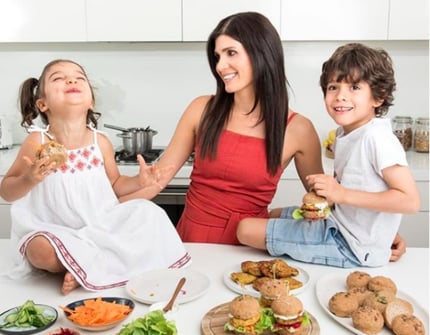
We all know the importance of prenatal nutrition to ensure your growing baby gets all the vitamins and minerals it needs for healthy development, but did you realise that what you eat during pregnancy not only nourishes your baby but can also influence their tastes and food preferences for years to come?
Pregnancy websites and books all tell us how essential it is to get enough omega 3s, protein, iron and folate when you’re expecting. But scientists have also discovered that during this time it’s possible to start shaping your child’s healthy eating habits – and in turn lower their risk of obesity and diabetes – by introducing them to certain flavours in utero.
As a paediatric nutritionist, I have parents begging me to help them with their fussy eaters – and I find it really exciting that it’s possible to get a head start on a lifetime of healthy eating before your baby is even born. In my workshops, I always explain that there are three key stages of influence when it comes to encouraging a balanced and varied diet:
1) What mum eats during the third trimester 2) What mum eats while breastfeeding 3) What the whole family eats when introducing solids

Mandy's sweet potato crackers. Check out the recipe below. Image: Supplied.
If you want your child to have a really healthy start in life, it comes from you – and there’s no better time to make changes to your diet than during pregnancy. While sensitivity to some tastes is genetic, most of our food preferences are learned – and there is a growing body of research that shows this learning begins before birth.
Share the love.
During pregnancy your baby really does taste what you taste, with the flavours of your food making their way into the amniotic fluid, which is then repeatedly swallowed by the foetus. And studies have shown that babies seem to recognise and prefer these tastes once they are out in the world.
In one experiment, mothers who drank carrot juice every day during their last trimester of pregnancy had babies who seemed to prefer the taste of carrot juice to those whose mothers just drank water.
And another study conducted on pregnant rats showed that the offspring of mothers given a diet of processed food that was high in fat, salt and sugar were more likely to prefer junk food – and dislike healthy food – once they had been born.
Tastebud training.
So what flavours should you expose your baby to during pregnancy? Above all you want to make sure you’re eating a balanced diet, choosing fresh fruit and vegetables over salty, processed snacks. This not only helps keep you healthy during pregnancy, but it also sets the stage for your baby to love healthy, diverse tastes.
Choose foods high in omega 3s (check out recipes like my mango chia pudding, sweet potato crackers, rainbow salad and bean salad here) and don’t shy away from flavoursome foods that you enjoy and want your baby to learn to like too. Distinct flavours like garlic, mint and curry are among those that are transmitted most strongly through your amniotic fluid.
The best way to avoid foods which are full of additives and preservatives is having healthy snacks on hand. Try my delicious tzatziki dip with dill and mint combined with delicious cauliflower, chia and cheese falafels, which are packed with protein and loaded with vegetables. Or for an easy snack on the go you can’t beat beetroot and spinach bliss balls – as well as having a strong flavour you might want to introduce your baby to, beetroot is rich in vitamin C, fibre and folate making it a pregnancy superfood.
Beetroot and spinach bliss balls. Image: Supplied.
Baby steps.
If you’re reading this thinking that your child is way past the weaning stage or that you missed your window of opportunity in pregnancy then please don’t worry – all is not lost and it’s never too late to retrain your kids’ (or your) tastebuds and encourage healthy eating habits.
The key is to take small steps towards change so as to not overwhelm tiny taste buds with new flavours all at once. My book, Wholesome Child, offers an easy-to-follow eight-step family nutrition program with simple swaps that allow you to slowly but surely increase the variety in your child’s diet. Once you start to make small changes, the door opens to a wide range of nutritious food and you can start to greatly improve the health of your whole family.
Rainbow salad. Image: Supplied.
Good taste can be taught.
The message is clear – if you want your child to eat a diverse range of foods, start early. Will eating kale every day during pregnancy ensure that your growing toddler loves his leafy greens? There’s no definitive proof that it will, but if it’s healthy and good for both of you then there’s no harm in trying.
Introduce as many different flavours as you can during pregnancy and continue to expose your child to a wide range of foods while you’re breastfeeding, starting them on solids and beyond – it’s never too late to promote healthy eating and your child will thank you for it one day, I promise.
Visit the Wholesome Child website to learn more about Mandy Sacher. Her book “Wholesome Child: A Complete Nutrition Guide and Cookbook” is available to purchase online and through iTunes. Connect with Mandy on Instagram and Facebook. Or, for more information contact Mandy Sacher.
Author
No Comments
Be the first to leave a comment