This week, thousands of schools, organisations and businesses are celebrating Harmony Day or Harmony Week.
It's often marked with people being told to wear orange, celebrate diversity and 'bring a plate' of food that reflects their cultural heritage. It's marketed as a bright and positive occasion designed for everyone to come together to share in the joys of multiculturalism.
Sounds nice, right?
Well up until recently, many of us didn't think twice about celebrating Harmony Day. But as the dark history behind the event emerges, more people are thinking twice about whether this 'day of diversity' really is as inclusive as we've been made to think it is.
But first watch: Tony Armstrong on racism in Australia. Post continues below.
What exactly is Harmony Day?
On the Australian Government's Harmony website, it states: "Harmony Week is the celebration that recognises our diversity and brings together Australians from all different backgrounds. It's about inclusiveness, respect and a sense of belonging for everyone."
It's been going on for years, many of us likely having experienced celebrating the day in our schools or workplaces. On the government's website, there are plenty of really great success stories celebrating migrants and refugees. Those stories are always brilliant and important to highlight.
But not so visible on the website is why Harmony Day exists in the first place – and the origins behind it.
Listen to Mamamia's The Quicky on this subject. Post continues after audio.
Wait hold up – what's this 'dark history' behind Harmony Day?
Interestingly, Australia isn't the only country that celebrates Harmony Day. Instead, Harmony Day — aka March 21 — is marked internationally as the International Day for the Elimination of Racial Discrimination.
For most countries, it's a day to reflect on the impact of racial discrimination, and the need to eradicate it.
On March 21, 1960, a large group of mostly Black people gathered in Sharpeville in South Africa to protest against apartheid laws. These laws were all about segregation and discrimination, directly targeting Black people.
While the protest against injustice took place, it ended in police officers opening fire on civilians — including children — killing 69 and injuring 180 more.
Six years after the massacre, the United Nations officially declared that March 21 would be the official International Day for the Elimination of Racial Discrimination (IDERD). It was to honour the victims of the Sharpeville Massacre and to shine a light on the need to end racial prejudice and discrimination.
21 March 1960. Police shot dead 69 unarmed black South African demonstrators in the Sharpeville Massacre. In present-day South Africa, 21st of March is celebrated as a public holiday in honour of human rights and to commemorate the Sharpeville massacre. pic.twitter.com/jR8EFR9AYu
— Prof. Frank McDonough (@FXMC1957)
So why did Australia decide to swap IDERD for Harmony Day?
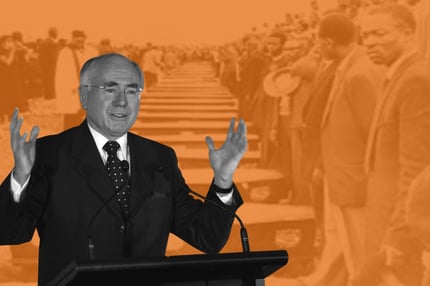
In 1991, the Australian Government led by John Howard commissioned a study on racism in Australia.
Off the back of that study's findings, Prime Minister Howard decided to swap IDERD for Harmony Day in Australia – which many argue was a way to further hide from Australia's colonial roots.
A day highlighting what racial discrimination can lead to was essentially replaced with a focus on the positives, rather than the overwhelming work that still needed to be done.
And in the late '90s Australia celebrated its first Harmony Day, portraying a unified multicultural society — a country that didn't need to actively combat racism.
Christina Ho is an Associate Professor in Social and Political Sciences at the University of Technology Sydney. She researches migrant and multiculturalism in Australia, and told Mamamia's The Quicky that it's very telling why the Howard government decided to rebrand IDERD.
"The Howard government was very socially conservative. In relation to questions around cultural diversity, they were really resistant to talk about things like discrimination or racism," she said.
"John Howard famously refused to say sorry to the Indigenous people, despite a lot of pressure on him at the time. He even removed the word 'multiculturalism' from the federal department which used to be called the 'Department of Immigration and Multicultural Affairs'."
Howard thought the word 'harmony' would therefore be more politically unifying, according to Professor Ho.
'Harmony' at its core is an objectively positive word. It refers to people coming together, celebrating tolerance and togetherness. That's what Harmony Day is all about showcasing — the great aspects of multiculturalism, like the food, the festivals and the cultural outfits and customs.
But when it comes to talking about the realities many people of colour face in Australia, advocates say Harmony Day pushes those valid and serious subjects to the background, rather than addressing them head-on.
f**k racism Today is the International Day for the Elimination of Racial Discrimination. In Australia, it was re-branded to Harmony Day by the Howard Government, but the words and origins of why it’s the day for the elimination of racial discrimination matters.
— Tarang / तरंग (@tarang_chawla)
Calling #IDERD ‘Harmony Day/Week’ causes harm to our collective anti-racism journey, because it undermines efforts to identify and address the harm experienced by negatively racialised communities. #ItStopsWithMe #IDERD #HarmonyDay
— Australian Human Rights Commission (@AusHumanRights)
"If you're a first-generation migrant, I think there is some validation in having other people acknowledge your cultural traditions. There is one argument to be made that the more we understand each other, the more tolerant we'll be. But that's a superficial way of understanding others — only through the happy moments," Professor Ho said toThe Quicky.
"We do need to get beyond the surface of just eating each other's food."
Now many advocates are calling for Harmony Day in Australia to go back to its IDERD beginnings, saying the current day is "white-washing and tokenistic".
As Professor Ho said: "No one wants to confront genocide, dispossession. But this is the foundation story of Australia as a nation. Australia has a self-image as a relaxed, egalitarian, fair-go society. So racism and discrimination are hard things for Australians to confront."
So perhaps rather than a superficial celebration of diversity, now is the time for Australia to reflect on what IDERD really stands for — and whether we're doing enough to recognise and stop racism in its tracks.
Feature Image:

Sign up to Mamamia Daily
Sent daily
Isabella Ross
Senior News Writer
No Comments
Be the first to leave a comment