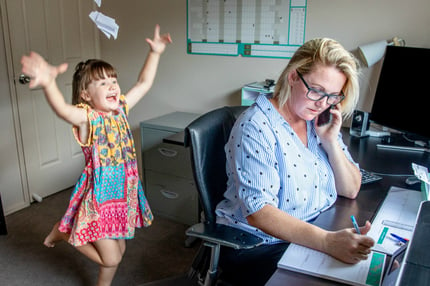
The feature image used is a stock image. The contributors of this story are known to Mamamia but have chosen to remain anonymous for privacy reasons.
“When something has to give, it is very often women’s careers: their working hours, the expectations of what they are able to accomplish on the job, or the job itself.”
**
When I shared this quote by author and academic Caitlyn Collins with a group of Mamamia mothers, it hit a nerve. I was inundated with messages from women who have been spending the coronavirussilently seething.
As one woman, Lucy, explained, this crisis has made her realise that the gains made by women in terms of equality, work, income distribution, and equal parenting are built on an incredibly fragile foundation.
WATCH: Horoscopes homeschooling. Post continues after video.
“There has definitely been a shift in the distribution of domestic work (I’m doing a bigger proportion), now that we’re both working from home, and I think it’s been far too easy to revert to traditional gender roles. It definitely makes me worry about the future of my two daughters,” Lucy toldMamamia.
Before the pandemic, fellow mum Kerry was working 20 hours a week as a solicitor while her two-year-old spent three days a week in care, and her older two attended school.
Once all three children were home, and both she and her husband were trying to work amongst it all, she quickly realised it was her work that was going to have to suffer – not his.
“I have often felt close to crying with rage at the unfairness of it all. It is so disempowering. Any attempts to try and equalise the load resulted in my husband pulling the financial ‘trump card’ because he earns so much more than me,” she toldMamamia.
While Kerry has spent her evenings trying to catch up on missed work while juggling homeschool and childcare during the day, he has pretty much worked on uninterrupted, apart from occasionally getting angry at the noise the kids were making in the background of his Zoom calls.
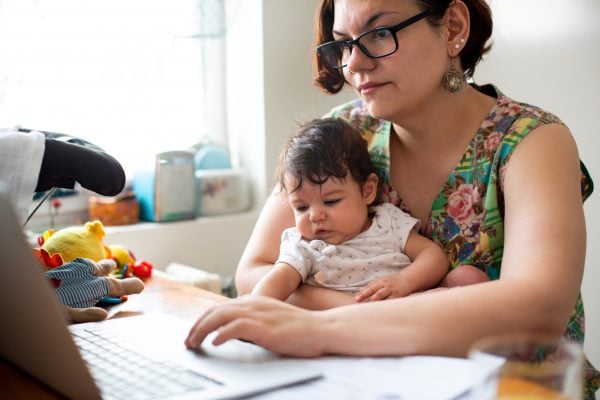
Mamamia was inundated with stories of women who have been forced to lean out of their careers because of the COVID pandemic. Image: Getty.
Cat has had to do the same, and shared: "As a family this is the logical solution in the circumstances, given he earns more than me but I feel that ever since having children my career (and salary) has suffered."
Even though paternal parental leave is an option, Claire's right - it is generally mothers who take the more significant career break when a heterosexual couple starts a family. According to 2017 data, only one in 20 fathers use the scheme.
But now COVID-19 has hit, these women's careers are again being sacrificed.
Eve earns more than her husband, and yet in lockdown he's just assumed she'll take care of it (it being entertaining their four-year-old while they both work from home).
"He disappears to his office without asking if I can watch our son. He insists however that I can always ‘ask him to help’. Him ‘babysitting’ often means he will turn on the TV," she toldMamamia.
LISTEN: Holly and Andrew talk parenting in isolation. Post continues after podcast.
Candy's husband has been on parental leave and returned to work last week. Even with his return she's still the primary breadwinner, but: "
"
Sociologist with the University of Tasmania Meredith Nash isn't surprised by these stories.
Speaking toMamamiashe explained,"E
"
Then there's the guilt.
"
The conversationsMamamiahas had over the past week suggest the answer to that is a resounding no. Of course, there will always be exceptions. But judging by the ferocity at which these women jumped at this conversation, with many remarking 'thank god it's not just me,' it's hard to ignore the trend.
**
But it's not just in male-female relationships where this backwards slump into outdated and sexist behaviour has been noticed. Some women have also become aware of the disturbing attitudes of their employers.
Karen has had feedback from her boss that "they weren't happy with my productivity while working from home and looking after two toddlers". Her husband's employer on the other hand has been incredibly supportive of him, as though their mentality is "OMG he is also taking care of children - that must be so hard".
Sarah has been forced to take leave without pay because her boss wouldn't support the reduced hours that would allow her to look after her kids during the pandemic. It's resulted in her missing important events, projects, and end-of-year reviews.
Chelsea - who only returned from maternity leave in May - has just found out she's the only person in her 40-odd office to be made part-time during the pandemic (something she didn't ask for).

During the pandemic, it seems, women are giving up more. Image: Getty.
Rafael Mayano, Australian CEO of the Adecco Group, the world's leading HR solutions company, toldMamamia, "
But ultimately, Rafael thinks in the long-run COVID-19 will revolutionise workplaces into a new normal which will benefit working parents.
"
Encouragingly, Rafael also thinks the pandemic will reveal that "crisis leadership requires a different set of skills and behaviours that may help a new breed of leaders to emerge, who are more empathetic and seek input and listen. One case in point is the observation that countries and cities led by women have fared better during the COVID-19 crisis so far," he explained.
The frustration among working mothers right now is palpable. For some it's their workplace that's completely poked holes in any flexibility they'd previously alluded to, while for others it's their partners whose attitudes are far more rigid and conservative than they'd ever realised.
Either way, for many women, the coronavirus pandemic has forced them back into traditional gender roles. Roles that don't allow women the freedom and autonomy we've spent decades fighting for. And roles that ultimately don't allow them to be wholly independent.
As Mary, who recently found out her husband is having an affair, says, "We need to support women in making the best long term decisions for them, not just the best short term decision for the family.
"As long term, you may not have the nuclear family that you sacrificed your career for."
Feature image: Getty.
This article originally appeared in Gemma Bath’s weekly news deep dive email. You can subscribe right here.
Gemma Bath
True Crime Conversations host
No Comments
Be the first to leave a comment