Content note: This post deals with themes of disordered eating. For support, please contact The Butterfly Foundation.
I can hear Laura Henshaw’s words are exiting from a cheek-reaching grin, enthusiasm pouring out with every sentence.
She talks quickly – like the passionate sometimes do – about all things health and fitness, how working out and hitting the gym makes her happy, her love of avocado and her passion for doing, and being, well.
A model, well-known Instagram star and law student, 24-year-old Henshaw is known – at least in her demographic – for the pursuit of her best and healthiest self. She’s known for her unparalleled devotion to making sure her very young, female followers know they should be kind, in every sense of the word, to their body. If they don’t feel like working out today, ditch it. If they want a treat, take it, stay balanced.
She has co-founded a website with friend and model Steph Claire Smith calledKeep it Cleaner,where Smith and Henshaw provide “health and wellness inspiration” through blog posts, recipe and workout ideas.
But this acceptance of her body, and the knowledge that being well sits at the core of her mental state, wasn’t always the way.
“It was a horrible time,” she tellsMamamiaon the phone, recounting a time in her life when food was her enemy, and her body moreso.
“I was following calorie counting accounts on Instagram, eating only fruit and veggies and doing every single thing I could to stay skinny.”
A post shared by laura henshaw (@laura.henshaw) on
Jul 12, 2017 at 4:12pm PDT
She was 18, trying to crack into the modelling industry and knew she had to be “stick thin” to have even a chance of getting work.
“I didn’t care about my health, I was extreme about everything. If my friends wanted to go out for dinner, I wouldn’t go if it wasn’t a really healthy restaurant, and I would get anxiety about the entire thing. I wouldn’t eat anything if I didn’t know how it was prepared. It controlled me.
“It was when I started cancelling my plans because I couldn’t control what the food was [that I realised I had a problem]. That’s where it started. Mentally it’s really hard, because I honestly thought I could lose more weight.”
Henshaw is just one of so many young women who have a history of disordered eating who later go on to have an influence, and a stake, in the health and fitness industry.
It’s a brutally complex issue and journey so many young women take, in an era where #fitspo saturates our newsfeeds, our flaws are erased with the flick of a filter and insecurities exposed by the devil that is comparison.
I ask Henshaw – in this journey to healing her “mental health” – if she every worries that her love of the gym makes her fearful of slipping back into old habits.
Does she ever fear she is just trading obsession for obsession?
“I think now, at 24, I know I will never go back, but it’s taken a long time to get there. It’s only in the past year that I’ve known I will never go back.”
She’s particularly aware, she says, of her 124,000 followers on Instagram, a large portion of which are teenage girls.
“Everything I post, girls are doing. If I ever caused someone to go through what I went through, it would be so upset me so much. I feel so accountable to them.
“I know the influence I have, and how influenced I was at that age. Young girls are so easily influenced. Whatever we tell them, they do. That’s why our message is always about balance and moderation, being healthy but mostly just being happy.”
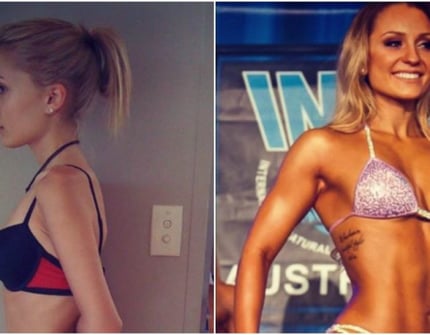
When I ask 23-year-old student Claire Jenkins at what point she, too, realised food was beginning to control every decision she made, she recounts memories of turning down invitations to restaurants for fear of what would appear on her plate.
A post shared by Claire Jenkins (@clairejenkins) on
Dec 8, 2015 at 12:32am PST
It’s an interesting – and and extraordinarily coincidental – parallel to Henshaw’s story. These two narratives, that still seem to follow an underlying tale of food and control.
It was about age 14 when Jenkins grew hyper-aware of everything going into her mouth.
“I was very focused on it. I thought [my weight] was something that made me explicitly unhappy, so I figured if I fix that, I will be happier. As a child, I just saw it as a direct line.”
Jenkins is beautifully articulate when reflecting on her experience with anorexia; one that saw her hospitalised twice for treatment.
She spent years, from the age of 13 or 14 to the age of about 16, working through her issues around food. It wasn’t until Jenkins was about 16, after her second hospitalisation, that the “switch just flicked”.
“I was done putting energy into destroying myself. I wanted to start putting energy in something that has longevity,” she says.
The 23-year-old stresses her journey from being sick to going to the gym was “gradual”. It certainly didn’t happen overnight, nor did it even happen the next year.
“I built a different vision for myself and I met lots of influential people,” she recalls. She began, very slowly, going to the gym. She eventually became qualified as a personal trainer, competed in a body building competitions and began studying – eventually – nutrition at university.
And although her focus is still nutrition, after a couple of years training, she began to steady, checked in with herself and stepped back from it all.
“A year ago I wouldn’t have said this, but I do now believe the fitness industry is a glorified eating disorder. The only difference is you’re nourished enough to look after yourself. It is the same thing, it’s just a different obsession. You’re still riding that initial high, not noticing how that high might not have longevity.
“For some people it suits them, but for myself, it went from one extreme to the next. I didn’t feel the severe anxiety or depression from being ridiculously underweight, and I was nourished, so I could be more a little more balanced and rational in my decisions. But I did begin to think, maybe I am in too deep. Maybe I am putting too much energy into this. So I have backed off a bit. I am experimenting to find that happy medium.”
Jenkins is sure that a healthy transition from having an eating disorder to being involved in the health and fitness industry is possible, though she acknowledges it’s incredibly labour intensive.
“I have worked with girls who have severe eating disorders who channel it beautifully, but that doesn’t mean there aren’t concerns with it and relapsing. You can help someone with an eating disorder get into the fitness industry in a healthy way, it just needs to be done in such an intensive way.
“It’s really important to establish their motives. We need to make sure they’re really, really comfortable with their motives and what they want to get out of it. If their motives are to drastically change their body, it’s just the same sh*t, different day.”
Another eating disorder survivor, 20-year-old Sophia Hatzis, concurs with Jenkins.
A post shared by Sophia (@sophiahatzo) on
Jul 11, 2017 at 4:00pm PDT
“There’s a really fine line between navigating recovery and moving into fitness and becoming obsessed, even orthorexic.
“A lot of women and men make the mistake not recovering first, and that’s really problematic. It’s important to show everyone’s recovery is different. There are a lot of potential problems if that transition isn’t managed really effectively by professionals and family.”
Hatzis tellsMamamiashe “probably always had an unhealthy relationship with food”. Growing up with a Greek background, food was never just about food. Food was family, food was an experience.
“I would eat when I was bored, sad and happy. It was such a coping mechanism. I would use it in unhealthy ways and I was obsessed with the way food made me feel,” she says.
“I was slightly overweight as a teenager and my body started changing. I went to the doctor and they told me I was slightly overweight, and now that I look back and that was definitely a triggering moment for me.”
She decided she was going to live a healthier life, and for her, healthy meant skinny.
“I started exercising and restricting the food I was eating. As I got a bit healthier, my parents thought it was OK and weren’t worried, they thought I was just making an effort to be healthy. It was only when I started dropping weight very quickly, started getting really moody and was obsessed with what I was eating, that they realised something wasn’t right.
“So, they took me to the doctor – the same doctor who told me I was overweight – and sat me down and wrote anorexia nervosa on a piece of paper.”
It was 2010, and a month later she found herself admitted to hospital, a kind of “forced treatment”, she calls it.
“I started getting into fitness into the latter part of 2015, after I had been in recovery for about six months. If I am honest, I would say it was probably too soon upon reflection. By the time I had started getting into the gym, my weight had stabilized and I was in an active state of weight gain, I was seeing a psych and dietitian and they had cleared me to exercise within very strict parameters.
“It was very different to the exercise I had done before. When I started in recovery, and I was feeling better, stronger and more capable, exercise became far more about being strong and being fit and healthy, rather than about burning calories. That’s a really important distinction, that difference in viewing exercise. We were very careful in those early stages of recovery, I was weighed regularly to make sure I wasn’t losing weight.”
Author
No Comments
Be the first to leave a comment