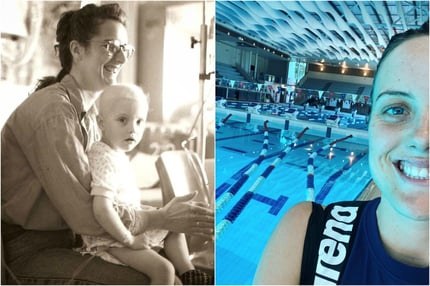
Ellie Cole doesn't remember having cancer.
Or losing her leg.
Or the anguish and heartbreak her parents went through, sending their then three-year-old daughter under the knife for life-saving surgery.
She had been diagnosed with a rare tumour - a sarcoma that was wrapped around the nerves of her right leg - and it hadn't responded to chemotherapy.
Ellie's twin sister Brittany had been by her side through every hospital appointment and every chemotherapy session, and on February 14, 1994, she thought she was going to be wheeled in to get her leg amputated too.
WATCH: Ellie stars in the new Netflix documentary, Rising Pheonix. Post continues after video.
"She wanted to be like me," Ellie, now 28, toldMamamia."That goes to show the innocence of a young kid."
Ellie's leg was amputated above her right knee, but for her there's "no sense of loss or trauma" because she doesn't have any memories of it.
"Growing up with one leg was very similar to what it would have been like for you growing up with two, I don't know any different," she explained.
"But a lot of people when they see me with my leg, don't understand how uncomfortable it can be. The socket is made out of fibreglass. It's like having a hot fibreglass shell that just rubs on your leg and cuts into your skin," she said.
Ellie thinks of it like wearing an uncomfortable bra.
"As soon as you're home, you take off your bra, you take off your leg," she told Mia Freedman on her No Filter podcast earlier this year.
LISTEN: to Ellie Cole on No Filter. Post continues after podcast.
But despite it being normal to her, others were worried about her limitations.
The surgeon had given her parents a list of things she wouldn't be able to do now that she only had one leg - things like bike riding, roller-blading, and running.
"But I was very lucky to have a twin sister who taught me how to do absolutely everything on that list," said Ellie.
"I grew up not understanding what having a disability meant. I got sent to school and it was just like 'good luck,' there was nothing about my disability and what I might have to be careful about," she said.
But it was at school where Ellie realised she was different. Suddenly teachers and students were "benching her" for things they assumed she couldn't do.
"They were putting their social anxieties on me," she said. "That was really tough for me."
Bullying never proved to be an issue for a young Ellie. In fact, she was only bullied once, on her first day of high school. But after pegging her leg at the bully in question, that was that. She was never bullied again.
Ellie had always been obsessed with swimming.
She'd started in the pool eight weeks after her surgery as a way of rehabilitating her body. But it wasn't until she was 11, sitting cross-legged on the floor and channel surfing on the family TV that she stumbled across the 2004 Athens Paralympic Games.
"I already loved swimming and I was training at that point, but with able-bodied kids," she toldMamamia."I didn't even know the Paralympic Games existed. I was shocked."
"I saw people with arms and legs missing - people who looked like me - doing professional sport. I was in shock. I felt like I had been lied to my whole life."
Back then, the Paralympics wasn't even nearly as celebrated.
But as Ellie explains, "it wasn't just the Paralympics....the disabled community as a whole was ignored a little bit. In the 90s when I was growing up you would never have celebrated a person with a disability, and you would never have thought of them as a professional athlete."
But Ellie was smitten.
She went from having posters of Olympians on her wall, to having Paralympians plastered above her bed, and within four short years she found herself in the athlete's village as a competitor.
"I felt like I could be myself for the first time ever," said Ellie of standing amongst thousands of Paralympians in Beijing in 2008.
"It's so nice because it feels like you've found your people. I had so many people underestimate me growing up, and in Beijing, I was surrounded by people who just get it," she said.
"I don't mind people making comments to me, but when they say it over and over again for like 20 years, all of a sudden you walk into a Paralympics and everybody there is looking at you in the eyes, instead of down to your leg. You don't get that anywhere else. It kinda sucks you only get it for two weeks every four years," she toldMamamia.
Ellie
Gemma Bath
True Crime Conversations host
No Comments
Be the first to leave a comment