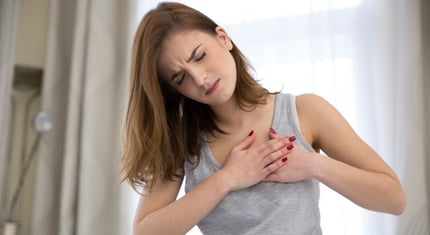
Image via iStock.
It’s a health issue we often associate with grey-haired men with high cholesterol, but new studies have found that young women are actually more likely to die of a heart attack than their male counterparts.
Twice as likely in fact.
That’s more than 15,000 women under the age of 55 dying of heart attacks every year. The main reason why? Researchers are saying it’s due to the fact women are reluctant to seek help as we don’t want to be labelled hypochondriacs.
RELATED: Want to live longer? All you need to do is this one (fairly) simple thing
The Yale School of Public Health recently published a study on the experiences of women under the age of 55 who had been hospitalised for a heart attack.
The biggest surprise was the discovery that it was not uncommon for younger women to “ignore” or “dismiss” their symptoms and hesitate or “delay” seeking care, due to anxiety about raising a false alarm. Premature death is an absolutely devastating side-effect of being embarrassed or hesitant about seeking medical attention.
http://cdn.theglow.com.au/app/uploads/2015/03/heart-attack-gif.gif Most people assume heart attack symptoms are like those they see in Hollywood.
The study also indicated that a lack of awareness about heart disease is also largely responsible for such a huge number of women losing their lives to heart attack.
RELATED: This is why heartbreak physically hurts
Even some participants in the Yale study who had a family history of the disease greatly underestimated how much they were personally at risk, usually reasoning that they were "too young" to be having a heart attack.
Part of this problem is an ignorance of actual symptoms. Many assumed heart attacks were the same as what you see acted out in Hollywood movies: a sudden onset of chest pains and then a shooting left arm pain. In reality, women often experience different symptoms to men.
Some of our favourite women on their body image (post continues after gallery).
We love these celeb quotes on body image
Rebel Wilson
The actress said on Twitter; "I'm not trying to be hot. I'm just trying to be a good actress and entertain people." Image via @rebelwilson
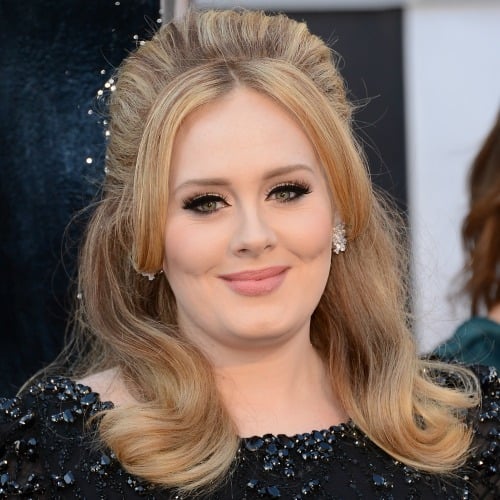
Lady Gaga
After the media focused on her alleged weight gain in September 2012, Gaga hit back at critics by baring her body in photographs, sharing her struggles with an eating disorder, and inviting her fans to join her in a "body revolution"/ Image via @ladygaga
Ashley Judd
After the March 2012 frenzy around Judd's "puffy face" the actress fought back in 'The Daily Beast', calling the media out for making women's bodies "a source of speculation, ridicule, and invalidation, as if they belong to others". Image via @ashley_judd
Christina Aguilera
"I am always in support of someone who is willing and comfortable in their own skin enough to embrace it," the singer said in a recent interview. Image via @xtina
Lena Dunham
At the 2012 New Yorker Festival, the magazine's TV critic, Emily Nussbaum, asked Lena Dunham, producer, creator and star of the hit HBO show 'Girls' why Dunham is naked in so many scenes. Dunham responded; "I realised that what was missing in movies for me was the presence of bodies I understood." She said she plans to live until she is 105 and show her thighs every day. Image via @lenadunham
Alexa Chung
Chung responded to critics who suggested that her slight frame made her a bad role model for young women, saying: "Just because I exist in this shape doesn't mean that I'm, like, advocating it." Image via Twitter @alexa_chung
Beth Ditto
This five-foot-tall, 200-pound singer spoke openly about her weight to 'The Advocate' saying, "I feel sorry ... for people who've had skinny privilege and then have it taken away from them. I have had a lifetime to adjust to seeing how people treat women who aren't their idea of beautiful and therefore aren't their idea of useful, and I had to find ways to become useful to myself." Image via @marybethditto
So when women began to experience the signs they're more likely to get than men, such as upper back pain, jaw pain and feelings of indigestion, nausea and fatigue, they were more likely to attribute them to other health problems.
RELATED: What it’s like to live with the constant “sleep attacks” that come with narcolepsy
So why is there such little understanding when it comes to a woman and man's different experience of a heart attack? It all comes back to gender.

One woman in the Yale study was told by her doctor to schedule a regular appointment - five days later.
Any mention of stress saw a major shift in diagnosis from physical to psychological.
A series of studies in 2008 asked 230 family doctors to evaluate two hypothetical patients: a 47-year-old man and a 56-year old woman, with the same risk factors and the "textbook" heart attack symptoms.
When there was no mention of stress, there was no difference between the doctors' recommendations to the woman and man.
When it was added as a symptom - boom. An enormous gender gap appeared.
RELATED: “My doctor told me I was too fat to run. Here’s what I did next.”
Only 15 per cent of the doctors diagnosed heart disease in the woman, compared to 56 per cent for the man.
Keep in mind this was for women at an age where both genders have the exact same risk of a heart attack. With younger women, on average, at a lower risk of heart attack than younger men, the tendency to dismiss their symptoms as anxiety becomes even more likely.
Unfortunately, there is no denying the fact that there are clear symptom overlaps between a heart attack and an anxiety attack, with younger woman also at higher risk for the latter.
This only serves to make it even more important that women young and old are educated about the real risk and real symptoms of heart disease.
And while it's easier said than done, don't let the fear of being perceived as a hypochondriac deter you from going to the doctors when something doesn't feel right. Worst case? It's not what you think - but at least you know.
Symptoms
Heart attack symptoms include:
- Pain, pressure, heaviness or tightness in your jaw, shoulders, neck, chest, back or arms
- Shortness of breath
- Cold sweat
- Dizziness
- Nausea
For more information on how to identify if you or someone you know is having a heart attack visit heartattackfacts.org.au
Love this story ? Follow us on Facebook
Author
No Comments
Be the first to leave a comment