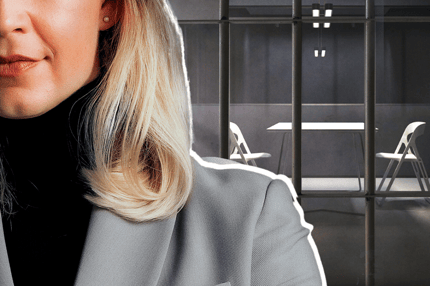
Book extract taken from Inside Job by Dr Rebecca Myers, published by HarperCollins.
My heart is thudding inside my chest like a trapped bird against glass. To my right is an enormous concrete wall capped with a metal tube and, balancing on top, a curling roll of razor wire. To my left is one of the red-brick wings of the maximum-security Graymoor prison, dotted with rows of tiny white barred windows.
The cells. A low wolf-whistle and a shout cut through the drizzle. I cannot see where from, but someone can see me. A man with an Alsatian is patrolling the lonely strip of green at the bottom of the wall. The dog strains on his choker lead, pulling the prison officer along. Both dog and man have their eyes low, searching for contraband thrown over the wall.
We walk down the wide tarmac drag until we reach the arched wooden door of the old prison. I’m with my newly appointed supervisor, Louise, a senior forensic psychologist.
She draws a bunch of oversized keys from the leather pouch on her belt and unlocks the door to reveal a barred gate. It swings heavily inwards to allow us to pass into what is known as the 'Centre' of the prison. I look up, not expecting the tall ceiling.
It’s a domed, circular space and radiating from it like spider’s legs are four wings, four floors high, all encased in cream metal bars and steel mesh.
The first thing that strikes me is the distinctive smell.
An institutional cocktail of unwashed, incarcerated men and boiled vegetables, brewed courtesy of the fusty air circulating through the Victorian prison’s heating and ventilation system. The second thing is the noise. A loud, deep, constant mumble of men talking. No one voice identifiable, rather a current of sound, like a rumbling river.
Occasionally there is a yell or a call, one voice rising above the flow. And doors banging. Metal on metal clanging. It is the unnerving sound of cell doors shutting.
I stand on the grey Centre floor trying to breathe, my mouth dry. It is like being ensnared in a large metal cage.
From where I am standing, I can see through the barred gates of each wing and down the landings. Each floor is lined on both sides with rows of green metal doors. There are no windows, but the high white ceiling gives a strange illusion of freedom and space to the meshed enclosure I am standing in.
It is lunchtime and the prisoners are moving back to their cells after a morning in the workshops or education. Not shackled or handcuffed, just walking along like men leaving an office or factory at the end of a shift.
An assorted collection of beings dressed in blue jeans and striped blue-and-white shirts. They look like normal men. Young and old, some black, some white, occasionally smart, mostly scruffy, but the prison clothes and the knowledge that they have all committed heinous crimes makes me feel intimidated and unsure where to look.
I glance down at my smart, polished heels, my exposed legs in their thin tights. I wish I had not worn a skirt. My jacket has a belt that squeezes my young waist, and it has an enormous burnt-orange fur collar. It is like having a warm, itchy fox draped around my neck and I am sweating.
I follow Louise’s lead. She stands there quietly, letting them pass. Occasionally a prisoner speaks to her – 'Hi, Miss' – and she nods in response. I am attracting long stares of curiosity and interest.
I look around. Louise and I are the only women in sight. I am 22 years old. A slim, blonde psychology graduate. There are close to 800 men in this prison, and they are on the move. A heady combination of murderers, rapists and child molesters. It strikes me that if all 800 prisoners do want to try to escape at that very moment, there is little that the meagre number of staff patrolling the constant stream of prisoners can do.
I feel vulnerable as I stand and watch, but there is no imminent uprising. They stream past me, finding their home wing, conditioned and toeing the line. To my utter relief, we move into the Centre office for safety.
The reprieve is temporary.
Watch the trailer for Inside The World’s Toughest Prisons. Post continues below.
Entering the Centre office is like entering the spider’s lair. It is full of maybe a dozen male prison officers in officious blue-and-white uniform and shiny boots. I stand there in my new Topshop suit feeling overawed and eyeing the floor again, shrinking behind Louise. Feeling like a trapped fly, I am not sure where I am attracting the most unwanted attention: in the office with the male staff or standing outside with the murderers and rapists.
Several of the officers stop what they are doing to look me up and down at leisure, taking in the only skirt in sight with undisguised pleasure.
It is the late 1990s. Fresh-faced young females are as rare as hen’s teeth in maximum-security prisons. Especially those bedecked in fur.
'What’s this young lass doin' in 'ere? Is school out?' one mutters.
Another chuckles in response.
The Centre office is the hub of the prison and from its large glass windows the staff can see each wing and down along each landing, such is the design of the radial Victorian prisons. There are no corners to block the view, helping to keep staff and prisoners safe, and order and control in the jail. It is a busy spot.
Several officers are watching 'line route' – the prisoners moving en masse around the jail under staff supervision. Staff come in and out, and the radios on their belts buzz and crackle like wasps. Clipboards with curling lists hang haphazardly on hooks at every available spot on the brick walls and there is a large wooden board at the back with numbers chalked on.
I am introduced to the principal officer (PO). Short and squat, he has a cigarette dangling from his thin lips, defying gravity, and is the man in charge of the Centre. He explains the numbered board. The cigarette hangs on.
Known as the 'roll board', it lists at any given time the total number of prisoners he is responsible for, and where they should be. It is a serious business checking that there are no escapees or deaths.
'Natural or otherwise,' he says with a wink.
A roll check is called several times a day. Perhaps in order to emphasise his point about the roll, the PO goes on to recount the story about Graymoor prison’s most infamous roll check. In the 1970s, according to Graymoor legend, the serial killer Robert Maudsley strolled into the wing office, placed a knife on the desk in front of the officers and said, 'You’ll be two down on the roll tonight.'
Maudsley, well known for the previous murder and cannibalism of a fellow patient in hospital, had killed two inmates, storing one of them under his bed. It brought his murder tally up to four.
'It’s OK,' reassures the little PO. 'It’s a long time ago. Bob lives in the Block now. For as long as I can remember. And probably as long as he can too,' he says with a chuckle.
He means the Segregation Block where prisoners are kept in isolation for either their own safety, or for the safety of others.
I can see the other officers watching for my response. I adopt Louise’s approach and give a non-committal nod, as free from anxiety as I can muster.
Listen to No Filter: 804 Days In An Iranian Prison with Kylie Moore-Gilbert. Post continues after audio.
Through the thin glass windows, I can see the prisoners continuing to flow past, no more than a couple of metres away. How and where would they get a knife from? At the time I had not given much thought to my physical safety. I rationalised that I would not be left on my own with a prisoner, never mind a dangerous or notorious one. Yet infamous prisoners were part of the reason I was drawn to the work. I was an avid spectator of TV programmes about prisons, and a consumer of real-life crime books. Such crimes attract public attention in extraordinary degrees and the more macabre and gruesome the better, it seems.
People want the gory details, the inside story. I wasn’t after the grisly details. I wanted to try to understand why some humans make such terrible decisions and commit atrocious acts with appalling consequences for themselves and others.
I couldn’t think of anything more interesting or worthwhile to invest my life in. I was also drawn in by a – somewhat voyeuristic – altruism and I was desperate to meet and talk to these strange, hidden and caged creatures and see how they were different from the rest of us.
Throughout my degree I was set on this being my career and I knew exactly where I wanted to be: a maximum-security prison for men. I never had any real interest in working with women. Women seemed too complex, tragic and emotional. Men seemed far simpler.
Perhaps I veered away from trying to fathom women because of my complicated relationship with my own mother. She left the family home – me, my father and two younger sisters – when I was about 14 years old after having an affair. My sister tells me we came home from school one day and she had gone. Bolted. We were abandoned. Three eggs left in a nest before we had fledged.
I don’t really remember it. I think I put the rejection and the loss to one side and then got on with being as rebellious, self-indulgent and irresponsible as I could – including collecting petty criminal, fixer-upper boyfriends – all in a self-destructive attempt at attention seeking.
My dependable, devoted father picked up the pieces.
As soon as I could I was off travelling and then to London and university for more pleasure-seeking, but with bells on, as the house music and rave scene took off in the early 1990s. Dressed in the tiniest, shiniest of outfits picked up from the haze of Camden Market, I indulged in the various stimulants on offer so I could dance for 10 hours straight in huge, thumping warehouses with dripping-wet walls.
Weekends were a hedonistic escape that left no room in my head for anything but the reassuring beat of the music. I succumbed to a tattoo here, several piercings there (perhaps my form of self-harm), all of which had to be later removed or kept covered for my new law-abiding and respectful job in the prison service.
A world away from that coveted spot in front of the speakers.
At least two of my previous boyfriends ended up in prison. One memorable unsuitable had a glass eye to replace the real one lost in a shooting accident, a pit bull and an array of Union Jack tattoos. Fresh out of prison and the local hard man, he was well known to all, and there was an inherent status in being his girlfriend.
I wonder if I was drawn to trying to repair challenging men. Maybe it was a distraction for avoiding mending myself. Maybe those who have been through some form of trauma are drawn to the psychologically damaged.
Working at HMP Graymoor was certainly going to offer the ultimate challenge in fixer-uppers.
Later that first week, before I am to be given keys, I am instructed to attend 'the Security Talk'. I trot off down the corridor of the admin block and find myself in a small, cluttered room with three prison officers squeezed in around untidy desks. One of them is extremely handsome and not much older than me. He has chestnut hair, caramel skin and chocolate eyes, all of which are enhanced by the uniform. He smiles at me, and I notice his perfect teeth.
'You must be Rebecca. I’m Dominic.'
I feel myself blushing, redness rising slowly like a sunrise up my neck and bursting onto my cheeks. One of the other officers has spotted it like an apex predator would its prey.
'Bloody hell, you’re in there, Dom. Look at the colour of that lass’s cheeks!'
'Let’s get down to business,' he says, grinning.
'Easy, lad!' chortles the officer. He looks like an egg with his bald head and shiny, hairless face.
'Come on, away from these idiots,' Dominic offers.
He gives me a quick wink as the officer does a pumping action with his arm.
With my personal sunrise still glowing, I am glad to be out of their den. Dominic spends the morning with me, covering security basics including what you cannot bring into the prison – umbrellas and metal cutlery (potential weapons), chewing gum and Blu Tack (useful for blocking up keyholes and can also be used by prisoners for imprinting and then copying keys). There is a strict dress code, which includes not wearing scarves or necklaces (strangulation risk) or anything revealing. No high heels in case you must run. He doesn’t mention fur, but I have already struck that one off my list.
He talks to me about grooming and manipulation. How prisoners can build up powerful relationships over time with staff, then encourage them to start bringing in, or taking out, prohibited items, make mistakes or do favours.
It is time for a visit to 'The Black Museum', as Dominic calls it, a dusty glass cabinet in the corridor full of illicit items made or obtained by prisoners. I peer in. Dominic is standing behind me and is clearly looking at my bottom. There are several rusty razor blades moulded onto toothbrushes. The really lethal ones have two razor blades side by side instead of bristles, so if slashed with this the medics cannot easily sew you back together. I see huge, ugly knives handmade from plastic, metal or glass, and tiny, deadly shanks with grubby string around the handle so they can be held without injuring the perpetrator.
Time, ingenuity and improvisation are all that is needed, it seems. I now know where Maudsley got his knife. There is even an attempt at a gun.
Dominic proudly assures me it has a working mechanism. I consider the assorted collection of offensive weapons and escape tools. Is the sole purpose of the museum to terrify ne

Sign up to Mamamia Weekend Reads
Sent weekly
Dr Rebecca Myers
Author
No Comments
Be the first to leave a comment