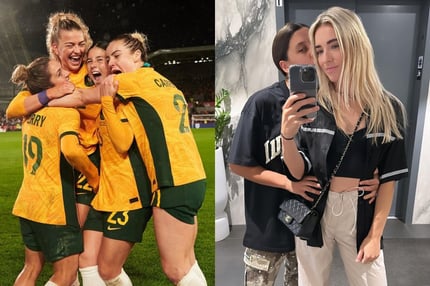
I wouldn’t call myself the sportiest person in the world. I like sports, particularly women’s leagues, but I hadn’t, until recently, ever really felt deeply connected to a team in the way some people do.
You know the people I’m talking about – the ones who cry when their teams lose or who know the personal lives of all their team's players. I’d always been a bit jealous of these people because they got to believe in something special. I wanted to believe in a team in that same way.
And… now I do. My support for the Matildas has grown into that same feeling I was jealous of. A deep feeling of belonging to something.
There are a few things that got me to this point. The obvious one is how special of a time it is right now in Australian history. It feels different. The anticipation for the 2023 FIFA Women’s World Cup is building and we all just know that after it ends, we’ll never be the same.
Having the Cup on home soil is something that solidifies women in football. It says, ‘Women in sports are here to stay, we are equal, and we will Never Say Die.’
But, the thing that brought me over the line, now at the point where I’m basically part of the Matildas' family (self-appointed, but a member all the same), was watching Matildas: The World at Our Feet, the 6-part docuseries on Disney+ that captures the behind-the-scenes of the Matildas during this monumental moment in sporting history.
I started the series because I wanted to know desperately about the team and the women who are changing our world so drastically. And, I finished it because watching their lives, and their true selves, made me feel so immensely proud and so connected to each and every player. My heart gets that big swelling feeling every time I think about it.
Here are 4 of the most noteworthy learnings I took away from the series.
Representation matters.
Steph Catley said it best when she said she had no female football role models to look up to growing up. And all of the Matildas' repeat this sentiment throughout the docuseries. They reiterate how important it is for them to show up and play, not just for themselves and for their country, but for all the little girls watching and thinking that maybe they too can be professional footballers – because they finally have role models to look up to, who represent them and who prove that women are equal in sport.
It’s not just women though, while watching the docuseries our queer community and our Indigenous community were both heavily featured.
As a gay woman myself, I can comment on how this queer representation made me feel. And let’s just say I jumped and screamed as soon as Sam Kerr and partner Kristie Mewis hit my screen in episode one.
My partner and I get oddly excited whenever we see another queer female couple, so I immediately messaged her to let her know I was watching a very cute and loved-up Sam and Kristie on TV. It seems like something small but the way queer love was normalised in the series meant a lot to me.
Special mention to when Emily Gielnik proposed to her long-term girlfriend, Temica, after talking about how she found it really difficult to come out for a long time because of her heritage, but found strength and love through her team and her partner. I cried a lot watching this part of the show play out (crying in happiness and love seems to be a common thing for me while watching.)
Family is as important as the player.
This is an overarching theme throughoutMatildas: The World at Our Feetthat I didn’t completely expect.
The way they all treat each other as family; how each player’s family is welcomed by the rest of the team. It brought real-life tears to my eyes. It shows just how integral family is to the Matildas' success.
When Katrina ‘Mini’ Gorry spoke about having her baby as a single mum through IVF, then coming back to the game bringing her beautiful girl, Harper, with her – I just about sobbed (heaved, more like it). Rather than being punished for creating a family and being a mum, Mini was celebrated by the team and Harper was welcomed into the camp as if she was a player herself. Mini and the Head Coach, Tony Gustavsson, both say in the series how this makes Mini a better player overall.
Laura Koefoed
Author
No Comments
Be the first to leave a comment