
The below article is one perspective based on estimates about the potential spread of COVID-19. Currently in Australia, there are 29 confirmed cases, and you can read up to date information here.
There’s been a huge amount of talk about the coronavirus on social and traditional media. There seems to be a sense that we shouldn’t worry, with a few key points being repeated:
“It’s just the flu”.
“The mortality rate is only 2 per cent.”
“Only 3000 people have died so far.”
“The only people dying are the old and people already sick.”
If you’re young and healthy, what is there to worry about?
Well, let me explain:
The main risk of the coronavirus outbreak isn’t that you’re going to get sick and die. It’s that so many people could get sick so quickly that our healthcare services and infrastructure become completely overwhelmed.
Of course, at this stage, no one knows if that will happen. But let’s look at what we do know.
Listen: Mamamia’s daily news podcast The Quicky answers all your questions about coronavirus. Post continues after audio.
The information we have so far, based on multiple sources, is that COVID-19 has an incubation period of 2–14 days, and can be transmitted via coughing and sneezing, as well as via infected clothes, furniture, hair, and so on. It’s also thought COVID-19 may be carried by dust and air, and the virus may persist on surfaces for up to nine days.
Its symptoms include fever, cough, and shortness of breath, and 20 per cent of patients require hospital treatment.
For every person infected with COVID-19, it’s estimated roughly 2 more will become infected. The current death rate, which is difficult to calculate, has most estimates in the range between 1 and 2 per cent. In Wuhan province, however, that mortality rate was 4.9 per cent, due to the hospital system being overwhelmed.
It appears COVID-19 has a higher death rate in older populations.
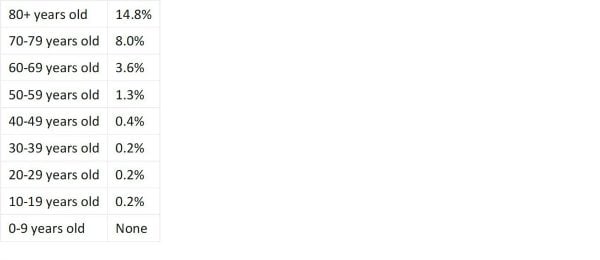
Image: Medium.
The worrying part is that the virus is highly infectious, potentially nearly twice as infectious as the flu, and infected people could spread the disease for up to two weeks before showing symptoms.
In The Atlantic, Marc Lipsitch, a leading epidemiologist at Harvard reported that "that within the coming year, some 40 to 70 per cent of people around the world will be infected with the virus that causes COVID-19". This was last week and while ridiculed at the time, a lot more epidemiologists are now agreeing with Lipsitch.
“Right now, we've come to the conclusion that this virus is not going to be contained. So that means every country, every location really needs to prepare,” infectious disease specialist Dr. Amesh Adalja tells @smerconish about coronavirus in the US. https://t.co/cj8pEPqI4z pic.twitter.com/uARlYtwhEv
— CNN (@CNN) February 29, 2020
As of this morning, there are over 80,000 reported cases in China, almost 5000 in South Korea and over 2000 in Italy.
In most western countries the number is much smaller, 103 in the USA, 40 in the UK, 34 in Australia. You can find up to date data for your country here.
The first thing to note is that Korea and Italy have been testing much more widely than other countries. Up until recently, most countries have only been testing people that have visited China.
The second thing to note is that “confirmed cases” is not the total number of cases in that country. “Confirmed cases” is the lowest possible number of cases in that country. It’s the lower bound of an estimate.
The third thing to note is that while the number is relatively small right now, cases outside of China are doubling roughly every five days. The reported rate of infection in China is lower, but China has taken drastic quarantine measures, including welding people inside apartment buildings.
Ok, so it’s infectious. But it’s not a problem, it’s just like the flu…right?
Comparison to the flu
Each year the flu infects between two to 11 per cent of the population.
The infectiousness of a disease is measured by its R0 value. R0 is a measure of how many people will catch a disease from one infected person. The R0 value of the flu is 1.28. The R0 of COVID-19 is assumed to be between 1.4–3.8
Dr Marc Wathelet, research leader at the only institute in the world dedicated exclusively to research on respiratory disease transmission wrote an article this week claiming that the R0 is being severely underestimated and the real value could be between 4.7 and 7.12.
Okay, okay so it might be much more infectious than the flu, but that’s fine because the mortality rate is only two per cent, right?
Mortality rate
Let’s assume the Chinese data is correct.
The formula China is using is current total deaths/current confirmed cases.
When this widely circulated mortality rate was calculated, 97 per cent of the country’s total deaths (414) were in the Hubei Province.
Mortality rate in Wuhan was 4.9 per cent.
Mortality rate in the Hubei Province was 3.1 per cent.
Mortality rate in other provinces was 0.16 per cent.
Mortality rate nationwide was 2.1 per cent.
When asked why Wuhan was so much higher than the national level, the Chinese official replied that it was for lack of resources, citing as an example that there were only 110 critical care beds in the three designated hospitals where most of the cases were sent.
If you’re young and healthy, you’re probably going to fight the virus off just fine. 80 per cent of the cases are mild and if our hospitals hold out, the mortality rate should be the same as the hospitals outside of Hubei, a manageable 0.16 per cent.
If you’re not young and healthy, you might want to be more careful. The death rate is far higher in older cohorts, it’s at least 14.8 per cent in the over 80 group.
Why does that matter?
The UK has 2.8 million people over the age of 85.
The US has 12.6 million people over the age of 80.
Trump told people not to worry because 60,000 people a year die of the flu. If just 25 per cent of the US over 80’s cohort get infected, given current mortality rates that’s 466,200 deaths in that age group alone with the assumption the healthcare system has the capacity to handle all of the infected.
The problem
The danger doesn’t come from the virus, it comes from our under-prepared, fragile healthcare systems.
Western governments are responding by saying they are prepared and ready to deal with the crisis, that it’s similar to the flu.
A recent paper suggested 80 per cent of all cases are mild but 20 per cent of those infected required hospitalisation and 14 per cent of those hospitalised require intensive respiratory treatment.
Can you guess the number of people that have contracted the flu this year that needed hospitalisation in the US? 0.9 per cent.
Let’s use Belgium as an example.
On the 26th of February, a minister answered a question about the preparedness of the country by saying:
"In Belgium, we have enough beds and sufficient treatment capacity. When we compare it to a winter flu and the number of elderly patients who are hospitalised, the situation is identical."
In response, Dr Marc Wathelet, the expert I mentioned earlier, wrote a letter to the Belgian government yesterday morning noting that the infectiousness and hospitalisation rates are much higher than the flu. He wrote:
"In my file, I cited the WHO, which on February 10 estimated that 16 per cent of symptomatic patients were in a condition serious enough to require hospitalisation. Influenza? 0.2 per cent of cases.
"The WHO released a report yesterday stating we now have more precise figures for symptomatic patients: 80 per cent of mild cases, 13 per cent of severe cases (hospitalisation), 6 per cent of critical cases (intensive care).
"If the proportion of symptomatic cases due to the new coronavirus reaches 1 per cent of the population, we would be on the verge of a hospital crisis due to lack of beds."
Humans are pretty good at understanding threats to ourselves. We evolved to be on the lookout for prehistoric predators, and in the modern day we understand the chances of being hit by lightning, or dying in a plane crash are pretty unlikely.
Evolving to be observant of direct dangers to ourselves seems to have left us terrible at predicting second and third-order effects of events.
When worrying about earthquakes we think first of how many people will die from collapsing buildings and falling rubble. Do we think of how many will die due to destroyed hospitals? How many will die because medicine can no longer be delivered on damaged roads?
The average mortality rate of 2 per cent is with the caveat that our healthcare systems can manage severe cases.
We know that if the virus becomes widespread, they can’t.
We think the virus might be much more infectious than the flu, but let’s assume that only 8 per cent of the UK population gets infected, the same as a severe flu season.
The UK population is 67 million people, that’s 5.4 million infected.
Current predictions are that 80 per cent of the cases will be mild.
If 20 per cent of those people require hospitalisation for 3–6 weeks?
That’s 1,086,176 people.
Do you know how many beds the NHS [National Health Service in the UK] has? 140,000.
If the present data about the virus is correct, even at conservative estimates we are going to have hundreds of thousands of people needing hospitalisation and intensive care.
The strain that this will place on the healthcare system cannot be overstated. We are not prepared to deal with a pandemic.
This is a coronavirus isolation facility at a hospital in Lincoln, in England.

This is a Coronavirus isolation facility at a hospital in Lincoln. Image: Medium.
No, not the building. The tent.
The potential for the healthcare system to be overwhelmed is very real.
If our hospitals are overwhelmed, how many will die from unrelated conditions because they can’t get access to healthcare?
How many will die because of shortages of medication?
The limited availability of beds in Wuhan raised their mortality rate from 0.16 per cent to 4.9 per cent.
This is why the Chinese government built a hospital in a week.
Are our governments capable of doing the same?
The virus is not the main danger, our unprepared medical system and fragile supply chains are.
How many people are going to be prevented from going to work because of quarantine?
The FDA this morning reported the first drug shortage in the US caused by the coronavirus.
What can you do?
The CDC warned that disruption to everyday life might be severe
Adam Wren
Author
No Comments
Be the first to leave a comment