Image via iStock.
When I first heard about the menstrual cup, I was seeking to get rid of tampons. I set out to find something else besides pads that could help me out at that time of the month. That’s when I stumbled across the menstrual cup.
There’s a fabulous community of women online that will happily introduce anyone to the menstrual cup. Some girls are ready to make the switch—others need some convincing. I was ready to switch, and ordered my first menstrual cup after reading about it online.
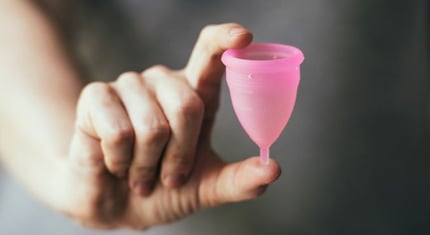
The menstrual cup is a small cup that usually comes in two sizes—small and large—made out of medical-grade silicone or natural rubber latex that is inserted into the vagina, catches the menstrual flow, and then is removed and emptied when full, or, after up to 12 hours.
The biggest thing to keep in mind about the menstrual cup is cleanliness, as not washing our hands or the cup when taking it out or inserting it can increase our risk for urinary tract infections (which, sadly, happened to me my first summer with the menstrual cup).
When taking it out or putting it back in, we have to be diligent about washing our hands first and washing the cup. I use natural castile soap to do both.

The menstrual cup is not tested on animals and there’s no known risk of toxic shock syndrome. When used properly, it can help alleviate menstrual cramps and make our periods lighter.
But perhaps the most important thing the menstrual cup offers to women and girls is the opportunity to get familiar with their bodies, something we seem to be rather ignorant of in this day and age.
Tampons come in wrappers, in pretty colors, they can be plastic or cardboard, but in the end, they’re all disposable and are meant to be discarded immediately after they’ve absorbed the correct amount of blood from us. (Post continues after gallery.)
Popular forms of birth control
Contraceptive pill
The Pillis the most popular form of birth control. There are two types: the combined pill, containing two hormones, and theprogestogen-only, or mini, pill, which only contains one female hormone. The combined pill works by preventing the ovary from releasing an egg each month. The mini pill changes the mucus at the entrance of the uterus, which stops sperm from entering. Both are 99.7% effective; however, they don't offer protection from STDs.
Intrauterine device
IUDs are small, T-shaped devices that are inserted into the uterus by a doctor in order to prevent pregnancy. There are two types of IUD: copper, which affects the movement and survival of sperm in the womb while changing the lining of the womb;and hormonal, which releases progestogen (a synthetic version of the naturally-occurring hormone progesterone) into the uterus. Although IUDs have a success rate of more than 99%, only around 2% of Australian women currently use one.
Condoms
The male condom is a barrier contraception that prevents both pregnancy and the transmission of STDs. They work by collecting semen so it doesn't enter theman's partner's body. Condoms are 95 to 99% effective at preventing pregnancy.
The female condom
The female condom is a pre-lubricated sheath, which loosely fits inside of the vagina. The condom has a removable ring, which helps to insert the sheath and keep the condom in place. A larger ring remains on the outside to cover the opening of the vagina. They are designed to fit all women and can only to be used once. Due to misuse of the product it is only 79 per cent effective.
Diaphragm
Like the male condom, the diaphragm is a barrier method of contraception. It's a shallow silicone dome that's inserted into the vagina andcovers the cervix, which is the entrance to the uterus. It's held in place by the pelvic muscles, and works by preventing sperm from entering the uterus. After sex, diaphragms need to remain in placefor another six hours, in which time the sperm inside the vagina die. This method is 88 to 94% effective at preventing pregnancy, although this rate increases with experience.
Birth control implant
This is a 4cm-longimplant that is inserted into a woman's upper arm, just under the skin, by a doctor. It releases a hormone called etonogestrel, which prevents ovulation and thickens the mucus in the cervix, which can stop sperm from entering. Contraceptive implants - usually sold as Implanon - are removed under anaesthetic every three years, and are close to 100% effective.
Vaginal ring
Vaginal rings are soft plastic rings that contain the same two hormones as the combined pill - oestrogen and progestogen. The ring is inserted into the vagina, where the hormones are absorbed into the body and then prevent the ovaries from releasing eggs. Once inside the ring can't be felt, and it needs replacing every three weeks (with one week's break in between). When used correctly, this method is more than 99% effective.
Depo Provera
Depo is a long lasting hormonal injection. The synthetic form of progesterone is administered every 12 to 14 weeks to woman, preventing pregnancy within this ongoing time period. The injection, which is given in the buttock or muscle of the upper arm, prevents ovulation and thickens the mucus in the cervix, helping to block sperm. The injections are 99 per cent effective but do not protect against STDs. Male contraceptive injections are currently being trialled
The morning after pill
Emergency contraception (popularly referred to as the morning after pill) is used to prevent a pregnancy following unprotected sex. Other reasons include missing a contraceptive pill or a condom breaking. It is common in Australia to use the progestogen-only method. This entails a dosage of EC pills containing progestogen or the synthetic version. A doctor can prescribe the pill or they can be bought over the counter at a pharmacy without a prescription. Emergency contraceptionis 85 per cent effective in reducing the risk of pregnancy.
Sterilisation
Sterilisation is a permanent form of contraception. For women there are two types of sterilisation: tubal ligation, in which clips are placed on the fallopian tubes, or tubal occlusion in which a device is inserted into the tubes. These methods work by preventing the sperm from reaching the egg. Tubal litigation is 99.5 per cent effective. The Vasectomy (for men) works by cutting and blocking the tubes called the vas deferens, preventing sperm from leaving the testicles. The chances of impregnation with a vasectomy are 1 in 1000.
The menstrual cup has a lifespan of 10 years or more—in fact, it may never need to be replaced. The menstrual cup is much more than just sticking a cup up your vagina: it requires us to get familiar with our anatomy because the menstrual cup depends on proper placement in order to do its job properly.
Women bleed from their cervix, which is a small knob that feels very much like the end of our noses, and also marks the entrance to the womb. Without successfully locating this, the menstrual cup won’t work and will end up leaking (which, trust me, can be incredibly frustrating).
The position of each woman’s cervix will be unique to her. Some women have high cervixes, some have low, some are angled left, or right. We need to find our cervix and then determine which cup would suit us best based on the position. The size of the cup will also depend on your age and if you’ve given birth or not.
The menstrual cup has totally changed my period by forcing me to get more familiar with myself down there. My cervix is angled slightly to the right, so I need to position my cup so. After going through three menstrual cups to find my perfect fit, my cramps have gotten better, and I feel so in touch with my body.
Menstrual cups may be a revolutionary idea for some, or it may be old news to some of us girls! After all, they’ve been around since the 1930s, but were not commercial until about the 70s. Regardless of where we stand on the menstrual cup, we can all make better, healthier choices for ourselves, our bodies, and the planet by exploring the option of menstrual cups. (Post continues after gallery.)
Products to care for down there.
Menstrual cups
Ni
Author
No Comments
Be the first to leave a comment