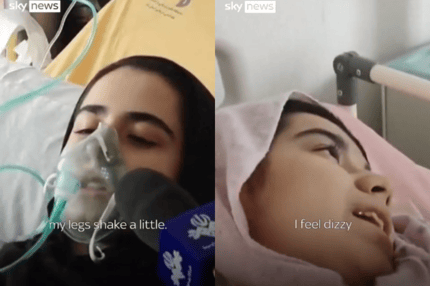
Right now, dozens of school girls in Iran are ending up in hospital beds.
Over the past three months, hundreds of girls have reportedly been poisoned in schools around the country, according to Iran's Etemadnews agency.
Authorities have acknowledged suspected attacks at more than 50 schools across 21 of Iran's 30 provinces since November.
Videos on social media show girls falling ill, feeling nauseous or suffering heart palpitations. Others complained of headaches.
"I feel pain in my chest and when I walk my legs shake a little," an unidentified school girl said in a video shared by Sky News.
Parents have been seen gathering at schools to take their children home, while some students have been taken to hospitals by ambulance or buses.
A girl at a school in the Iranian city of Semnan, Semnan province is unable to walk amid gas poison attacks at her school and on school girls across the country. #Iran's government has known about the attacks since November yet has not stopped the poisoning of school girls to… https://t.co/CmQooaGvRF pic.twitter.com/qQcQM5htlV
— IranHumanRights.org (@ICHRI)
Protests have broken out in Iran's capital Tehran after hundreds of girls were suspected to have been poisoned in dozens of schools Sky's @DominicWaghorn calls the suspected poisoning as "deeply sinister and worrying" 👇 pic.twitter.com/0bSGNUzim8
— Sky News (@SkyNews)
Over the weekend, Iran's Interior Minister Ahmad Vahidi said "suspicious samples" had been gathered by investigators, without elaborating. He called on the public to remain calm and accused unnamed enemies of inciting fear to undermine the Islamic Republic.
On Saturday, worried parents gathered outside an Education Ministry building in western Tehran to protest over the suspected attacks, which turned into an anti-government demonstration, according to a video verified byReuters.
Similar protests were held in two other areas in Tehran and other cities including Isfahan and Rasht, according to unverified videos.
“Death to Khamenei” State media in Iran is portraying Khamenei as someone who's come to the rescue of targeted schoolchildren in the chemical attacks which they call "suspected poisoning". But Iranians took to the streets and chant against Khamenei and pic.twitter.com/VN7OwofVJn … https://t.co/F79pp3Tv81
— Masih Alinejad 🏳️ (@AlinejadMasih)
The outbreak of the illness comes at a critical time for Iran's rulers, who have faced months of anti-government protests sparked by the death of 22-year-old Mahsa Amini, who died in September while in the custody of the morality police.
Here's what we know about the suspected attacks.
Why are girls reportedly being poisoned?
Despite reports of the attacks going on for months, Iranian officials have only just acknowledged the issue in recent weeks and have provided no details on who may be behind the attacks or what chemicals - if any - have been used.
Iran has also imposed stringent restrictions on independent media since the outbreak of nationwide protests in September, making it difficult to determine the nature and scope of the suspected poisonings.
Some politicians have suggested the girls could have been targeted by hardline Islamist groups opposed to girls' education, according toAAP.
However, unlike neighbouring Afghanistan, Iran has no history of religious extremists targeting girls' education.
Women and girls continued attending school even at the height of the 1979 Islamic Revolution that toppled Iran's US-backed monarchy.
Iran's interior minister said results from the "suspicious samples" collected would be "published as soon as possible".
What is being done about the attacks?
This week, Iran's Supreme Leader Ayatollah Ali Khamenei, who has the final say on all matters of state, spoke publicly about the suspected poisonings for the first time.
"Authorities should seriously pursue the issue of students' poisoning," Khamenei was quoted as saying by state TV.
"If it is proven deliberate, those perpetrators of this unforgivable crime should be sentenced to capital punishment."
On Friday, the United Nations human rights office in Geneva called for a transparent investigation into the suspected attacks.
Iran rejected what it views as foreign meddling and "hasty reactions" and said on Friday it was investigating the causes of the incidents.
"It is one of the immediate priorities of Iran's government to pursue this issue as quickly as possible and provide documented information to resolve the families' concerns and to hold accountable the perpetrators and the causes," Foreign Ministry spokesman Nasser Kanaani told state media.
In the US, White House press secretary Karine Jean-Pierre has also called for a "credible, independent investigation" into the incidents.
"If these poisonings are related to participation in protests, then it is well within (the) mandate of the UN independent international fact-finding mission on Iran to investigate," she said Monday.
Women and girls everywhere have a fundamental right to education, and the continued poisoning of schoolgirls across Iran is unconscionable. There must be a credible, independent investigation and accountability for those responsible. pic.twitter.com/eYSRXAloQ6
— Karine Jean-Pierre (@PressSec)
The World Health Organisation documented a similar phenomenon in Afghanistan from 2009 to 2012, when hundreds of girls across the country complained of strange smells and poisoning. No evidence was found to support the suspicions, and the WHO said it appeared to be "mass psychogenic illnesses."
- With AAP.
Feature Image: Twitter @SkyNews
Brielle Burns
Author
No Comments
Be the first to leave a comment