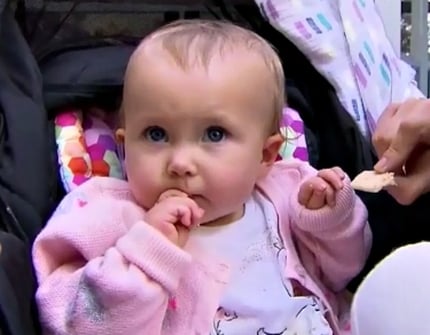
Johnny and Bethan McElwee are uncertain about their little girl’s future. A just 13 months old, Aviana suffers from Spinal Muscular Atrophy Type One, a rare genetic condition that causes progressive wastage of the muscles.
It’s terminal; most children don’t live beyond the age of two. And while she’s undergoing treatment via a drug called Nusinersen, doctors have told the couple to prepare for the inevitable.
“We know the future is probably not great still,” Johnny McElwee told Nine News .
“What [the drug] does give us is the chance to have quality time, the chance to enjoy this moment.”

Johnny, Bethan and Aviana. Image: 9 News.
SMA Type One is childhood version of Motor Neurone Disease, and the biggest genetic killer of children under the age of two in Australia. Yet it could be stopped.
A genetic test is available to couples to determine if they both are among the one in 35 Australians that carry the SMA Type One gene, yet according to Paediatric Neurologist Dr Michelle Farrar not enough are encouraged to undergo it.
"This is where I feel very sad about potential missed opportunities," Dr Farrar toldNine News.
"There needs to be education and resources to enhance the awareness and I think potentially with those, this could be a preventable disease."
Kathy Kelly won't let losing her children define her. (Post continues below.)
According to Spinal Muscular Atrophy Australia Inc. all SMA children appear normal at birth before the deterioration and loss of movement in their limbs begins to become noticeable, usually by the time they reach six months.
Among the key indicators of SMA are:
While there is still no cure, clinical trials for promising gene therapy research have advanced recently, offering the first glimmer of hope to families affected by this cruel disease.
For more information, visit the Spinal Muscular Atrophy Inc website and speak to your doctor.
Belinda Jepsen
Author
No Comments
Be the first to leave a comment