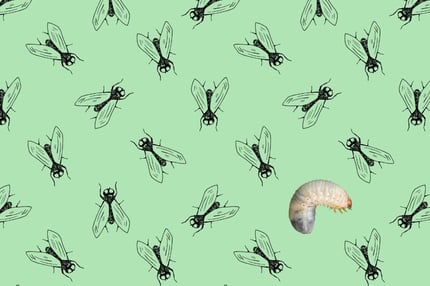
'The maggots gave the prime-suspect an alibi', is not a sentence I ever thought I would write and yet here we are.
It's all in a day's work for Paola Magni, a forensic entomologist whose expertise with creepy crawlies has helped solve many crimes.
She's one of only about 250 in her niche field in the world, and her work specifically with barnacles in Western Australia is world-leading.
But first, let's get back to the maggots. Because they're entomologists' bread-and-butter, and can reveal a surprising amount about a crime scene.
In the maggots-alibi-case, Magni was called in by the local police after a female body was found wrapped in plastic, a doona and then a piece of carpet. The maggot mass that had found her was enormous.
As Magni explains to Mamamia'sTrue Crime Conversations,"This amount of maggots make their own temperature. Why this is important is flies grow faster or slower based on the temperature they live in."
By determining the temperature of the mass, Magni could work out how old the maggots were and therefore the approximate time of death of the victim.
Turns out the police's prime suspect had been in prison when Magni determined the woman had died, and couldn't have committed the murder.
Listen to Australia's 'bug whisperer.' Post continues after podcast.
In another case featuring a man found in a mummified state in his home, Magni was called in to examine the excrement of beetles that'd taken up residence in the man's body.
Immediately Magni could tell he had been there for a significant amount of time, as these particular beetles only appear after a certain time-frame.
As she will tell you, "bugs don't lie", and she's worked with enough of them; fireflies, mosquitos, centipedes, flies and barnacles to name just a few. But her work in the crime-space tends to be on bodies that are highly decomposed. She deals with the most smelly and often most revolting types of cases where a body is being eaten, or playing shelter to other living things.
She admits she doesn't really get grossed out by what she sees, but she does get frustrated, particularly by a certain variety of jumping maggots.
"You try to work and they jump on your face," she explains.
Then there was the time she walked into her lab to find 5000 maggots had escaped from the fridge, on the hunt for food. But she was more annoyed at having to start her experiment again than the masses of wiggling worms on her floor.
The most challenging murder cases to solve are ones where the bodies are found underwater.
As Magni says, "aquatic environments are difficult to investigate, [and] the most basic reason is because we are not aquatic animals. Finding the body is difficult, reaching the body is difficult, staying underwater to do an investigation is difficult..."
Decomposition underwater also starts much quicker than on land, putting investigators on the back-foot.
In terms of Magni's speciality, many of the animals that attach to submerged bodies cannot survive once brought to the surface, ruining her chance of examining them.
But Magni has found a work-around examining the clothes and shoes of victims and the barnacles that attach to them. The type of crustacean found can give information on the body's length of time in the water and in what kind of environment the body has been in (was it in an enclosed space? Floating? Weighted down in open sea?).
In recent years, her team's research was called on to help in the Melissa Caddick case after the Sydney woman's severed foot and shoe washed up on a beach on the southern NSW coast.
They could determine how long the shoe had been in the water based on the barnacles that had found shelter on them.
Watching the case on TV she noticed barnacles attached to pieces of debris from the plane that had been recovered, and as she tellsTrue CrimeConversationsthey were "the same species of the ones I had [done experiments with]."
But as is the case with Magni's work, she has to be given the go-ahead by the authorities in charge to be a part of a case and that's often the tricky part. Investigations don't have endless budgets, and detectives have to pick and choose the experts they want and need the most.
"The reality is there are some forensic sciences that are considered to be more useful and 'cool' like DNA, toxicology and artificial intelligence. So there is more demand [for those services]," she says.
TV big-wigs disagree with Magni's assessment, however. CSI Italy has a character based on Magni, who has been a part of the fabric of the show for eight seasons.
But despite her on-screen fame, the industry itself is still in its relative infancy.
As Magni tellsTrue Crime Conversations,"There is so much to do, there is so much to learn, there is so much to discover."
Feature image: doc_magni.
Gemma Bath
True Crime Conversations host
No Comments
Be the first to leave a comment