
Belinda Teh’s mother, Mareia, was devoted. A devoted mother, a devoted nurse and a devoted Catholic.
For a decade she had suffered with back pain – not at all a surprise, given the busy job that kept her on her feet for hours on end.
But then the pain got worse. Over the counter painkillers weren’t cutting it anymore. It was agony.
How new laws will help Aussies die with dignity. Post continues after podcast.
When Belinda and Mareia sat down to find out the results of an MRI scan, the doctor told her she was very sick.
After further tests, it was confirmed Mareia had breast cancer that had spread all over her body through her bone marrow, causing a tumour in her spine. This tumour had grown so big it had fractured two vertebrae.
As an oncologist put it, she was “chockablock full of cancer”.
If she responded well to chemotherapy, Mareia would survive three years. If she didn’t, she had less than 12 months to live.
She did not respond well. In fact, the chemo was killing her: “We need to stop treatment and I’m here to tell you that you’ve got several weeks left to live, you should call your family, and I’m really sorry,” Belinda, who was 23 at the time, recalled the doctor saying.
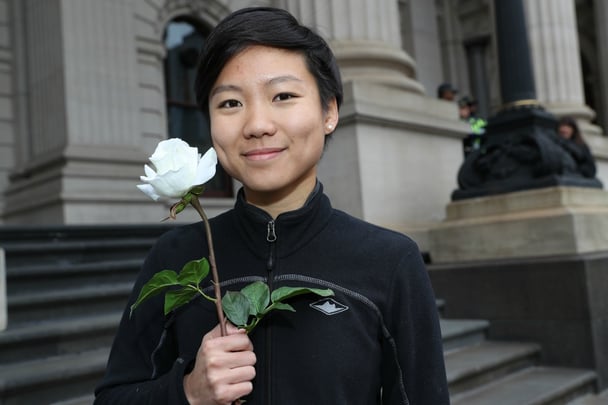
In May, Belinda set off to walk to Perth from Parliament House in Melbourne to honour the memory of her mother and encourage Western Australia politicians to pass a voluntary assisted dying law. Image: AAP.
Mareia asked - first her doctor, and then her palliative care consultant - if they could help her end her life quicker.
As a nurse, she knew what was coming over her last few weeks. She was informed, and she didn't want to go through it.
They couldn't help her, of course, because it was not legal.
Mareia died 11 weeks after her diagnosis.
"I sat next to her bedside for weeks and weeks in that hospice, watching her cry in pain. I saw her become extremely emotionally and psychologically distressed," Belinda, now 27, recalled onMamamia's daily news podcastThe Quicky.
"The thing that gets me out of bed every morning is the last four hours of my mum's life, which I won't go into too much detail, but basically watching my mum die over the very final hours of her life was like watching a horror movie but the star of the film was my mum. I couldn't turn it off, because you have to be there for those moments.
"If mum had satisfied all the eligibility criteria, which I believe that she would have, she would've had control. She would've had peace of mind of knowing as soon as she had enough, she could've made that decision for herself.
"A life with dignity must involve a death with dignity and I feel that if my mum had that option the end of her life, and therefore her life, would've been completely different."
Today, the legislation Mareia so long hoped for comes into effect in Victoria.
From today, Victorians will be able to end their lives via assisted dying – though there are stringent criteria and 68 safeguards. Victorian Health Minister Jenny Mikakos has described the Bill as the safest and most conservative set of euthanasia laws in the world.
In order to quality for assisted dying in Victoria, a gravely ill person must fit the following criteria:
The law states a person is not eligible for access to voluntary assisted dying if they have a mental illness only, or if they have a disability only. However, those with a mental illness and/or a disability can take part if they also fulfil the eligibility criteria above.
Euthanasia is illegal in Australia but states can pass their own legislation. Currently, Victoria is the only state to have done so.
For a time in 1996-1997, assisted dying was legal in Northern Territory but the law was void when federal parliament amended acts that allowed territories to create their own legislation on the issue. Laws have been voted down in New South Wales, South Australia and Tasmania.
An assisted dying bill is due to come before parliament in Western Australia this year and in Queensland, an inquiry into legalising euthanasia was launched in November.
Chelsea McLaughlin
Author
No Comments
Be the first to leave a comment