This post deals with child sexual assault and might be triggering for some readers.
Dassi Erlich was groomed and abused from when she was in year ten, by the principal of her Ultra-Orthodox Jewish school, who knew about her difficult home life. Last year, after a 15-year campaign, her abuser, Malka Leifer, who had fled to Israel, was tried and sentenced, convicted of 18 charges of sexual abuse against Erlich and her sister, Elly. (She was acquitted of charges involving a third Erlich sister, Nicole.)
At the very end of Dassi Erlich's account of abuse, trauma, and recovery through the slowly grinding mills of justice, she lists places where those who experience abuse may find help: including Kids Helpline, Lifeline and Women's Legal Services.
But when her need was most acute, Erlich could not have contacted any of these services. She had absorbed the message that contact with the world outside her family’s enclosed community was a sin.
As the Royal Commission into Institutional Abuse has revealed, coercive control comes easily to patriarchal institutions — and Melbourne's Adass Israel community is particularly patriarchal and controlling.
Adass Israel 'evokes 19th-century Europe'.
As with most ultra-Orthodox Judaism, Adass Israel originated in 19th-century Europe as a conservative reaction to liberal secularism. The cut of the men’s black silk coats worn with white shirts, and their mink hats, come from that time and place.
The Australian congregation was only formed in 1939, but the tiny enclave within East St Kilda and Ripponlea where Melbourne’s Adass Israel community lives effectively evokes 19th-century Europe.
Its members live without television, radio or secular newspapers. Internet access and telecommunications are strictly regulated. Lives revolve around the synagogue and festivals of faith. Most of the approximately 250 families are descended from immigrants who arrived as Holocaust survivors in the years after World War II. That collective memory colours responses to any perceived threat.
In this community, Erlich's family were outsiders. Her parents had joined a generation later, as converts to Orthodoxy after emigrating from England. She notes that as a result, "my mother was on a mission to prove her worth to the Adass community".
The children suffered for her ambition, and from her unpredictable rages and punishments. Erlich writes that from a young age, she realised her mother’s rage "had no rhyme or reason, no trigger we could predict". On one memorable occasion, her mother cut the faces from her daughters' dolls, as they were “idols”. The children were punished by being deprived of food and even the ability to go to the toilet at night.
The community's rules are many. Women's dresses have long sleeves, while thick stockings cover their legs. Wigs or scarves conceal their hair. Modesty is all. The 613 commandments extracted from the Torah govern every aspect of daily life, including the timing of sexual relations between married couples. There is no birth control. Large families are the norm.
People marry young, shortly after the legal age of consent. Marriages are arranged via matchmakers, and couples have few meetings before their wedding. Erlich writes that the first time she had an unsupervised conversation with her former husband, Shua Erlich, was on their wedding day.
Such is the fear of contamination by gender, unrelated girls and boys do not mix after they turn three. At the school for girls, the modified curriculum teaches to keep the commandments, to be good wives and mothers, to obey both future husbands and the religious authorities. Descriptions of animal or human reproductive organs are off the agenda.
In adolescence, Dassi Erlich became upset at the way her father would grab her and hold her close to his body, but did not understand either his motivation or her response.
Such children are vulnerable, easy pickings for predators. The Erlich sisters, with their difficult mother, were especially so.
'It was just a woman'.
When Dassi Erlich was in year nine, in December 2002, a new principal was appointed to the girls' school. Malka Leifer had come from Israel with excellent references and appeared to be everything this devout congregation could desire. Erlich writes of "the respect and awe" the schoolgirls felt in the presence of this charismatic woman, who exuded authority.
At first, the child was thrilled to be noticed, to be singled out for particular attention, to be told she was "special" and not stupid. Her mother was flattered when Leifer offered to give her daughter private lessons out of school hours, to advance her religious education.
Erlich wrote of these "lessons" that "I never found my words" to object to the continuing assaults on her body. She lacked the language, the knowledge or the power to speak out. The account of her inability to escape is hard to read, but is also hard to stop reading. The abuse only ended with her wedding, in September 2006, when she was 19. Its consequences never ended.
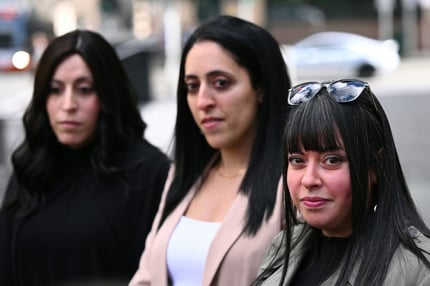
Watch: Dassi and her sisters outside court. Post continues after video.
It was only some years later, when she was in Israel and being counselled for her ongoing depression, that Erlich recognised what had happened to her. She then discovered two of her sisters had also been abused, under similar circumstances. Without language, without knowledge, they had not been able to confide in each other.
The Royal Commission into Institutional Responses to Child Sexual Abuse uncovered that when abuse is discovered, the standard response of many religious institutions is to conceal the evidence. It is hardly surprising the Adass community reacted to the news of the principal’s criminal behaviour in the same way.
In 2008, Leifer vanished overnight from both the school and Australia — before any formal complaint could be made. When the issue was raised, the rabbi's response was: "Mrs Leifer should not be considered guilty of any crime as there has been no investigation."
Given the circumstances, it is hardly surprising Erlich suffered from recurring mental health issues in the following years. Her religion controlled every aspect of her life, but could not save her from being raped. One rabbi, on hearing of Leifer’s acts of abuse, said, "What's the big deal? It was just a woman."
Unrestrained power, control and authority.
In the way it charts her pathway towards healing,In Bad Faithbecomes more than an indictment of a fundamentalist misogynist sect. There are heroes as well as villains.
When Erlich becomes suicidal after the birth of her daughter, her husband's liberal Jewish father pays for her admission to the Albert Road psychiatric clinic. She gives full credit to both her
Joanna Mendelssohn
Author
No Comments
Be the first to leave a comment