Change can be averyscary thing.
Moving house. Having kids. Finding (and losing) relationships.
But what about the women who defy a 'typical career path' at an age when many believe a woman's future should be set in stone?
The median age of Australian women is 37, and that age is only getting higher. But the stereotype exists that female workers in their forties and fifties have slimmer career opportunities.
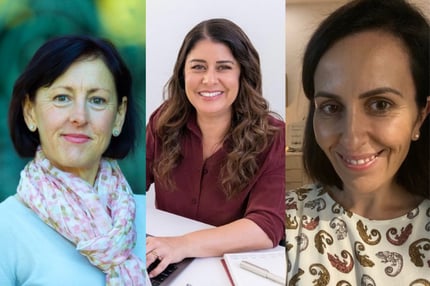
The age-old saying goes: "Great things never came from comfort zones." So we decided to chat to 7 women who flipped the script to see how they changed their careers after turning 40.
Angela: "Follow your gut, and do whatever it is you didn't make time for."
Angela is no stranger to working in diverse industries.
From working in the fashion industry, to marketing for retail companies, property development, and investment banking, she finally landed a position at Qantas in her mid-thirties. She thought she was settled for the long haul.
"I moved into the airline industry and I was at Qantas for 10 years," she toldMamamia.
"I was the woman who got sick every time she went on holidays, which I know now is a prime sign of being exhausted. So I went to a one-week long health retreat."
It was Angela's experience with holistic health while on her retreat that reassured her decision to pursue a future that nurtured her passions.
So, she quit.
"Once I left the airline I moved into non-for-profit work at Taronga Zoo and Habitat for Humanity," she explained sharing that those experiences ticked two of her three 'passion boxes'.
"Animals, social justice and health and wellness."
To fill her final box, she enrolled at Endeavour College of Natural Health to study nutritional medicine.
"It was very difficult letting go of a salary, identity and an executive role and heading into college with a backpack," she said.
It was befriending 'like-minded women' and mature-aged students that most helped her through.
"We're still friends today," she added.
Once she'd completed her degree, Angela launched her own business, Nutritional Matters, as a clinical nutritionist. She is proud of this career change and loves the flexibility it's enabled her.
"Follow your gut and do whatever it is you didn't make time for when you were building your career. Often, we just build a career because that's what feels like the right thing to do at the time, and it's not necessarily where our passion is.
"There is some ageism out there but you can continue to work until you don't want to. I intend to work until I'm 80."
"I remember the first time I went to university and everybody used to look a bit at the mature age students... But actually, the level of maturity of the cohort meant that they just really accepted me and seemed very grateful to have me there, because I brought a different flavour to the course and my knowledge of the outside world.
"The upside of going to study medicine as an older person is that you've got a huge amount of knowledge that you acquire over the years about how people work, about how systems work, about what's expected of you as a professional. So whereas there were some tricky parts, there were lots of positives in there.
"To me, it came down to: if I got to my deathbed and I hadn't done the thing that I wanted to do, would I be disappointed? And I kept coming back, thinking: yes.
"If you're looking at a career change in your 40s and beyond, I think you've got to think, 'Is this worth it in terms of my own satisfaction?'"
Eleni: "There is never a right time to pursue a passion."
"I began my career as a beauty therapist, then moved into an education-based role within my field.
"After the birth of my second child and adjusting to life with two children under the age of 3, I decided to take a voluntary redundancy in my role to be a stay-at-home mum.
"I knew then that it wouldn’t last long as I definitely had an itch to scratch.
"I had always been interested in natural medicine but there was never the right time to pursue this. Within my field, I was always more interested in less invasive alternatives to skin health so returning to study, I suppose, was inevitable.
"I decided naturopathy interested me as I felt drawn to this way of life and it complimented my existing skill set ever so perfectly. So I enrolled in a Bachelor of Health Science in Naturopathy.
"I was drawn to this course because of the flexible learning modes, both online and face-to-face, so this was appealing because it allowed me to study whilst at home with my babies. Plus, it would work around my work-life when I was ready to return to the workforce.
After 4.5 years of part-time study, Eleni's two children are now in primary school and Eleni has her own Holistic Skin & Wellness business, practicing holistic skin therapy while she completes her studies.
"It's been extremely challenging; juggling family, work and study life but I have enjoyed every step of the way. It's been something I needed to do for me.
"For a long time I felt that it wasn’t the right time, but there is never a right time to pursue a passion, so my advice to anyone considering a career change and return to study is to just go for it!"
Maria: "Certain things come into your life when you are ready for that change."
Maria gave up her 18-year teaching career to become an interior designer at age 40.
"It was very hard because when you've been in teaching for so long and you're established, you start questioning if it's the right thing to do. Am I going to regret this? But it's funny how certain things come into your life when you are ready for that change.
"My sister-in-law was building a house and then the thought came about, 'How about looking into interior design?' So I did an online course first, and it wasn't until three years later that I decided I wanted to do more face-to-face study and then decided that it was now or never: take the plunge. I didn't want to stay in teaching forever, and I didn't want to waste any more time.
"I had no regrets leaving teaching even though at the time I was very fearful of leaving. It was probably one of the best decisions I ever made.
"You don't want to look back 20 years down the track and think, 'Why didn't I do it?' I'm no one extraordinary; if I could do it, I think anyone can do it. It's just a matter of making that decision and chasing after it."
Kathryn: "Let armchair moments come to life."
Kathryn recalls sitting in an armchair at 3am holding her newborn daughter warmly in her arms. She was in Glasgow, Scotland at 29 years old.
Fifteen years later, Kathryn could still recall that night as a moment of clarity when the reality and responsibility of motherhood weighed heavily on her mind and heart.
"At the same time, I felt joy and acceptance of my journey ahead – how mothering my daughter could truly shape her world and make a difference. I felt exhilarated.
"Fast forward to November 2019. I have my final exam of my Nutritional & Dietetic Medicine degree in a few minutes. If I’m honest, I had an inkling in that 3am armchair moment years ago that my 'why' involved health and wellness.”
For Kathryn, the jump seemed absurd, impractical and scary. Mostly scary. She had started her degree at 37 years old, and was terrified.
"While having children provided me with a natural closure to my desk job in the finance and IT industry and flexibility to study my fitness courses, commencing part-time study to complete a degree in nutrition over six years while nearing 40 felt anything but practical.
"So, this exam, this final exam, was my way of declaring my desire to make a difference. To serve others. To listen and hear them. To collaborate. To focus on meaningful action. To prioritise values in ways that were practical and repeatable rather than idealistic. To research and make science clinically relevant. To let armchair moments come to life."
Kathryn is now 44 and has two teenage girls. She says that she sits in a new armchair in Sydney, having bought it to take space in her new business and office where nutrition, health and wellness are discussed daily.
"My business is Sagely Clinic. I have lots of armchair moments now, each of them exhilarating, and I sense a difference has been made. But it happened first in me.
"I had to stop listening to hamster-in-the-wheel-like thoughts that told me I’m not good enough, that I can’t make a living out of this change in career, or that I can’t make a difference.
"These thoughts are why I stalled changing careers. And confession: the hamster-in-the-wheel thoughts haven’t totally disappeared.
"I tell my clients to focus on doing ‘one thing well’ daily, because that’s how my own change came.
"It happened daily and over years; I kept saying yes, and eventually my ‘yes’ spoke louder than my fears.
"Having the mindset of doing one thing well has helped me immensely to adapt to my new career and role, and put aside doubts and unrealistic thoughts of having to have the overnight success business.
"Instead, and I wish I’d understood this sooner: I fell in love with the process of change."
Vicki: "As long as you wake up and you're conscious in the morning, it's not too late to do anything."
After years working as a translator in Canada and France, Vicki moved to Sydney to become a university lecturer.
After her retirement, she taught ethics to primary school students. Then, in her 70s, picked up a pen and wrote a book about her family's struggle with her mother's mental health issues.
In 2019, that book won a major literary award.
We are delighted to announce Vicki Laveau-Harvie’s memoir The Erratics as the 2019 Stella Prize winner. Laveau-Harvie’s sharp, darkly funny and powerful book explores the universal themes of family, the pain they can inflict and the legacy they leave. #2019StellaPrize #winner pic.twitter.com/PRTowAoU8r
— The Stella Prize (@TheStellaPrize)
"I was in my 70s. I didn't sit down to write it as a book. I sat down to write because I loved writing; I loved the process. I wasn't that concerned with sending it out into the world.
"But this experience with my parents in their very late years, and how things managed to be tragic and ludicrous at the same time, I found interesting and I thought, 'I would like to capture this on the page.'
"And then when it won, I thought this book may interest people who have had similar or the comparable problems in their own families.
"What I want to do and what makes things interesting for me is finding some kind of meaning in them. And I think that's what everybody is looking for.
"In all various ways, children are always asking you, 'What does that mean? And what is that?' And I think if you are an adult and you keep asking yourself those questions, you're probably doing the right thing with your human potential. That's my belief.
"We carry the double burden of being women and being older, which makes you damn near invisible in the supermarket aisle. But we still have some agency if we're articulate and if we are looking for some meaning. So let's use it.
"I think as long as you wake up and you're conscious in the morning, it's not too late to do anything."
Claudia: "Find your support network during the change."
Emma Gillman
News Writer
No Comments
Be the first to leave a comment