
In 2015, Chanel Miller made a spur-of-the-moment decision to join her sister at a Stanford University fraternity party.
When she next woke up, on a gurney in a hospital hallway, she had assumed other identities: ‘Emily Doe’, ‘unidentified victim’ and ‘unconscious, intoxicated woman’.
She did not initially realise what had happened to her. But as pine needles fell out of her hair, as nurses poked and prodded her body, as she sat at work in the days afterwards reading articles about that night, she pieced it together.
Chanel Miller, known as ‘Emily Doe’ for four years, reads her victim impact statement on 60 Minutes. Post continues below video.
She had been assaulted by former Stanford student Brock Turner behind a dumpster outside the party. He was stopped when two Swedish international students saw him, tackling him as he tried to run away and holding him down until police arrived.
Turner’s achievements as a champion swimmer were thread into articles about the case, read by his victim who was not afforded the same treatment.
“After I learned about the graphic details of my own sexual assault, the article listed his swimming times. She was found breathing, unresponsive with her underwear six inches away from her bare stomach curled in fetal position. By the way, he’s really good at swimming. Throw in my mile time if that’s what we’re doing. I’m good at cooking, put that in there, I think the end is where you list your extracurriculars to cancel out all the sickening things that’ve happened,” she read aloud at Turner’s sentencing.
In 2016, Turner was found guilty of three counts of sexual assault and sentenced to just six months in a county jail.
Prosecutors had sought a six-year prison term, but Judge Aaron Persky declared a stint in a state prison was not “the right answer” for Turner. That it would have a “severe impact” on him.
He never mentioned how Miller’s life had been impacted.
Turner was sentenced to six months in prison, but he walked out after serving just three.
The case sparked outrage around the world and led to a prominent campaign to have Persky recalled from the bench.
Turner’s name was held up as an example of rape culture and of white, male and class privilege. The backlash led to two law changes in California, so that in future, Turner’s offending would be covered under the state’s legal definition of rape. Another law provided a mandatory minimum three-year prison sentence for sexual assault on an intoxicated or unconscious person.
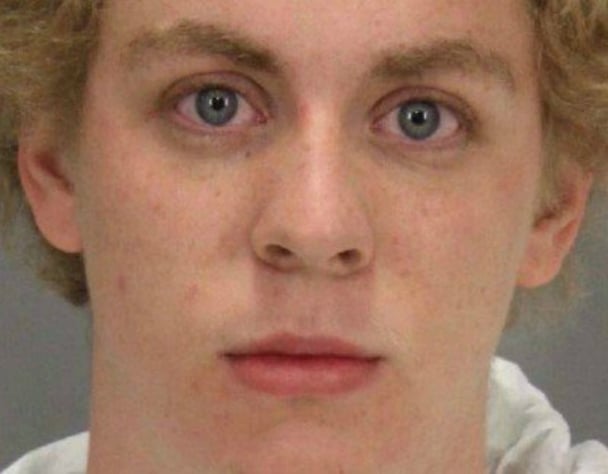
Brock Turner served just three months in jail.
Then, Buzzfeed published the powerful 12-page, 7000-word statement that was penned and read at the sentencing hearing by his unidentified 23-year-old victim, then known only as 'Emily Doe'.
"I was not only told that I was assaulted, I was told that because I couldn’t remember, I technically could not prove it was unwanted. And that distorted me, damaged me, almost broke me. It is the saddest type of confusion to be told I was assaulted and nearly raped, blatantly out in the open, but we don’t know if it counts as assault yet. I had to fight for an entire year to make it clear that there was something wrong with this situation," she wrote.
"In newspapers my name was ‘unconscious intoxicated woman’, 10 syllables, and nothing more than that. For a while, I believed that that was all I was.
"I had to force myself to relearn my real name, my identity. To relearn that this is not all that I am. That I am not just a drunk victim at a frat party found behind a dumpster, while you are the All-American swimmer at a top university, innocent until proven guilty, with so much at stake."
After years of remaining anonymous, she wants to shed 'Emily Doe'.
Her name is Chanel Miller.
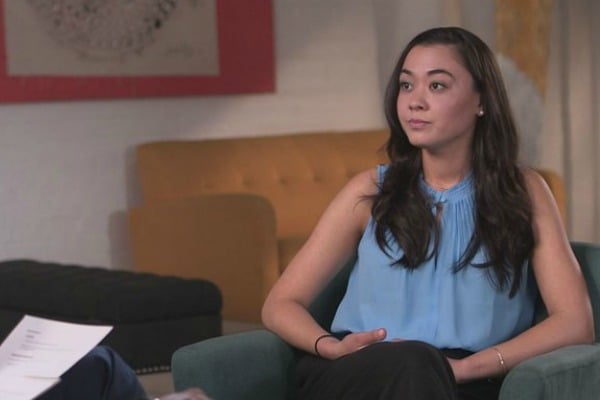
Image: CBS.
The California-based writer, now 27, is reclaiming her identity with her bookKnow My Name: A Memoirand by giving an interview to CBS'60 Minutes this weekend.
In a preview of the segment, Miller reads part of her victim impact statement.
The memoir, to be published on September 24, "illuminates a culture biased to protect perpetrators, indicts a criminal justice system designed to fail the most vulnerable, and, ultimately, shines with the courage required to move through suffering and live a full and beautiful life," according to publisher Viking.
Andrea Schulz, the editor-in-chief of Viking, told the New York Times that the memoir is "one of the most important books" she’s ever published.
"I just remember being in my kitchen and reading this incredible, riveting piece of work," Schulz recalled of reading Miller's victim impact statement.
"I jumped out of my chair to acquire it because it was just obvious to me from the beginning what she had to say and how different it was and how extraordinarily well she was going to say it. She had the brain and the voice of a writer from the very beginning, even in that situation."
Here is Chanel Miller's full victim impact statement, read at Brock Turner's sentencing hearing in 2016 and released by Santa Clara County:
Your Honour, if it is all right, for the majority of this statement I would like to address the defendant directly.
You don’t know me, but you’ve been inside me, and that’s why we’re here today.
On January 17th, 2015, it was a quiet Saturday night at home. My dad made some dinner and I sat at the table with my younger sister who was visiting for the weekend. I was working full time and it was approaching my bed time. I planned to stay at home by myself, watch some TV and read, while she went to a party with her friends. Then, I decided it was my only night with her, I had nothing better to do, so why not, there’s a dumb party ten minutes from my house, I would go, dance like a fool, and embarrass my younger sister. On the way there, I joked that undergrad guys would have braces. My sister teased me for wearing a beige cardigan to a frat party like a librarian. I called myself “big mama”, because I knew I’d be the oldest one there. I made silly faces, let my guard down, and drank liquor too fast not factoring in that my tolerance had significantly lowered since college.
The next thing I remember I was in a gurney in a hallway. I had dried blood and bandages on the backs of my hands and elbow. I thought maybe I had fallen and was in an admin office on campus. I was very calm and wondering where my sister was. A deputy explained I had been assaulted. I still remained calm, assured he was speaking to the wrong person. I knew no one at this party. When I was finally allowed to use the restroom, I pulled down the hospital pants they had given me, went to pull down my underwear, and felt nothing. I still remember the feeling of my hands touching my skin and grabbing nothing. I looked down and there was nothing. The thin piece of fabric, the only thing between my vagina and anything else, was missing and everything inside me was silenced. I still don’t have words for that feeling. In order to keep breathing, I thought maybe the policemen used scissors to cut them off for evidence.
Then, I felt pine needles scratching the back of my neck and started pulling them out my hair. I thought maybe, the pine needles had fallen from a tree onto my head. My brain was talking my gut into not collapsing. Because my gut was saying, help me, help me.
I shuffled from room to room with a blanket wrapped around me, pine needles trailing behind me, I left a little pile in every room I sat in. I was asked to sign papers that said “Rape Victim” and I thought something has really happened. My clothes were confiscated and I stood naked while the nurses held a ruler to various abrasions on my body and photographed them. The three of us worked to comb the pine needles out of my hair, six hands to fill one paper bag. To calm me down, they said it’s just the flora and fauna, flora and fauna. I had multiple swabs inserted into my vagina and anus, needles for shots, pills, had a Nikon pointed right into my spread legs. I had long, pointed beaks inside me and had my vagina smeared with cold, blue paint to check for abrasions.
After a few hours of this, they let me shower. I stood there examining my body beneath the stream of water and decided, I don’t want my body anymore. I was terrified of it, I didn’t know what had been in it, if it had been contaminated, who had touched it. I wanted to take off my body like a jacket and leave it at the hospital with everything else.
On that morning, all that I was told was that I had been found behind a dumpster, potentially penetrated by a stranger, and that I should get retested for HIV because results don’t always show up immediately. But for now, I should go home and get back to my normal life. Imagine stepping back into the world with only that information. They gave me huge hugs and I walked out of the hospital into the parking lot wearing the new sweatshirt and sweatpants they provided me, as they had only allowed me to keep my necklace and shoes.
My sister picked me up, face wet from tears and contorted in anguish. Instinctively and immediately, I wanted to take away her pain. I smiled at her, I told her to look at me, I’m right here, I’m okay, everything’s okay, I’m right here. My hair is washed and clean, they gave me the strangest shampoo, calm down, and look at me. Look at these funny new sweatpants and sweatshirt, I look like a P.E. teacher, let’s go home, let’s eat something. She did not know that beneath my sweatsuit, I had scratches and bandages on my skin, my vagina was sore and had become a strange, dark color from all the prodding, my underwear was missing, and I felt too empty to continue to speak. That I was also afraid, that I was also devastated. That day we drove home and for hours in silence my younger sister held me.
My boyfriend did not know what happened, but called that day and said, “I was really worried about you last night, you scared me, did you make it home okay?” I was horrified. That’s when I learned I had called him that night in my blackout, left an incomprehensible voicemail, that we had also spoken on the phone, but I was slurring so heavily he was scared for me, that he repeatedly told me to go find [my sister]. Again, he asked me, “What happened last night? Did you make it home okay?” I said yes, and hung up to cry.
I was not ready to tell my boyfriend or parents that actually, I may have been raped behind a dumpster, but I don’t know by who or when or how. If I told them, I would see the fear on their faces, and mine would multiply by tenfold, so instead I pretended the whole thing wasn’t real.
I tried to push it out of my mind, but it was so heavy I didn’t talk, I didn’t eat, I didn’t sleep, I didn’t interact with anyone. After work, I would drive to a secluded place to scream. I didn’t talk, I didn’t eat, I didn’t sleep, I didn’t interact with anyone, and I became isolated from the ones I loved most. For over a week after the incident, I didn’t get any calls or updates about that night or what happened to me. The only symbol that proved that it hadn’t just been a bad dream, was the sweatshirt from the hospital in my drawer.
One day, I was at work, scrolling through the news on my phone, and came across an article. In it, I read and learned for the first time about how I was found unconscious, with my hair disheveled, long necklace wrapped around my neck, bra pulled out of my dress, dress pulled off over my shoulders and pulled up above my waist, that I was butt naked all the way down to my boots, legs spread apart, and had been penetrated by a foreign object by someone I did not recognise. This was how I learned what happened to me, sitting at my desk reading the news at work. I learned what happened to me the same time everyone else in the world learned what happened to me. That’s when the pine needles in my hair made sense, they didn’t fall from a tree. He had taken off my underwear, his fingers had been inside of me. I don’t even know this person. I still don’t know this person. When I read about me like this, I said, this can’t be me, this can’t be me. I could not digest or accept any of this information. I could not imagine my family having to read about this online. I kept reading. In the next paragraph, I read something that I will never forgive; I read that according to him, I liked it. I liked it. Again, I do not have words for these feelings.
It’s like if you were to read an article where a car was hit, and found dented, in a ditch. But maybe the car enjoyed being hit. Maybe the other car didn’t mean to hit it, just bump it up a little bit. Cars get in accidents all the time, people aren’t always paying attention, can we really say who’s at fault.
And then, at the bottom of the article, after I learned about the graphic details of my own s
Chelsea McLaughlin
Author
No Comments
Be the first to leave a comment