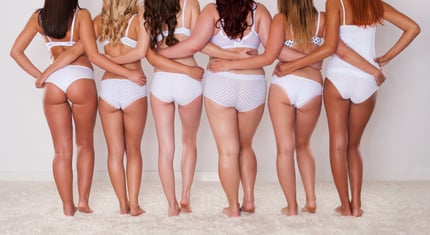
Image via iStock. By Winona Dimeo-Ediger.
Judging other women’s bodies became a defense mechanism — a fleeting, superficial salve against the hate I felt for my own flesh.
If I could instantly identify 10 things wrong with another woman’s outfit, or another woman’s body, then maybe I would feel OK about mine.
For the majority of my adult life, even after writing about inclusive style and body positivity for years, I judged other women’s bodies. It would happen in less than a split second, usually sparked by a piece of clothing, a monologue hissing through my head: “She definitely should NOT be wearing that.”
Maybe I saw a larger woman showing “too much skin” and thought, “She needs to cover up.” The sight of a very thin woman might spark the most original of digs: “She needs to eat a sandwich.” It was as instant and reflexive as pulling my hand from a hot stove: see a woman; identify her flaws. Lather, rinse, repeat.
RELATED: Lauren Conrad bans “body shaming” words from her site – but is that really helpful?
I’m deeply embarrassed to admit this publicly, but I want to put it out there because I know my body-policing habits aren’t uncommon; in fact, they’re more the rule than the exception.
Our culture polices women’s bodies constantly, but what’s even worse is the way we, as women, learn to police each other’s bodies. We’ve all done this, at some time or another, out loud or silently (Post continues after gallery).
Celebrities talking about positive body image.
Rebel Wilson
The actress said on Twitter; "I'm not trying to be hot. I'm just trying to be a good actress and entertain people." Image via @rebelwilson

Lady Gaga
After the media focused on her alleged weight gain in September 2012, Gaga hit back at critics by baring her body in photographs, sharing her struggles with an eating disorder, and inviting her fans to join her in a "body revolution"/ Image via @ladygaga
Ashley Judd
After the March 2012 frenzy around Judd's "puffy face" the actress fought back in 'The Daily Beast', calling the media out for making women's bodies "a source of speculation, ridicule, and invalidation, as if they belong to others". Image via @ashley_judd
Christina Aguilera
"I am always in support of someone who is willing and comfortable in their own skin enough to embrace it," the singer said in a recent interview. Image via @xtina
Lena Dunham
At the 2012 New Yorker Festival, the magazine's TV critic, Emily Nussbaum, asked Lena Dunham, producer, creator and star of the hit HBO show 'Girls' why Dunham is naked in so many scenes. Dunham responded; "I realised that what was missing in movies for me was the presence of bodies I understood." She said she plans to live until she is 105 and show her thighs every day. Image via @lenadunham
Alexa Chung
Chung responded to critics who suggested that her slight frame made her a bad role model for young women, saying: "Just because I exist in this shape doesn't mean that I'm, like, advocating it." Image via Twitter @alexa_chung
Beth Ditto
This five-foot-tall, 200-pound singer spoke openly about her weight to 'The Advocate' saying, "I feel sorry ... for people who've had skinny privilege and then have it taken away from them. I have had a lifetime to adjust to seeing how people treat women who aren't their idea of beautiful and therefore aren't their idea of useful, and I had to find ways to become useful to myself." Image via @marybethditto
A few years ago, I made the decision to stop, and it’s been a surprisingly tough habit to exorcise from my psyche. I haven’t stopped all body judgments completely, but I’ve gotten better, and I’m trying. I want all of us to try, and to keep trying, because we deserve better than this.
The thing is, we soak in these body-judging lessons from a very young age, before we even know how damaging they are. Some of the messages are implicit, like when we see a fat girl getting made fun of on the playground (or, for many of us, when we are the fat girl getting made fun of on the playground) and learn that being fat is not just wrong, it’s a punishable offense.

Some of the messages, like tabloid covers with big red arrows pointing to cellulite on a tiny actress’s thigh, are so ridiculously explicit you’d think we’d be able to ignore them, but they seep in too. Fashion magazines put beautiful people side-by-side and ask, “Who looks better?” Oprah has sharp-tongued “fashion experts” that literally chase down women in the grocery store and berate them for wearing a bra that shows their back fat.
The hosts of What Not To Wear — which used to be one of my favorite shows — put people who don’t conform to cultural fashion norms in a 3-D mirrored box, and point out their flaws until they cry.
RELATED: “What I say to my daughter when she asks me if she looks fat.”
Between the playground, the media, online comments, and words from our mothers and best friends, by the time we’ve reached our early 20s, most women have become skilled body-image assassins, highly trained to identify and point out flaws in seconds.
As someone who has always loved fashion, I got pulled into this cycle even more dramatically. I figured if I wanted to be a real fashion writer, I better understand the definitions of “looking good” and “looking bad.”
I studied worst and best-dressed lists. I sought out harsh fashion rules. What I didn’t realize, as I breezed through stacks of fashion magazines and nodded my head emphatically when Stacy London advised wearing boot cut jeans to disguise large thighs, is that fashion is just a convenient gateway into body policing.
We can hide behind the idea that we are assessing garments and fit, but we’re really body policing, assessing the body underneath.
When we say, “she shouldn’t be wearing that,” 99 per cent of the time we really mean, “She shouldn’t be showing her body in that way.” In the fashion world, we don’t just talk about clothes being right and wrong. We’re talking about bodies being right and wrong, which translates to women being right and wrong.
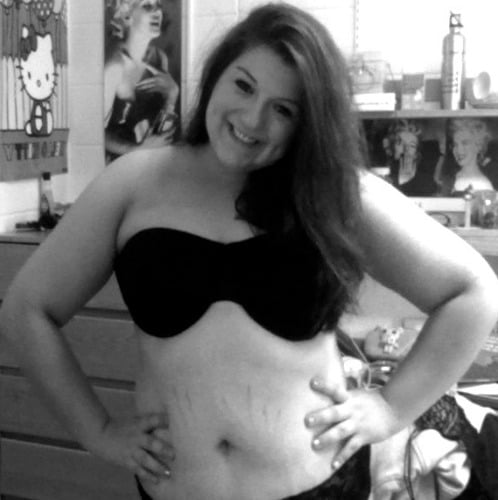
There’s another reason judging others came so easily to me: I hated my own body, which has always been soft and chubby, and from second grade onward I’d had to deal with people judging me.
Every time I looked in the mirror, I gave myself an instant head-to-toe assessment more vicious than I’d ever give someone else. I hated my thighs, stomach, boobs, upper arms and face. I loved fashion but hated the way clothes looked on me, and how hard it was to find jeans in my size. (Post continues after gallery.)
The advice we'd give our younger selves.
Author
No Comments
Be the first to leave a comment