If you want to support independent women's media, become a Mamamia subscriber . Get an all-access pass to everything we make, including exclusive podcasts, articles, videos, and our exercise app, MOVE.
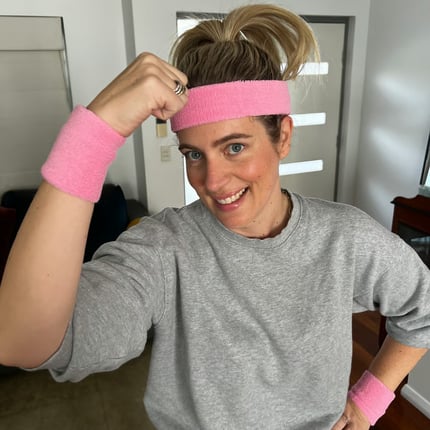
Look, I have never been huge into exercise. I was not a sporty kid. You would have found me in the drama room, interpretive dancing to music at lunchtime and gossiping with friends, rather than kicking a ball on a field.
In the last few years, though, I have really shifted the focus and made movement a priority. I know how much it directly affects my mental health.
And when I say "focus", I mean lots and lots of walking. I was even super proud of myself for introducing running into my agenda. Yes, at the ripe age of 42, I decided I would become a runner.
But as it turns out, starting a high-impact sport out of nowhere in your fifth decade comes with some baggage.
Watch: Exercise Hacks: Sneaky Squats on WELL. Post continues below.

Suddenly, my knees started to protest. I was finding myself genuinely exhausted. And sore. Like, everything-hurt-and-I-felt-stiff sore.
So, like any self-respecting woman in 2026, I turned to a podcast for advice: Mamamia's WELL.
Well, I was today years old when I learnt that as a woman in my forties, I am missing a vital, crucial element of my routine. I am meant to be doing weights and strength training.
By skipping the resistance, I'm essentially gambling with my skeleton's structural integrity.
It turns out my muscle mass is performing a slow-motion vanishing act with every lap of the sun, driven by the biological reality of ageing and the total hormonal heist that is perimenopause.
The metabolic truth about muscle.
The fitness echo chambers of social media have turned exercise into a tug-of-war between the barbell and the treadmill. But apparently, forcing women to pick a side is the first mistake in the fight against age-related decline.
"Realistically, for overall health, longevity and just how you feel, a moderate amount of each is going to be superior," Dr Joanna McMillan, a nutrition scientist and lifestyle medicine expert, told Mamamia.
Dr Jo, who is 53, admitted that even she underestimated the shift.
"I just thought I've always exercised all my life. And what I've learnt, particularly going through the perimenopausal years, is that does change, and you have to change the way that you exercise", she said.
"You think it's never going to happen to you. There are so many women who are telling me they've got frozen shoulders and tennis elbow, even though they've never played tennis in their life".
It's not just about the joints, though. It's about our internal chemistry. Dr Jo highlighted that muscle is actually a metabolic organ.
"It's not just there to lift heavy things or to make you look muscular and athletic. It plays a much more important role," she explained.
"One of the most important things muscles do is blood sugar control. It's our biggest organ, pulling up glucose from our blood. So if your muscles start not working quite so well, it's not as metabolically active... your muscles start to slowly wither away".
Yikes.
Listen to Mamamia's WELL podcast, where hosts Claire Murphy and Dr Mariam ask, 'can you actually age-proof your body'. Post continues below.
This natural decline is called sarcopenia. If we don't actively work to maintain that muscle mass, it becomes increasingly difficult to claw it back. Dr Jo was quick to clarify that this doesn't mean we ditch the morning walk.
"Cardio is really important for your cardiovascular health, and it's very good for your mental health. So it doesn't mean to say you abandon all your cardio and you just do strength, we need both".
Why oestrogen changes the rules.
If Dr Jo provided the "why", Dr Gina Levy, Senior Nutrition Manager at Kellogg's Australia, provided the biological "how".
It all comes down to the hormone shift we all know is coming (or are currently drowning in): oestrogen. Dr Gina cautioned that as oestrogen fluctuates in our 40s and beyond, our muscles become less responsive to the signals that prompt repair.
"Even if someone continues to eat and move as they always have, the body simply does not rebuild muscle as efficiently," she said.
And it's the bones that really need our attention. Dr Gina explained that oestrogen usually helps regulate the cells that break down old bone. When that regulation disappears, bone breakdown begins to outpace new bone formation.
"Muscle and bone will only strengthen when they are challenged. Weight-bearing and resistance training provide the mechanical signals that tell these tissues they are still needed," she noted.
"Without that stimulus, the natural default is gradual decline.
"Good nutrition supports this transition through protein, calcium and vitamin D, which is essential, but it cannot address this issue on its own.
"Calcium helps mineralise bone that has already been formed. It does not stimulate the body to build new bone. Only weight-bearing exercise can activate the cells that create new bone structure."
The takeaway? Lifting "heavy" doesn't mean you have to be an Olympian. It just means choosing a level of resistance that forces your body to adapt.
Our new action plan!
If the idea of a gym floor full of Grunting Gym Bros™ makes you want to retreat to the drama room, Judy Davie, Personal Trainer and Food Coach from Clareville Fitness, has some good news.
"For many women over 40, returning to, or venturing into, a gym with weights can feel quite intimidating," Judy admitted. But spoiler alert, you don't need fancy gym equipment to incorporate this into your routine.
"The key to strength training is to challenge the body with weights that are heavy enough so that by about the 8th repetition your muscles feel quite fatigued, and you feel only capable of one to two more good-quality reps."
Judy's simple starting routine (2–3 times per week).
Aim for 8–12 repetitions of each exercise, for 3–4 sets.
The Squat (Thighs): Try a sit-to-stand from a chair or squats holding a heavy kettlebell or weight plate.
The Hinge (Glutes and Hamstrings): A deadlift is vital for protecting your lower back. You can use a bar or simply load a backpack with heavy books at home.
The Lunge (Legs and Balance): Step forward or backward. To level up, add bicep curls using dumbbells.
The Push (Upper Body): Push-ups against a wall, a bench, or on the floor. Overhead presses with weights also work.
The Pull (Upper Back and Posture): Bent-over rows using dumbbells or a loaded backpack. This helps reverse the "slump" of desk life.
The Twist (Core): Gentle rotational movements, plus "dead bugs" or planks to support the spine.
Gait and Balance: The "Farmer's Carry", literally just standing upright with heavy weights in each hand and walking.
Judy also gave a special shout-out to our glutes, which tend to "disengage" as we age and sit too much. Weighted bridges and banded "fire hydrants" are your best friends here to prevent back pain.
And if you're time-poor? "It doesn't all have to be done in one session," Judy said.
"Short 10-minute 'exercise snacks' throughout the day can be just as effective as a longer workout."
Her final piece of wisdom for us? "Don't compete with your younger self."
Right, well, I don't know about you, but I am going to start implementing these "exercise snacks" immediately.
I love that I don't need a fancy membership to follow Judy's routine, just the weight of my own body, something heavy around the house and a bit of grit.
Bring on my new strength training era. My knees (and my future self) will thank me.
Feature Image: Supplied.
Dr. Gina Levy is a Senior Nutrition Manager at Kellogg's passionate about the crucial role of protein during the 'mid' phase of life. To help close the 'breakfast protein gap' you can find out more about Kellogg's High Protein Granola here .
Dr. Joanna McMillan is a PHD qualified nutrition scientist and lifestyle medicine expert. You can find a copy of her new book The Fibre Factor here.
Judy Davie is a Personal Trainer and Food Coach from Clareville Fitness. Find out how you can get involved in her Strength, Balance and Cardio Classes for over 50s here.
Well, Mamamia's health brand for women is shaped by the health experiences of women just like you. Sign up to the Well newsletter to receive your weekly dose of trusted health expertise without the medical jargon, ask a question or share your story.
Annaliese Todd
Lifestyle Producer
No Comments
Be the first to leave a comment