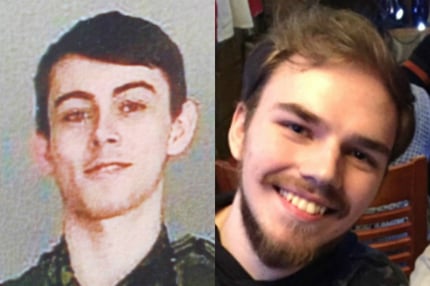
The bodies of the teenagers suspected of murdering Australian tourist Lucas Fowler and his US girlfriend Chynna Deese have been discovered in thick brush near Gillam, Manitoba.
RCMP Manitoba assistant commissioner Jane MacLatchy told reporters she was “confident” the bodies were missing fugitives Kam McLeod and Bryer Schmegelsky “but to be sure we have to go to the autopsy”.
The breakthrough came on Friday with the discovery of “items” on the shoreline of the Nelson River near Gillam, about 8km from where the duo dumped their Toyota RAV4 getaway car on July 22.
Items found by the vehicle include food scraps suggesting the pair ate oranges and pork chops as their last meal, news.com.au reports.
At about 10am on Wednesday Manitoba time (2am Thursday AEST) RCMP officers “located two male bodies, in the dense brush, within 1km from where the items were found”.
As reported by news.com.a u , Bryer Schmegelsky would have turned 19 last Monday, August 4, but authorities say it’s likely he and accomplice Kam McLeod died “agonising and gruesome” deaths in the insect-infested swamp days earlier while on the run from a military-level search.
While MacLatchy declined to say if the teenagers had suffered injuries or provide details about how they may have died, injury, exposure, water contamination, animal attack, anaphylactic shock from insect bites and suicide are all possibilities.
Rumours the pair committed suicide have circulated since July 28, when locals reportedly heard gunshots during a police SWAT team raid of the nearby community of York Landing, following a sighting.
Reports of the noises were documented by locals on social media.
The RCMP denied reports of gunshots, before conceding two of its members had in fact fired shots to communicate their location to fellow officers.
“To the families of everyone affected by the series of events over the last few weeks, I know it has been so very difficult and I hope today’s announcement can begin to bring some closure,” MacLatchy said.
The breakthrough ends a tense three-week pursuit stretching 3000km across northern Canada.
Canada-wide warrants were issued for McLeod and Schmegelsky after Canadian authorities officially charged the pair with second-degree murder of Vancouver man Leonard Dyck, whose body was discovered near their burned out Dodge in northern British Columbia on July 19.
The Royal Canadian Mounted Police deployed a massive contingent of personnel and were assisted by Royal Canadian Air Force planes equipped with infra-red cameras and imaging radar to search 11,000 square kilometres around the town of Gillam and surrounding wilderness, but last week announced the search would be scaled back.
More than 500 homes and buildings were canvassed and train tracks, trails and other locations were searched but authorities have failed to make any confirmed sightings.
The items and the boat.
Over the weekend the RCMP announced that underwater recovery teams were being called in to Gillam, with divers to begin searching the Nelson River on Sunday.
They discovered a damaged aluminium boat, about 8km from where the duo dumped their Toyota RAV4 getaway car on July 22.
Nearby, they discovered items that were “directly linked to the suspects”.
These items have now been revealed as a sleeping bag, half-eaten pork chops and orange peel found alongside the vehicle the pair set fire to. The findings suggest they ate their rations of meat and fruit before heading into the depths of the swampland.
Canned fish, tools and other supplies were left behind, suggesting they had not intended to camp in the wilderness for long.
The RCMP sent in dive teams on the weekend to scan the river and searchers went into the thick scrub around the area.
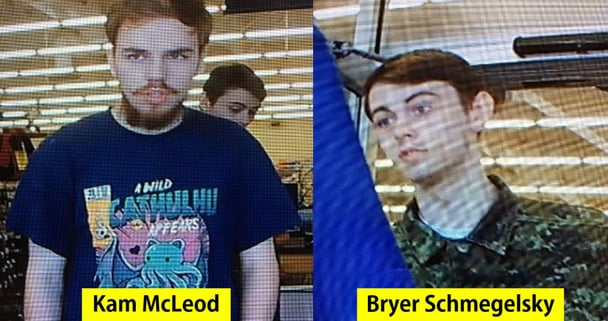
Kam McLeod and Bryer Schmegelsky as seen on recent CCTV. Image: BCRCMP.
False sightings in Ontario.
Police were investigating several unconfirmed sightings of the pair in the state of Ontario.
The Ontario Provincial Police (OPP) said one of the reports related to a pair of "suspicious" men fitting the descriptions of McLeod and Schmegelsky in the northern Ontario town of Kapuskasing.
According to OPP, a white vehicle was seen driving suspiciously through a construction site on Highway 11 in the northern Ontario town of Kapuskasing about 10.30am on Wednesday.
Another false sighting was reported near Moonbeam, where a construction worker claimed they were driving a white Ford Focus.
The man claimed a man showed him a handgun and was wearing the same camouflage shirt he was captured wearing in CCTV images.
A statement by OPP said it has followed up on the sightings and "none of them, including the one earlier in Kapuskasking have led us to believe the suspects have made their way to Ontario."
The checkpoint.
On Tuesday authorities confirmed the duo was stopped after running a checkpoint but then let go.
It comes as a once-promising search near a garbage tip proved fruitless.
McLeod and Schmegelsky were stopped by Split Lake First Nations safety officers last week after they drove through an alcohol search checkpoint, but the officers had not been alerted to be on the lookout for the teenagers.
"These two individuals kind of drove through the check stop where we had the two constables follow them into the community and stop them," Nathan Neckoway, the band councillor of the Tataskweyak Cree Nation, told Canada'sCTV Newson Tuesday.
Alcohol is banned in the area.
When a search of the car did not find alcohol, McLeod and Schmegelsky were allowed to continue driving.
They apparently drove 90km west to Gillem, crashed their Toyota RAV4 on a gravel road, set fire to it and vanished.
Neckoway said the teenagers said during the stop they were from British Columbia.
The search of the car did not find weapons, but maps and camping equipment were sighted, he said.
Neckoway said "it was quite shocking" when the officers later realised the teenagers were fugitives.
"Eat them alive."
Dave Arama is one of Canada's leading survival experts.
He knows the dangers lurking in the swampy sub-Arctic boreal forest around Gillam, where McLeod and Schmegelsky were suspected of hiding out for more than a week, before unconfirmed sightings possibly placed them in Ontario.
If the duo did enter the wilderness and did not find some type of shelter Arama predicted they would be dead or close to it.
But it is not the black bears, polar bears or wolves Arama places high on his top 10 list of dangers the teenagers would have faced.
It's the insects. There's relentless blood-sucking deer flies, mosquitos, sandflies and other bugs.
"They eat you alive," Arama, owner of the Ontario-based WSC Survival School, toldAAPon Tuesday.
"They won't stop biting until until your eyes close and you can't see no more.
"Or, if you get enough bites you can go anaphylaxis and then end up in a serious life-threatening reaction."
Water might be plentiful in northern Canada during summer but instead of keeping the teenagers alive it also could be highly hazardous.
"If they drink any water it is likely filled with parasites, giardia and they'd get sick as hell from that," he said.
For McLeod and Schmegelsky to survive more than a few days in the wilderness they would have had to have found a hunting cabin or another type of building.
In winter the temperatures drop to below minus 20C with the windchill pushing it down to the minus 50s, but even the current summer months the temperatures have dropped below 10C and there have been rainstorms.
Both teens are thin, standing 193cm tall and weighing just 77kg, making it less likely they could survive a week outside without food and appropriate clothing.
Arama said they would need to be wearing waterproofed wool and microfleece gear.
The camouflage attire Schmegelsky is seen wearing in video surveillance footage was inadequate and the t-shirt McLeod was in a certain death sentence.
Arama said he has had groups in the wilderness for nine or 10 days who on average lost 9kg to 23kg "just to try to stay warm".
"I'll be honest. With 40 years of experience, if you threw me out there with no knife, no tin can, no flint to start a fire, no tarp, no nothing, I'd rather die," Arama said.
"This is no Crocodile Dundee movie. This is real."
York Landing.
The RCMP announced on Tuesday it had withdrawn its heavy presence from another area near Gillam, the tiny community of York Landing, where they received a tip on Sunday of two men matching McLeod's and Schmegelsky's description foraging in a garbage tip.
"A search of the York Landing area, which included the use of helicopters, drones, military resources, and door-to-door canvasses, has been completed," the RCMP said in a statement.
"RCMP is unable to substantiate the tip that the suspects had been in the area.
"The heavy police presence in York Landing has been withdrawn and policing resources in the community is back to normal."
"The end of the road."
The manhunt began after the Toyota Rav4 that Vancouver Island teens McLeod and Schmegelsky had been travelling in was discovered by police burned-out near the extremely remote town of Gillam in northern Manitoba on July 22.
Gillam is more than 3000 kilometres away from where Dyck's body and their Dodge was discovered.
A petrol station attendant at Split Lake, Manitoba, about a two-hour drive west of Gillam, toldCBC Newsshe served the teenagers.
McLeod paid for $20 of fuel while Schmegelsky asked if they could consume alcohol in the community, which is dry.
"The guy who paid for the gas - he was quiet, he didn't say anything, he was just looking down," Mychelle Keeper said.
"They seemed like, I don't know, normal.
"I'm just so nervous right now thinking about it."
The last confirmed sighting of McLeod and Schmegelsky was on Monday.
The grey 2011 Toyota RAV4 was found Monday in bush off Highway 290, which links Gillam and Fox Lake Cree Nation. Now confirmed it had been driven by the two suspects wanted in connection to three homicides in northern B.C. pic.twitter.com/9onwY3G6K1
— Andrew Kurjata ???? (@akurjata) July 24, 2019
Gillam Mayor Dwayne Forman told theNational Posthe was surprised the suspects chose to drive to Gillam because to get out of the town, they would have to turn around and go back along the provincial road they drove in on.
Gillam with a population of just 1265, is so isolated Mayor Forman described it as "the end of the road".
"He wants his hurt to end."
Last week, the father of one of the suspects said he expected the murderous rampage to end in a battle with police.
A distraught Alan Schmegelsky said his son was dealing with some "very serious pain".
He said his son had an troubled upbringing after struggling with his parents marriage breakdown in 2005. Schmegelsky had been living with his grandmother.
"He wants his hurt to end," Mr Schmegelsky told Canadian Press, breaking down in tears.
Mr Schmegelsky said he knew his son would be dead soon.
"I know that. Rest in peace, Bryer. I love you. I'm so sorry all this had to happen, I'm so sorry I couldn't rescue you."
He said his son had no real guns, though he had gifted him a replica for Christmas two years ago, and also didn't know how to drive.
McLeod's father, Keith McLeod, released a statement talking up the compassionate nature of his son despite communities across Canada terrified of crossing paths with him.
"This is what I do know - Kam is a kind, considerate, caring young man," Mr McLeod wrote.
Trained in war and camouflage.
Schmegelsky's father Alan told CHEK News on July 22 his son had told him he and his best friend McLeod had been "training in war" in the woods for more than two years and were masters of camouflage.
Mr Schmegelsky said he had gifted Bryer an Airsoft replica gun for Christmas two years ago at his son's request.
"My son he’s like, they’re huge into video games — all kids are — and two Christmases ago he asked me for an Airsoft gun, which is a replica gun, right?" he toldCHEK News.
"So he was telling me: 'well me and the fellas, we like to go in the woods and play war' right?
"So knowing that the both of them are totally into that, if there was any threat, they would have done what they’ve actually trained themselves to do and they would have camouflaged themselves in the woods."
If the teenagers did flee into the wilderness, Gillam's Deputy Mayor John McDonald said the fugitives could not have picked a worse time.
"The sandflies came o
Chelsea McLaughlin
Author
No Comments
Be the first to leave a comment