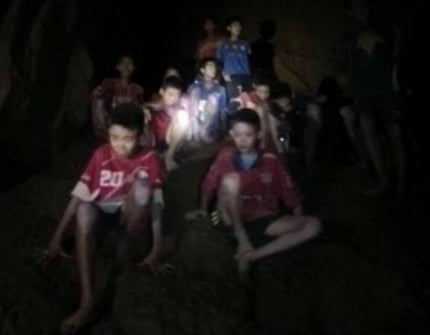
As the sun set on Saturday, June 23, a number of parents whose sons played for the local Moo Pa (Wild Boars) soccer team in Chiang Rai, Thailand, started to worry.
By 7pm, their teenage boys, aged between 11 and 16, hadn’t returned from a practice soccer game, which was to be followed by an excursion at Khun Nam Nang Non Forest Park. When they called the head coach of the team, Nopparat Khanthavong, he immediately made some phone calls, and learned that the 25-year-old assistant coach, Ekapol Chanthawong, and the rest of the team, had been exploring in the Tham Luang caves.
Nopparat quickly made his way there, to discover bikes and bags at the entrance to the cave, and water seeping out.
Speaking to The Washington Post , the 37-year-old said, “I screamed — ‘Ek! Ek! Ek!’ My body went completely cold.”
It’s believed the team and their coach ventured into the cave for an ‘initiation ceremony’ which involved writing their names on the cave walls. After the group entered, however, it started to rain, sending floodwater into the mouth of the cave. The monsoon flooding blocked the group’s exit route, so they kept walking until they found a space that was slightly elevated and dry. This is where they remain stuck.

Ekapol Chanthawong with members of his soccer team. Image via Facebook.
Now, 17 days later, eight of the 12 boys trapped in the cave have been rescued, with four boys and their coach still stuck, four kilometres deep and hours away from safety.
As the world holds its breath, waiting for news about the remaining rescues, an expert has detailed the reality of the cave's escape route - which she calls "the scariest environment imaginable".
Kera Rolsen is a certified cave diver with over 20 years diving experience. In a series of tweets on Monday, Rolsen shared her knowledge of what the dive journey to safety is like for the schoolboy soccer team and their coach.
"For once, I'm 100% qualified to talk about current news," she wrote. "Cave diving is a monster."
Rolsen explained that while open water diving is well lit, with a low current and a low risk of death, cave diving is muddy and dark, with a medium to high current. It's more dangerous than other types of diving, she says, and making an error with your gear or gas calculations can be fatal.
For once, Im 100% qualified to talk about current news #ThaiCaveRescue Hi I’m Puff & I’m a cave/cavern/tech/Nitrox/tri mix/wreck cert’d diver. Summer 01, I worked at a dive equipment manufacturer and was part of the only team in all central FL Buckle up, we’re talking rescue 1/X
— Puff, probably a real person (@Where_is_Puff) July 9, 2018
Cave diving is a monster. Open water: bright, well lit ocean floor, low current, pretty fish, low risk of death. Problem? Gently ascend and go to your boat. Cave diving: dark, muddy tunnels, medium to high current. You are kicking and breathing so hard you get headaches
— Puff, probably a real person (@Where_is_Puff) July 9, 2018
Cave diving is 30-90’ of overhead. You F up you gas calculations you die. You have a catastrophic gear failure? You die. You go in untrained? Guess who gets to pull you bloated corpse out. Worst days were when we’d get calls from the Alachua Co. Sherrif’s office
— Puff, probably a real person (@Where_is_Puff) July 9, 2018
Rolsen also emphasised the degree of training required for cave diving. While most divers don't even attempt cave diving without significant experience in open water, these young boys are entering the "scariest environment imaginable" with a severe lack of skills, poor swimming ability, and weakness from lack of food.
Divers have been training the boys in diving for the past week, but the death of 38-year-old former Navy SEAL Saman Kunan on Thursday, who died bringing oxygen tanks to the boys, underscores the risks associated with this environment.
It takes a lot to train a cave diver. Open water cert, usually 50 dives open. Then cavern, then cave. I cert’d at 18 with 4 open dives b/c my father is a cave instructor and a moron. In retrospect I’m not sure how I never died, I had no business in caves that early. But I digress
— Puff, probably a real person (@Where_is_Puff) July 9, 2018
So, to be a cave diver and rescue cert’d is a lot of work. Think about the Thai SEAL who died, that man has more time and skill in a cave than 99% over divers alive Let that sink in Now you are asking if terrified, starving young men to enter the SCARIEST ENVIRONMENT IMAGINABLE
— Puff, probably a real person (@Where_is_Puff) July 9, 2018
Have you seen someone panic? Genuine, gut shaking, lose you fucking mind panic? I have and it’s uncontrollable. As a lifeguard p, you learn that a drowning person is likely to try to kill you in their panic. It’s th same for rescue diving.
— Puff, probably a real person (@Where_is_Puff) July 9, 2018
The potential for panic is also a very real threat. If the boys become anxious or distressed during their rescue, there's the risk they'll become disoriented, lose their awareness of the thin gold line guiding them, or place further stress on the divers assisting them.
Now put boys weak from starvation, on the verge of panic from the pressure of life and death, THEN flood that cave. That’s what they’re doing right now Teaching these boys to scuba, follow a thin gold line on minimal training and hope they don’t kill their rescuers
— Puff, probably a real person (@Where_is_Puff) July 9, 2018
Every young man that emerges from that cave alive will be a testament to the indomitable human spirit. The ability to overcome the more extreme of circumstances The will to survive
— Puff, probably a real person (@Where_is_Puff) July 9, 2018
If nothing else, I hope two fact puts things in perspective for you. 1) three of my friends have died cave diving 2) I’ve never successfully pulled a live human from the water (scuba, lifeguarding another matter)
— Puff, probably a real person (@Where_is_Puff) July 9, 2018
"Every young man that emerges from that cave alive will be a testament to the indomitable human spirit," Rolsen said, before adding that she hopes these confronting details lay out "the magnitude of what's going on in Thailand right now".
ABC reports that the rescue trip with each boy takes about eight hours (although Monday's good conditions reduced this time), and is an incredibly delicate operation. On their way out, the boys will need to dive and wade through muddy waters, which, in some parts, has almost no visibility.
Inside the rescue of the eight boys. Post continues after video.
According to ABC's South-East Asia correspondent Liam Cochrane, the narrowest gap in the journey is just 38cm in diameter - only slightly bigger than the width of a school ruler. At this point, the boys will have to be pushed through the gap, which is only large enough to fit their head through.
"The man who is leading this rescue operation described them as having the boys underneath them and swimming below and guiding them through the waters with almost no visibility," said Cochrane.
Rolsen also explained that the weight of the gear the boys will have to swim with, as well as the temperature of the water, are further obstacles.
I hope this all lays out the magnitude of what’s going on in Thailand right now. Cheers
— Puff, probably a real person (@Where_is_Puff) July 9, 2018
I forgot a couple important points. 1) you are wearing half your bodyweight in gear. I'm about a buck twenty in the photo and my whole rig weighed about 60lbs. It's gotten lighter but its no joke pic.twitter.com/byVGwmkkyE
— Puff, probably a real person (@Where_is_Puff) July 9, 2018
2) ITS COLD! You are looking at 68F/20C in central FL and Thailand. Not too terrible in open air but it will rob you of body heat in minutes. They are probably in drysuits which are bulky, unwieldy, and can easily blowout neck/wrist seals
— Puff, probably a real person (@Where_is_Puff) July 9, 2018
I don't know what the boys are in but even a 7mm wetsuit gets cold after 45 minutes. 3-5 hours, when already depleted and weak will literally be a fight for life.
— Puff, probably a real person (@Where_is_Puff) July 9, 2018
This is a Mexican cavern, circa 2003. Clear, bright, low flow. Best diving in the world. pic.twitter.com/Xkbhi0oUfd
— Pu
Clare Stephens
Contributor
No Comments
Be the first to leave a comment