If you want to support independent women's media, become a Mamamia subscriber . Get an all-access pass to everything we make, including exclusive podcasts, articles, videos and our exercise app, MOVE.
This article contains spoilers from Dalliance.
Is there a moment when you finally feel like a grown-up? When you cross some invisible line into adulthood, and life makes sense?
As I hurtle toward 43, I still haven't hit it. And watching this show, it clicked: that moment doesn't exist.
Growing up in Australia in the early 2000s, The Secret Life of Us was our blueprint for the twenties: chaotic flat shares, heartbreaks, the messy search for identity.
A decade later, Offspring caught us in the thirties: juggling career demands, complicated family dynamics, pregnancies, and the chaotic reality of trying to finally feel like an adult.
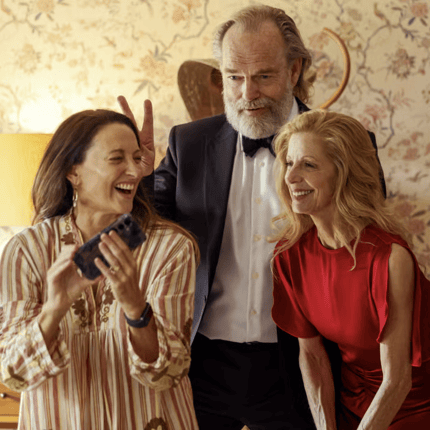
Now executive producer John Edwards (the mastermind behind both) is back with Paramount+'s Dalliance, a six-part midlife series proving a lie we've previously been sold wrong: the script doesn't run out once you hit fifty or sixty.
If anything, the show makes a case that our twenties and thirties, scrounging for rent money or surviving toddler tantrums and school WhatsApp groups, were the easy part.
Watch: Official Dalliance Trailer. Post continues below.

Ahead lie ageing parents, grown children with their own real problems, long marriages buckling under decades of history, widowhood, becoming a carer to a sick partner, and the financial anxiety that hits when your working years are numbered.
Dalliance argues that nobody ever really has it figured out. We're all making it up as we go, which is terrifying and also, somehow, a relief.
Written by Pip Karmel and directed by Matthew Saville, it opens with a Sydney Harbour meet-cute between semi-retired cameraman Billy (Hugo Weaving) and restaurateur Dani (Heather Mitchell).
Billy has been married to Rose (Georgie Parker) for nearly 40 years. When Dani asks him to be her plus-one at a networking event, he says yes, with his wife's blessing. But he never makes it home.
His sudden death sends catastrophic ripples through a tight-knit circle of friends, unleashing hidden truths, paternity questions, and long-buried secrets.
What makes the series so compelling is its ensemble: you're just as invested in Gary (David Wenham), Billy's estranged brother, as you are in the friendship group Sarah (Catherine McClements), Luke (Wayne Blair), Adele (Carolyn Bock) and Manaaki (Kirk Torrance).
The characters are relatable. They aren't dutiful background parents or lingering widows waiting patiently for the next generation to take over.
They're in their sixties and still horny, hopeful, selfish, romantic, curious, jealous, messy, and completely capable of wrecking their own lives.
It reveals a truth not previously spoken: getting older doesn't fundamentally change what it means to be human. We still want to be loved. We still want to be wanted. We still want sex and adventure and friendship, and the thrilling possibility that something extraordinary might happen around the next corner.
Dalliance challenges the myth we've been sold: that 50 or 60 is the beginning of the end, when it could just as easily be another chapter, one where you finally get to ask what you actually want.
Beneath the romance and sharp Australian humour sits something darker: a genuinely brutal exploration of grief.
The show draws a stark, heartbreaking line between losing someone who chooses to leave, and losing someone who didn't choose to leave. We watch both play side by side through Rose and her lifelong friend Adele.
Adele walks a tightrope a lot of us have lived through or watched up close: navigating the fallout when a husband of decades decides to walk away.
We see her move through the familiar trajectory: the shock and despair, the sharp edge of anger, and eventually a proud, fiercely earned peace.
When a partner leaves by choice, the pain is searing, but there's an established framework for healing. You're allowed to be angry.
You can build a narrative around the rejection, and eventually find closure in the idea that it wasn't meant to be. It's a definitive rupture, a line in the sand you're permitted to rebuild from and, ultimately, feel liberated by.
Rose doesn't get this same familiar road map. She's plunged into the catastrophic aftermath of fresh widowhood after losing her husband of nearly 40 years in a heartbeat.
It's raw and unmoored. When someone is taken abruptly, the framework for healing vanishes entirely. It's not linear; it's a chaotic disruption of identity, routine, and physical intimacy.
There's no closure, no final argument, no chance to have the vital conversations or settle what was left unresolved. She's left suspended mid-sentence, skin hungry, carrying a void that anger can't fill, and no explanation can ever resolve.
Sitting that heavy truth alongside all the joy, lust, and chaos of getting older is what makes Dalliance land.
No matter our life stage, we're all still figuring it out, still reaching for someone, or something, still the main character in a story that isn't finished. And connection is the point all along.
Dalliance is now streaming on Paramount +
Feature Image: Paramount +
Win a $1000 voucher!
We want to ask you a few questions about how you look after your mental health! Complete our quick survey for your chance to win a gift voucher in our quarterly draw.
Take survey →
Sign up to Mamamia Daily
Sent daily
Annaliese Todd
Lifestyle Producer
No Comments
Be the first to leave a comment