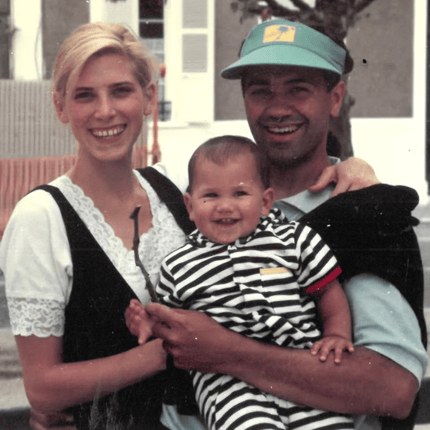
On a Wednesday morning in July 1992, André Hanscombe kissed his partner, Rachel Nickell, and their two-year-old son, Alex, goodbye before heading to work.
It was the era before mobile phones, a time when staying in touch meant relying on a landline and a routine. André always made a point of calling home a few times a day just to check in, to hear the comforting hum of his young family's routine.
Later that morning, he dialled his home number just as he always did. But Rachel didn't pick up. Instead, the heavy silence on the other end was broken by a man's voice. André's blood ran cold. The man on the line was a police officer, and in that single, shattering moment, André's world changed forever.
"A man's voice answered the phone and my blood ran cold. I just knew immediately that something was seriously wrong," André recalled in Netflix's new documentary.
Watch: The Murder of Rachel Nickell Trailer. Article continues after video.
Earlier that day, 23-year-old Rachel Nickell had set out for a leisurely stroll through South West London's Wimbledon Common, bringing along little Alex and their dog, Molly. It was a bright, public space, yet out of nowhere, a stranger lunged from the thick park bushes.
In a frenzied and terrifying assault, Rachel was sexually assaulted and stabbed 49 times, dying on the grass in broad daylight. Her toddler was thrown to the ground, his face dragged through the mud, forced to watch the entire nightmare unfold as the sole eyewitness.
It is a heartbreaking beginning to a tragedy that is currently captivating audiences worldwide, as Netflix has recently released two major projects that centre around this event. The first is a true-crime documentary titled The Murder of Rachel Nickell.
Alongside it is The Witness, a gripping limited series, which depicts the events and the long, painful aftermath through the eyes of the family left behind, with both Alex and André serving as consultants.
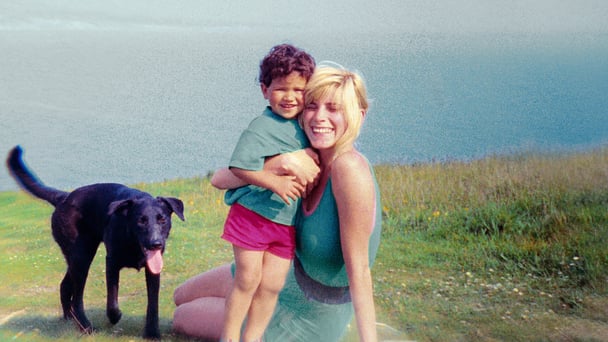
After the attack, Alex allegedly watched as the killer calmly walked to a nearby stream, washed the blood from his hands, and vanished into the trees like a ghost. Too young to grasp the finality of what had occurred, the blood-soaked toddler stayed by his mother's side, repeatedly begging her to wake up.
"I looked down at my mother lying on the ground. She looked so peaceful, as if asleep and ready to wake up at any moment," Alex told The Sun in 2017.
"I shouted, 'Get up Mummy!' with all my strength. In less than a second, life seemed to come to a standstill. She was gone. My heart was completely broken."
When she didn't respond, Alex wandered through the park alone until passing dog walkers discovered the traumatised child and alerted emergencies.
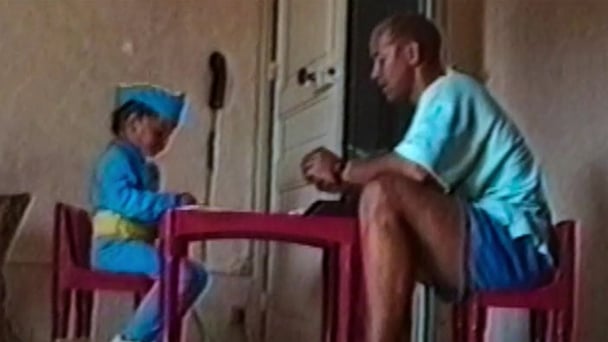
When they were finally reunited, André faced his young son and, at the instruction of a psychologist, explained that his mother had been in an accident and was gone. But it seemed little Alex already knew she was never coming back.
"It was clear that he was telling me 'I already know that. That's something you really don't have to explain to me,'' André recalled.
"He never asked again where his mother was. Not once."
Fearing for their safety with a killer still on the loose, André eventually relocated with his son, desperate to protect him from the intense public glare.
The pressure on the Metropolitan Police to solve the case was immense, but the frantic hunt quickly spiralled into one of the most infamously mishandled investigations in modern British history.
Detectives questioned more than 30 men, but without physical evidence, they zeroed in on Colin Stagg, a local man who frequently walked his dog on the common. Believing Stagg fit a specific psychological profile, the police launched a controversial operation, using an undercover female officer to charm and coerce a confession through a series of dark letters.
Though Stagg never admitted to the crime, police arrested and charged him anyway in August 1993. He spent 13 months in custody before a judge threw the case out of court, slamming the police for "deceptive conduct of the grossest kind."
Stagg was completely cleared and later awarded £706,000 in compensation, meaning the real killer had been left to walk the streets. But for Stagg, the devastation didn't end with his release. For roughly fifteen years, he remained branded as a criminal in the court of public opinion, with many still thinking he was guilty.
Just months after Stagg's arrest, a local mother named Samantha Bisset and her four-year-old daughter, Jazmine, were brutally murdered in their home by Robert Napper, a man with a history of violent sexual assaults.
It took a decade for science to catch up with the tragedy. In 2002, advanced DNA profiling allowed forensic teams to re-examine the evidence from Rachel's body, and by 2004, they had a definitive match.
In 2008, Robert Napper finally pleaded guilty to the manslaughter of Rachel Nickell, bringing a formal end to the 16-year mystery.
Almost 35 years after that fateful morning, the devastating reality of the case is being re-examined on screen.
For Alex, who now works as a yoga teacher, the eventual conviction brought little satisfaction, having already done the hard work of forgiving his mother's killer long before he knew his name.
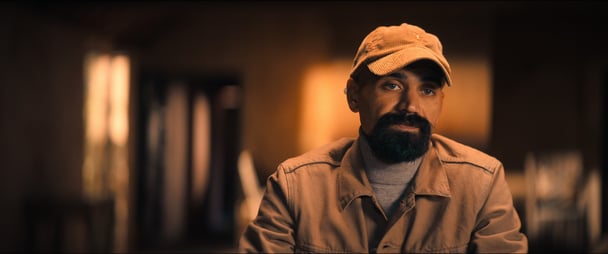
"We were ultimately forced to find our own closure, which I think was actually a good thing, and that was ultimately the realisation that you have to make peace with it," Alex said.
Now, Alex chooses to focus on his mother's legacy and speaking out about police reform, ensuring that Rachel Nickell is remembered not just as a victim in a headline, but as a loving mother whose memory still burns bright.
"The police made a series of mistakes. I believe the same would happen now, sadly. Their mistakes led to over 80 women being assaulted," Alex told The Sun.
"I think of my mother all the time and I believe she is with me, guiding me through. I know she would be proud of me."
The Murder of Rachel Nickell is now streaming on Netflix.
Feature Image: Netflix.
Chelsea Hui
Entertainment Producer
No Comments
Be the first to leave a comment