Become a Mamamia subscriber today and save 30%. By supporting independent women's media, you get an all-access pass to everything we make, including exclusive podcasts, articles, videos and our exercise app, MOVE. Offer ends June 30.
Hot flushes. Mood swings. Insomnia. Brain fog. A dry vagina. Five years ago, half of those words wouldn't have made it into the mainstream conversation.
Today, we say them out loud, and it's about time.
Watch: Why not all yoghurts are good for your gut. Post continues below.

But there is one perimenopause symptom still hiding in plain sight, often overlooked or blamed on something else entirely.
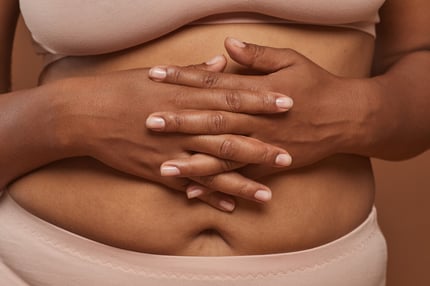
Your gut.
When your gut starts behaving like a stranger.
When you are a medical doctor treating women, you start to notice patterns.
And according to Dr Mariam on Mamamia's WELL podcast, sudden and frustrating changes in digestion are incredibly common for women in their 40s and 50s, yet they are rarely connected to fluctuating hormones.
During a recent episode, Dr Mariam addressed a listener's dilemma whose bowel movements had slowed to every three days, despite drinking three litres of water a day.
She revealed a truth not universally acknowledged: our digestive systems physically alter as the years tick by.
"Digestion does slow down as we age," she shared. "The muscles in our bowel and the lining start to lose tone."
"Peristalsis is the contractions along the bowel that move the poo across — it becomes less efficient and the transit time increases."
In a healthy gut, that transit time takes roughly 24 to 72 hours. But when it slows, food sits in the colon longer, more water gets absorbed back into the body, and stools become harder.
"Hello, constipation," Dr Mariam said.
The hormonal connection nobody made for you.
For women navigating midlife, an entirely separate biological driver is at play.
"We have oestrogen receptors everywhere, and they're also in your gastrointestinal tract," Dr Mariam explained.
"So, when your oestrogen drops, the bowel transit also slows, full stop. So many women notice this change, and nobody connects the dots for them."
Because nobody connects the dots, women are left feeling as though their sluggish digestion is a personal failure.
In a culture obsessed with hyper-optimising health, we assume that if our bodies aren't working perfectly, we aren't trying hard enough, lacking the discipline to drink enough water or buy the right supplements.
But as Dr Mariam points out, forcing a lifestyle fix onto a hormonal issue misses the mark entirely.
"Three litres of water is actually more than the general recommendation of about two litres for most women. More isn't always better here," she noted.
She advised that worsening changes in your 50s need a proper workup, not just diet tweaks. And she reminded us that the national bowel cancer screening age in Australia now starts from 45.
Listen: To the full conversation on WELL. Post continues below.
When the wellness industry smells an opportunity.
But understanding the hormonal root cause is only half the battle, because an entire industry has built itself on exploiting exactly this confusion.
This is exactly where the modern, multi-billion-dollar gut health complex steps in, weaponising normal biological changes to sell quick fixes.
According to food and nutrition scientist Dr Emma Beckett, the wellness industry has turned gut health into an oversimplified corporate buzzword.
"We've hyper-focused on this idea of good bacteria and bad bacteria, and people now have the impression that they can manipulate their bacteria in this very magical way," Dr Beckett explained on the WELL podcast.
"And the idea that any bacteria is just good or just bad is definitely oversimplified, and it's got us chasing some inappropriate spaces."
Instead, consumers get tunnel vision, assuming gut issues can be solved entirely by what we put on our plates.
"Gut health is not just nutrition. It's sleep, it's stress, it's exercise, and it's how we live and exist in the world. All of that's connected," Dr Beckett said.
This makes us highly vulnerable to what Dr Beckett calls the "health halo."
Take the grocery dairy aisle, for example, where millions reach for Greek yoghurt, assuming it will naturally fix bloating or slow digestion.
"Most of us assume that every yoghurt we get in the supermarket is a probiotic because all yoghurts wear what we call the 'health halo' of the probiotic yoghurts," Dr Beckett warned.
"Not every yoghurt is probiotic."
While all yoghurts use bacteria for fermentation, not all contain live, beneficial cultures that survive the journey to the lower gut.
"If it doesn't say that, it's not a probiotic yoghurt, and you might be tricking yourself."
The same illusion applies to expensive probiotic sachets flooding social media. When asked what they actually do, Dr Beckett's answer was refreshingly blunt.
"They might be doing nothing. They could be absolutely useless because if you don't need that microbe, there's no point adding it if you're not missing it," she explained.
Worst of all, they act as a psychological distraction. "Once we have that sachet, we tick that box," Dr Beckett said.
The danger is that this often makes it incredibly easy to dismiss underlying symptoms that actually need medical attention. We take the powder, consider our health handled for the day, and give ourselves a free pass to ignore the basics.
The $500 shortcut that isn't one.
When standard supplements fail to override a natural hormonal drop, the wellness industry escalates to the extreme of luxury trends: stand-alone wellness IV drip clinics, championed by celebrities like Kendall Jenner and Hailey Bieber to bypass the gut entirely.
Boutique IV lines carry real medical risks, including infection and allergic reactions. And if you are using them to bypass your digestive system, Dr Mariam has a reality check.
"Your gut still works perfectly fine, so there's no malabsorption happening. Have some water, have some electrolytes, have some food, and a bit of time will get you to the same place," she said.
"You're essentially paying north of $500 to make very expensive urine."
Ugh.
What your body actually needs.
The takeaway is clear. If you are navigating perimenopause and notice your digestive system has ground to a halt, it is not a personal failing or a lack of hydration.
It is an established biological response to dropping oestrogen levels.
Instead of chasing expensive, trend-driven illusions, the experts say it's time to give our bodies some grace.
True gut health doesn't come in a quick-fix health halo or an expensive supplement.
It comes from advocating for yourself with a trusted medical professional and returning to the foundations we keep ignoring: sleep, movement, and managing stress.
Disclaimer: The information in this article is for general educational purposes only and does not constitute medical advice. Every woman's health journey is individual; always consult a qualified health professional about what is right for your specific body and history.
Well, Mamamia's health brand for women is shaped by the health experiences of women just like you. Sign up to the Well newsletter to receive your weekly dose of trusted health expertise without the medical jargon, ask a question or share your story.
Feature Image: Getty.

Win a $1000 voucher!
We want to hear from you about female health. Complete our 3 minute survey for a chance to win a gift voucher in our quarterly draw!
Take survey →Annaliese Todd
Lifestyle Producer
No Comments
Be the first to leave a comment