
There is a kind of grief that rarely earns a name.
It is not the grief of death, nor even the grief that follows a diagnosis. It is the grief of the life we imagined we might live, and the slow recognition that it will not arrive.
For people shaped by chronic illness, trauma, infertility or long-term depression, the distance between hope and capacity becomes a defining feature of existence. That distance deserves to be mourned.
My own life has been shaped less by aspiration than by survival. Recurring depression and cyclothymic disorder threaded through my adolescence and adulthood, sometimes treated and sometimes not. Religious trauma compounded it, teaching me to frame suffering as virtue and to distrust my own anger, need, and limits.
Watch: The hosts of Mamamia's health podcast, Well, talk about body longevity. Post continues below.
A later diagnosis of Spinocerebellar Ataxia, a degenerative neurological condition affecting balance, coordination and cognitive stamina, gave language to what had always been present: a body and mind operating under constant strain. It explained years of instability, fatigue and inconsistency that had been misread by others and by myself as personal failure. These forces did not merely interrupt my life; they structured it.
There were moments when I moved briefly into public visibility. I appeared on The Bachelor and later Bachelor in Paradise, experiences that amplified exposure at times when my capacity for regulation and recovery was already fragile. At times, I needed extreme privacy, disappearing almost entirely. At others, I emerged in a heightened state — overexposed and visible in ways that were both embarrassing and unsustainable.
Each cycle ended the same way: withdrawal, fallout, failure. Regret became dense and immobilising. What appeared from the outside as inconsistency was, in fact, a nervous system oscillating between protection and overextension, between hiding and burning out.

I sometimes consider what might have been possible had survival not consumed so much, had my mind not been occupied with its own repair.
Mental ill-health is never only internal. It carries economic and structural consequences that compound over time.
Depression narrows energy and consistency; trauma erodes trust in systems meant to support stability; neurological illness limits endurance in ways that are often invisible.
Periods of relative wellness are frequently followed by collapse, making sustained employment difficult and financial security fragile. Poverty, debt and precarity are not personal failures in this context; they are predictable outcomes of a body pushed beyond endurance. The gap between what one could contribute and what one can sustain becomes another loss to grieve.
There are other losses that never announce themselves.
Although I am fertile, I have never been in a relationship stable enough for children, and now, with a degenerative brain disease diagnosis, I do not believe it is tenable for me to do it on my own. I was able, instead, to give someone else the gift of parenthood through egg donation. That, too, carries its own quiet grief — one that does not fit neatly into cultural narratives of loss or choice.
The grief of what-if is often waved away. Be realistic, we're told. Accept what is. But denial carries its own risk. If regret is untreated, if it hardens into identity, it becomes corrosive. It ceases to be grief and becomes a creed. That is where the damage quietly deepens.
Grieving an unlived life is not a refusal of reality. It is an act of honesty. Something was lost.
Pretending nothing was lost binds us to shame; naming it allows movement. It challenges the belief that worth is measured by productivity, consistency, or visibility. Survival, when understood honestly, is not failure; it is a form of adaptation.
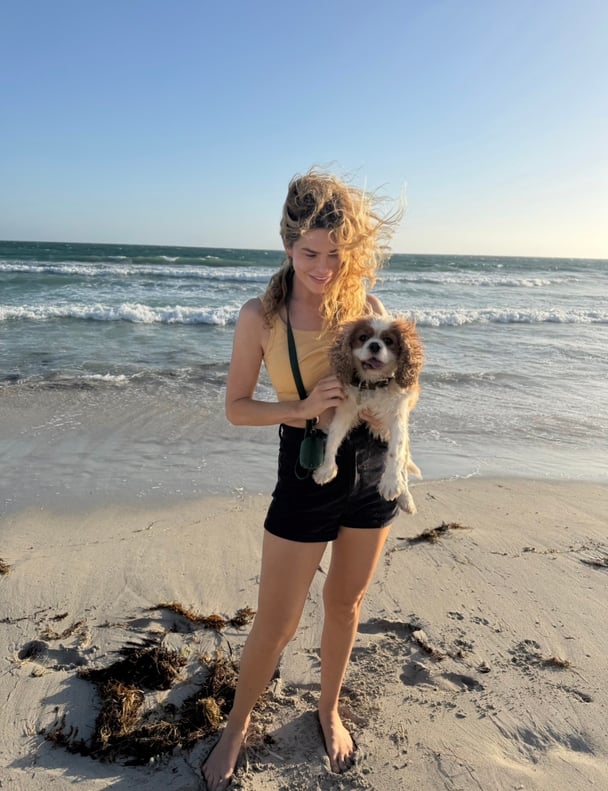
I carry an awareness of this grief, but I am careful not to let it contain me. I want a life that is workable and free in the ways that matter. That has required deliberate narrowing. In recognition of my neurological disease, and in protection against relapse, I have stripped my life back to what can be sustained.
I work in a role that is steady and useful, one that helps others and allows me to meet my own financial needs. I date rarely, aware that my nervous system is still recovering from earlier ruptures. I spend time outdoors — walking the beach with my dog, windsurfing, diving, camping — where the body can settle without explanation. I keep a small, carefully chosen circle of friends who see me, and I them.
I read, travel when I can, play guitar and sometimes paint. These are not distractions; they are structure.

When I allowed myself to grieve the life I could not have, I became more present to the life that remains. I am less tethered to impossibility and more attentive to what is still available. Memory loosens. Self-blame eases. Compassion widens — first toward myself, then toward others whose lives have also been shaped by forces that go largely unseen.
For those living with chronic illness, trauma, or persistent depression, the invitation is both simple and demanding: do not let your grief be dismissed. Do not bypass it for the comfort of others. Mourn what was lost, but remember what is still left of your life. In doing so, you clear space not for fantasy, but for a life that is honest, inhabitable, and still your own.
Megan is a Western Australian writer interested in illness, belief and the negotiations required to live inside an uncertain body. Her essays explore intimacy and meaning in the spaces where certainty falls away. She lives near the coast, where she works, writes, windsurfs and regularly tests the limits of optimism.
Feature Image: Supplied.
Calling all grocery shoppers!
We want to hear from you! Complete our 5 minute survey for a chance to win a $1,000 gift voucher in our quarterly draw!
Take survey →
Sign up to Mamamia Daily
Sent daily
Megan Marx
Author
No Comments
Be the first to leave a comment