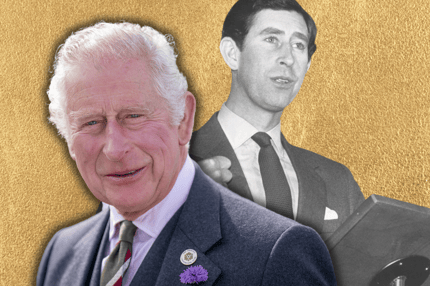
Prince Charles Philip Arthur George of Edinburgh.
Prince Charles of Wales.
And Duke of Cornwall, Duke of Rothesay, Earl of Carrick, etc. etc.
While he has been bestowed with various official titles over the years, none is greater than his latest:
King Charles III – King of the United Kingdom, and 15 Commonwealth realms.
But beneath the pomp and honorifics is just a man, complete with complexity and nuance.
And a story.
A sensitive boy.
Born on November 14, 1948, King Charles was the first child of then-Princess Elizabeth and Philip, Duke of Edinburgh. It wasn’t until he was four-years-old that his mother ascended the throne following the death of his grandfather, Bertie - AKA - King George VI.
It has been well documented that much of Prince Charles’ childhood was tainted by loneliness. With his father, an officer in the Royal Navy, stationed in Malta from 1949 to 1951, the Queen was also largely absent from the young prince, opting to spend more time with her husband instead.
The emotional distance between Charles and his parents was heart-achingly apparent upon the return of the Queen and the Duke to England following their six month Commonwealth tour.
Charles was five years-old, and his younger sister Anne, just three.
They were greeted by their parents with handshakes.
But affection was found from his maternal grandmother, the Queen Mother with whom he spent quality time. She gave him the hugs he desperately craved, writes Charles' US biographer, Sally Bedell Smith in Vanity Fair.
Charles was a kind and gentle boy, with an affinity for the arts - also encouraged by his grandmother.
“He is young to think so much,” observed former British Prime Minister, Sir Winston Churchill around the time of his fourth birthday.
But his timidness was perceived as weakness by his father.
The author of Charles’ 1994 authorised biography Jonathan Dimbleby, noted that as a little boy, Charles was “easily cowed by the forceful personality of his father,” whose rebukes for “a deficiency in behaviour or attitude ... easily drew tears”.
Charles described his mother as “not indifferent so much as detached”.
Despite opposition from the Queen Mother, Prince Philip insisted that Charles was educated at his former school, Gordonstoun. The Scottish institution was known for its toughness.
Mornings were punctuated with long runs at the break of dawn and icy showers. The windows of the dormitories were deliberately left open at all times.
“Charles had neither his father’s resilient temperament nor his relative anonymity, and he lacked the physical prowess to command respect. Encumbered by his titles and his status as heir to the throne, he was singled out as a victim from his first day,” said Bedell Smith.
There are accounts of relentless bullying and abuse that were directed towards the heir - especially in the dormitories at night. He was cruelly teased about his ears too.
In 1966, at the age of 17, Prince Philip decided to send Charles to Timbertop, the 'wilderness' campus of Geelong Grammar School. It was here in Australia that he found his feet.
Aside from the odd ‘Pommy bastard’ jibe, Charles was accepted and thrived away from the watchful eyes of royal expectation. Still with an emphasis on physical endurance, Timbertop challenged Charles with cross-country hikes, wood splitting and tending to pigs.
“But it was jolly good for the character and, in many ways, I loved it and learnt a lot from it,” he later said of his six-month experience.
Writes Bedell Smith, “On his own terms, in the right circumstances, he showed his toughness and proved to his father that he was not, in fact, a weakling.”
Enter, Diana.
Following in the tradition of his father, grandfather and two great-grandfathers, Charles went on to serve in the Royal Navy, following completion of his Arts degree at the University of Cambridge. He also received training in the Royal Air Force.
He dated various women, including Camilla Parker Bowles (then Camilla Shand), breaking it off only when he was sent abroad with the Navy. She moved on and married.
And later in 1977, at the age of 29, he met Diana Spencer - then 16.
They met at her home in Althorpe; Charles was a friend of Diana's sister, Sarah, and a member of the day's shooting party.
But they didn't begin dating until 1980. The story goes that they sat next to each other atop a bail of hay at a friend's barbeque. Diana commented on Charles' apparent loneliness (he had recently buried Lord Mountbatten - 'Uncle Dickie' - and had broken up with his former girlfriend).
In the documentary,Diana: In Her Own Words,she recounted her words to Charles: "‘It’s pathetic watching you walking up the aisle with Mountbatten’s coffin in front, ghastly, you need someone beside you.’ Whereupon he leapt upon me and started kissing me."
By February, Charles had proposed - at the urging of his father who was concerned by the intense media attention their courtship attracted.
"Without any apparent surge in feeling, he began to think seriously of her as a potential bride," recorded Charles' biographer, Dimbleby.
Indeed, it is reported that in the few days before the wedding, both Charles and Diana tried to call off the wedding - but it was too late.
They wed on July 29, 1981.
The following year, they welcomed their first child, William. Their second son, Harry, arrived in 1984. In a break with tradition, Charles was the first royal father present at the birth of his children.
But much of their marriage was plagued with misery. Their distance became obvious by their body language in public, and before long, rumours swirled that both were involved in extramarital affairs.
Charles later admitted to having rekindled with his former girlfriend, Camilla Parker Bowles in 1986.
Yet it took another six years before Charles and Diana announced their separation at the end of 1992. The following year, an intimate phone call between Charles and Camilla - dubbed 'Camillagate' - surfaced from 1989, and was leaked to the British tabloid press causing huge scandal.
The divorce was finalised in 1996 - just one year before Diana's life was tragically cut short in a car accident as she attempted to flee from paparazzi in Paris.
In 1998, Charles and Camilla went public with their relationship and in 2005, they married - 35 years after they first met.
In an interview with CNN in 2015, Charles said of Camilla, “It’s always marvellous to have somebody who, you know, you feel understands and wants to encourage. Although she certainly pokes fun if I get too serious about things. And all that helps.”
On the eve of her Platinum Jubilee earlier this year, Queen Elizabeth expressed her wish that once Charles becomes King, Camilla should have the title of Queen Consort.
"When, in the fullness of time, my son Charles becomes King, I know you will give him and his wife Camilla the same support that you have given me; and it is my sincere wish that, when that time comes, Camilla will be known as Queen Consort as she continues her own loyal service," she said.
The environment 'is a responsibility of all of us'.
For over 50 years, the environment has been a cause close to the heart of King Charles. He passionately advocates for climate action (and has done since the late 1960s), animal conservation and a sustainable future.
"There is an amazing amount that can be done. It is a combined responsibility of all of us, the public sector, private sector and civil society,” he said.
According to the official Prince of Wales website, around half of his office and domestic energy use comes from renewable sources such as woodchip boilers, air-source heat pumps, solar panels and “green” electricity. He also ensures the use of electric cars on his estates and has a strong interest in organic farming - even developing his own organic brand, Dutchy Originals.
King Charles also founded a number of environmental projects including the Sustainable Markets Initiative and Council, in collaboration with the World Economic Forum; Campaign for Wool (to re-popularise the fibre as a sustainable fabric), and the Prince's Accounting for Sustainability Project which aims to inspire action by finance leaders to drive a shift towards resilient business models and a sustainable economy.
Speaking withGQ Magazinein 2018, Charles said, "I have always believed that living on a finite planet means we have to recognise that this puts certain constraints and limits on our human ambition in order to maintain the viability of the planet”.
A patron of the World Wildlife Fund, the King is also a generous patron of the arts, has a keen interest in preserving traditional architecture, and is an enthusiastic gardener.<

Sign up to Mamamia Weekend Reads
Sent weekly
Rebecca Davis
Author
No Comments
Be the first to leave a comment