If you want to support independent women's media, become a Mamamia subscriber . Get an all-access pass to everything we make, including exclusive podcasts, articles, videos and our exercise app, MOVE.
I created a shrine for my dad knowing he never would have wanted one.
But grief isn't just about honouring the person who died. Sometimes it's about grieving the relationship you never got the chance to have.
We knew, without a doubt, that my father did not want any ceremony around his death. He was not into sentiment or ritual. So to honour him, I created both.
Watch: The grief that comes with life transitions. Post continues below.

His death was completely unexpected.
Not that anything can prepare you for such a phone call. I can still feel the gut punch when my mum spoke the words, "Chris died".
The fact that he requested to be called Chris and not Dad, tells you a lot about him already.
He was not into tradition.
My dad was highly intelligent. He spoke several languages and studied physics for fun.
He was practical and sometimes rigid—he refused to own more than seven pairs of underwear at any one time.
He was spiritual but only interested in questioning what happens after we die, not what happens to the people who are left behind.
Funerals are for the living, they say. What did my dad say?
"Just throw me down the trash chute when I die."
We didn't quite do that when he died but we had no plans to do anything at all. We quietly and privately grieved.
One day my mum arrived at my apartment with Dad in his box.
She thought he might appreciate a change of scenery.
I held his box with outstretched arms like I was holding a newborn for the first time.
I questioned my mum about leaving him with me — dad would never hang out with me for this long.
Processing grief without any acknowledgement of someone's death is a challenge but trying to do this for someone who you weren't as close to as you'd hoped is a particularly strange kind of pain.
You aren't just grieving the person. You're grieving the possibility of what the relationship could have been.
People expect grief to look like devastation over losing someone who was your everything.
But what happens when the person you lose was someone you loved, respected and wanted more from — but never quite knew how to reach?
Why didn't I try harder to form a connection with him? Why didn't he?
His death threw the reality of our lack of closeness in my face.
Along with the bitterness of lost opportunity. It officially is what it is. Or was what it was.
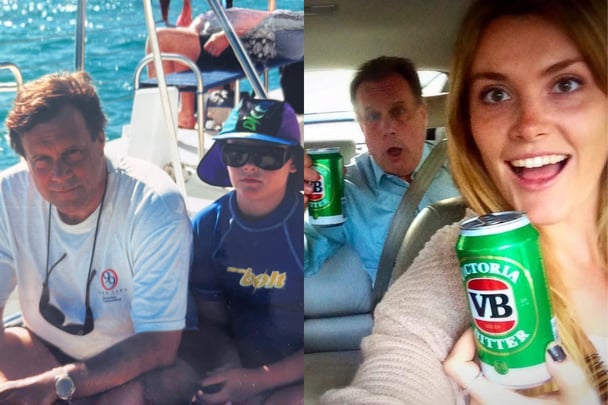
I loved and respected my dad but we were on different wavelengths. I owned more than seven pairs of underwear.
I felt like a fraud keeping the ashes over the rest of my family. My mum, his wife of 50 years, my sister, his "clone", or my brother, his best friend.
I plonked him down in the corner of my study where there was already two dead plants.
Fitting, I thought. My own little cemetery.
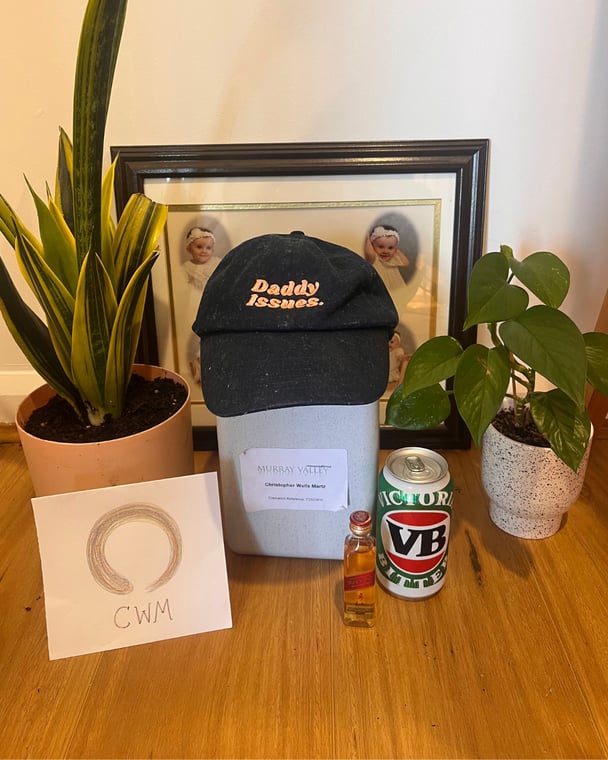
I remembered a cap I found that had Daddy Issues embroidered on the front so I put that on him too because him being dead was a pretty big issue.
I thought I was hilarious but my therapist thought I was indignant and hurt.
She tasked me with creating a shrine around my dad's ashes as a way to help me process my grief and our lacking relationship.
Honestly, I was resistant at first — he didn't want anything.
He'd judge me from the beyond if I started getting sentimental about him.
He probably doesn't even want to be with me. My therapist insisted.
I sat staring at his box and dead plants for a while. Then I cried. A lot.
I felt selfish for needing this.
I needed more from him when he was alive and I needed more from him in death.
Was it OK if I benefit from ceremony, sentimentality and ritual for a person who didn't want any of it?
I got rid of the dead plants and replaced them with some living ones.
I reflected on the things we had in common. I thought he would actually find the Daddy Issues hat funny — we shared a sense of humour (dark).
We also love food and booze.
I didn't want to deal with rotting food so I lay down offerings of his favourite but questionable beverages: VB and Johnny Walker Red Label.
I tried to make peace with the fact that I needed the shrine, even if he would have thought it was silly.
Listen: Dr Anastasia Hronis and co-host Ashani Dante explore grief in all its forms, and what healthy versus unhealthy grieving can look like. Post continues below.
Sometime later, my mum bought a new bed.
She was downsizing from the king they shared to a queen.
When she removed the old bed frame she found an assortment of food and beverages under my dad's former side: peanuts, popcorn and beer cans.
"He made his own shrine before he left us," my mum said, tears in her eyes.
And that's when I finally felt settled within myself.
I like to think that he was showing me that I had honoured him in the right way.
Or maybe he wouldn't have understood.
I'll never know.
But I know I needed it.
Grief doesn't only belong to the people who had perfect relationships with the person who died.
You're still grieving if you were distant, estranged, or never got the chance to know them at all.
It may take time to figure out how to grieve, but you're allowed to do so in whatever way you need.
Feature Image: Supplied.
Julia Martz
Author
No Comments
Be the first to leave a comment