Content warning: This story includes descriptions of sexual abuse.
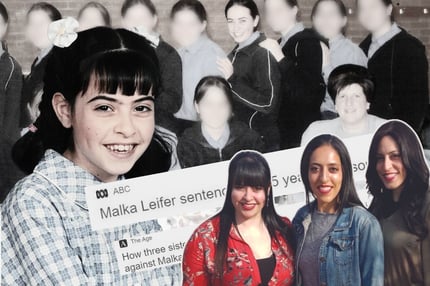
In August 2023, Dassi Erlich breathed a huge sigh of relief as she watched her former high school principal be sentenced to 15 years in prison.
She fought for 15 years to hear those words, after suffering ongoing sexual abuse at the hands of Malka Leifer as a teenager.
Leifer had been in charge of the Adass Israel School she attended in a close-knit and very isolated ultra-Orthodox Jewish community in Melbourne's south east.
The former teacher was convicted of 18 charges of sexual abuse including rape and indecent assault against Dassi and her sister Elly. She was acquitted of nine charges, including five relating to their older sister Nicole.
Their story received worldwide attention. They were the sisters fighting to get Leifer extradited back from Israel after she fled there soon after the allegations came to light. It took 70 extradition hearings and 13 years to bring her back to Australia.
"When I gave my testimony and during those awful five days of cross-examination, I couldn't see her. I didn't want to see her. There was no desire in me to face her," Dassi tells Mamamia's No Filter this week.
"I did when I gave my victim impact statement, I looked up and saw her. She had this utter look of disregard. There was no remorse whatsoever."
Listen to Dassi Erlich tell her story on Mamamia's No Filter podcast. Post continues after audio.
But there is more to Dassi, Elly and Nicole's story than Malka Leifer.
We got a taste of it during the trial, as the court heard details of school being a safe haven for the sisters and a place to escape a loveless home and a cruel and abusive mother.
But their mum wasn't the one on trial. The details of their childhood were only relevant as context to help put Leifer behind bars.
Now that chapter is closed, Dassi had the time and space to share her story in full, in her memoir In Bad Faith .
"We were robots, forbidden to move."
Dassi's family were part of Melbourne's most exclusive ultra-Orthodox Jewish community living in and around St Kilda East and Ripponlea in Melbourne.
One of about 250 families within the Adass Israel community, they rarely had to engage with the outside world. Their community was entirely self-sufficient with their own schools, shops, cemetery and medical services.
As Dassi explained to onNo Filter: "We would spend hours in school learning 'how do we get out of bed? What foot do we put down first? How do we wash our hands as soon as we get out of bed? How many times should we wash our hands, and what hand should we wash first?'"
One of seven children, Dassi's childhood wasn't like the ones she saw playing out on the driveways and the front yards of other Melbourne homes. In their world, married women covered their hair up, strict dietary laws were observed and there
She had a few fleeting experiences with secular society. Like the time she flew on a plane to New York with her mother (she wasn't allowed to watch, or even touch the inflight entertainment). Or the time her parents reported a robbery to police, and officers attended their home.
But it wasn't just her religious upbringing that dictated how differently she grew up, it was also her mother's abusive and troubled moods.
In their home, it wasn't out of the ordinary for Dassi's mother to stab the face out of her only doll because it was an 'affront to God'. It became normal to have to succumb to urinating in her bedroom cupboard because she wasn't allowed to go downstairs to the bathroom after being sent to bed for the night. It was routine for her mother to hit her over a poorly vacuumed room or crinkled bed sheets.
Food withdrawal was a common punishment, and Dassi was regularly refused dinner. Often, she'd resort to stealing snacks from kid's backpacks at school to help keep the hunger at bay.
"On the nights we were given dinner, we then spent the time until bed sitting on the pink couch in the dining room staring at the walls. We were robots, forbidden to move," she wrote inIn Bad Faith.
Dassi's memories of her early childhood are laced in fear and anxiety. She lived in a constant state of heightened vigilance and emotional distress and thought about death and the "relief I would feel to not wake in the morning" from a young age.
When asked byMamamia's True Crime Conversations if she had any happy memories from her childhood she replied, "That's a very difficult one to answer. Unfortunately, also, that's not how trauma works, you end up remembering the most traumatic memories.
"There were times that we went away on day trips or holidays, but that pervasive fear was always underlying everything we did."
When Dassi turned 12 her relationship with her father started to change, leaving her with no parental figure with whom she felt safe.
"In recent months he had begun to hold me tight against his body; so tight I couldn't move. 'You're beginning to feel like your mother,' he'd whispered to me as he traced his fingers over the front of my body," Dassi wrote inIn Bad Faith.
Her father's advances and touches increased as she got older. But sexual education, unlawful touch and consent weren't areas Dassi even had a vocabulary for until she was an adult. In her community, a girl's body was a secret and as a teenager she didn't even know the words for breast and vagina.
As Dassi wrote, "the language to describe sexual abuse didn't exist in our world, and it wasn't something we could discuss".
The only thing she was taught about was her period, but she was told menstruation was "punishment for being a woman" and something she should be embarrassed and secretive about.
Pain medication became something her mother refused her during painful cramps unless "she decided I deserved it".
Dassi's safe haven.
For eight hours a day, five days a week, the heaviness Dassi felt under the constant glare of her mother lifted.
At school, she could be herself. It was the only place she felt safe. But she was terrified her school friends would find out that her home life was different to theirs.
Addass Israel School was strictly religious. Her parents had to sign a waver before she and her siblings attended that stated they didn't have a TV in the house. Her father had to disclose that he used the internet for work, but it was out of the house and inaccessible to the children.
In 2002 while Dassi was in Year 9, the school's principal was replaced with a fairly new teacher who'd recently arrived from Israel, who was considered more in line with the school's Hasidic values.
Malka Leifer was quick to make her mark as a strong and passionate leader, and Dassi started to crave her compliments and attention. Leifer was known to have 'special students,' who were allowed to miss class to assist her in running errands and Dassi was thrilled when she became one of them.
"It was always the men that led everything. Suddenly there was this woman that people were so in awe of. It was something unlike anything I'd ever seen. I remember her being incredibly warm and vivacious," Dassi toldNo Filter.
"She was being kind to me, pullingmeintoherinner circle. I remember thinking, 'If only I had an adult that would talk to me, that I could share with what was happening at home."
In Year 10, her mother organised for her to have private weekend lessons with Leifer, unhappy with her daughter's performance at school and prospective 'marriageability.'
Dassi had been excited for the chance to learn from Leifer. She knew about her reputation of being more "touchy feely," but she brushed it off as being "an Israeli quirk of hers".
But from the very first Sunday she spent alone with her school principal, things changed. While asking Dassi about her home and school life, Leifer would touch her body. It would start innocently on her shoulders and back in a reassuring cuddle as Dassi shared details from her abusive home. But it would gradually move to her knees and then her thighs and then her breasts.
As their lessons continued, it got more and more sexual.
From one monster to another.
At first Leifer gave Dassi something she craved; a loving, nurturing motherly figure to look up to. But it didn't take long for that to evaporate.
From the age of 16, Dassi was regularly sexually assaulted by Leifer.
"The months passed and the scene was repeated. Each time, she pushed the boundaries further. She touched me everywhere; there was no place on my body her hands did not reach," she wrote inIn Bad Faith.
"Each time, I walked away as if it had never occurred, and spent days convincing myself it hadn't. So effective was my dissociation that each time I was shocked when it happened again."
Chatting toTrue Crime Conversationshe added, "She used to tell me that this is love and this is what love means. Not having any understanding of love, I believed her for a long time."
At 17, the abuse intensified. In her memoir, Dassi describes one instance of being digitally raped by Leifer during a school camp. Most of the time she was able to slip into a 'trance-like state' during the assaults, but during this particular incident she "struggled to disappear".
"This time I was captive to her crime," she wrote.
After completing highschool aged 18, Dassi got a job at the school, and the abuse continued.
Aged 19, Dassi married a man from her community in a union arranged by her parents. She had known Shua for eight hours before he proposed, but even though she didn't love him yet, Dassi was hopeful marriage would be her chance at happiness. She'd finally be away from her mother's wrath, her father's confusing hugs and her principal's abuse.
"Even when I eventually learnt about sex, a few weeks before my marriage by a bridal teacher, in my mind I didn't know that this was sexual abuse," Dassi toldNo Filter.
"I always had an idea that what was happening was wrong, but I had so much worthlessness, I had such low self-esteem I believed it must be that I was wrong. How could someone like Mrs Leifer be wrong?"
Married life and a confession.
Once engaged, Dassi was taught about sex.
While abusing her, Leifer had told her she was "preparing her for marriage". It wasn't until she started getting Kallah (bridal lessons), that she understood what that meant.
On her wedding night, Dassi and her new husband Shua retired to Leifer's empty home while she was in Israel. She'd offered it to Dassi's parents as a place for the newlyweds to stay before they travelled to Jerusalem to set up their new home and life. Dassi spent her wedding night in the home and bed she was abused in.
Once in Israel, Dassi was afforded a freedom she'd never experienced before. With access to the internet for the first time, she started to question her ultra-Orthodox lifestyle. Then, in 2008, she confessed to a counsellor she had started seeing for intimacy and marriage concerns, about the abuse she'd been subjected to at the hands of Leifer.
As word of Dassi's allegations made their way back to Melbourne, plans were secretly being made. Within days, Malka Leifer fled to Israel.
Soon after Leifer's escape, as news of her crimes started to reach Australian media headlines, the spiritual leader of Adass community gave a directive: discussing the matter would be considered loshen hora (malicious gossip), and was effectively banned.
"His words had an immediate effect, and hearing about them cemented the feeling that I was wrong," said Dassi.
It was only after Dassi's allegations became public that she discovered her sisters had their own stories.
Upon hearing of her younger sister Elly's experience, Dassi wrote, "I cried for her pain and out of guilt that I hadn't spoken sooner. I did not have the language to warn her, nor to describe what had occurred, even after my disclosure."
Becoming a Jewish mother.
In 2009 Dassi and Shua moved back to Melbourne and in 2010 they fina
Gemma Bath
True Crime Conversations host
No Comments
Be the first to leave a comment